



Kossuth’s March 3 address
Addressing the diet (session of parliament) in Pozsony*,
delegate Kossuth demanded the following major reforms from the
Lower House:
1. Abolish censorship, i.e. freedom of
thepress. 2. A Hungarian Ministry. 3. Annual Diet, elected by
universal suffrage. 4. Equality of all before the law.
5.Formation of a national guard. 6. No tax exemption for nobility
or clergy. 7. Suppression of feudal rights. 8. Elected juries for
criminal cases. 9. A national bank. 10. Create a national
army.11. Liberate political prisoners. 12. Unite Transylvania
with Hungary 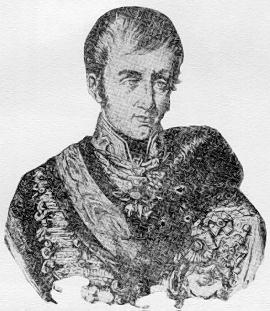
KOSSUTH
Afraid the Upper House would dilute and delay
action, Kossuth suggested the list be taken directly to the
monarch. On March 14, the Upper House supported the motion and a
delegation, headed by Kossuth took it as “Address to
theThrone” for accession by Ferdinand V.
* During the
Turkish occupation in the 16th and 17th century, the Hungarian
parliament moved out of the occupied heartland, and held its
sessions in Pozsony (now Bratislava, Slovakia; Pressburg in
German, Posonium** in Latin). The Habsburg kings, were crowned
here in
St. Martin’s cathedral.
FERDINAND V
**For a medieval view of “Posonium” Click here
Aptil 11 saw the acceptance of
the April laws. Approved by the Diet, (the session having
been personally closed by the king in the archbishop’s palace) 31
new laws largely reflected the Kossuth demands of March 3. They
were – in a sense – a new constitution, reputedly modelled after
that of Belgium.
Archbishop’s Palace
Discussed and voted on in haste,
the April laws contained some inconsistent elements, but
clearly reflected the Diet’s desire to emphasize Hungary’s
independent thrust.
Some major issues :
- The King to exercise power
through a responsible minister (without his endorsement
no order to be valid). - The bicameral Diet to be
convoked annually at Pest, the members being elected for
three year terms. - The King may dissolve the
Diet, but obliged to convoke a new one within three
months. - No dismissal until next
years’ budget approved. - The two elements were the
Chamber of deputies and Chamber of Magnates. - Franchised to vote were
citizens who paid taxes, also those with secondary or
higher education. - Official language to be
Hungarian, save Latin in some instances. - While endorsing freedom of
the press, inciting against the person of the King or
other parts of the Habsburg empire considered a crime. - While creating a cabinet
post of “Minister of War”, its authority not
delineated :- – jurisdiction over
Hungarian units stationed anywhere (e.g. in
Italy) ? - – or over imperial
forces (regardless of nationality) stationed in
Hungary ? - – deployment of
Hungarian troops “beyond the borders”
to require the “countersignature of the
responsible minister”.
- – jurisdiction over
- Borders not defined :
- – of Hungary ?
- – of the empire ?
- Some obligations of
“the peasants” relieved, others maintained.
|
Chamber |
Other elements :
Philosophically many had
questioned whether the April laws were to provide broad
equality or a rear-guard action by the nobility (i.e. Diet
members) to preclude more radical steps.
The April laws had other
deficiencies :
Relations with the several
minorities (Slovaks, Rumanians, Serbs, etc.) not defined, while
Hungarian declared the official language.Croatia-Slavonia had been an autonomous region of the
Hungarian Crown – its status undefined.
As was seen later, the anti-Hungarian faction in Vienna took full
advantage of such inconsistencies to undermine the Hungarian
government.
Sensing the unclear interface with Austria, Prince Esterházy
approached Austrian minister Pillersdorf to establish a
commission to deliberate common issues. The Hungarian
representative, Ferenc Pulszky, was cut short in his efforts,
when the Austrians adjourned the commissions’ activities.
Back to Milestones of 1848-49
 Mondák
 Vicc
Vicc Költő / Író
 Népdal