



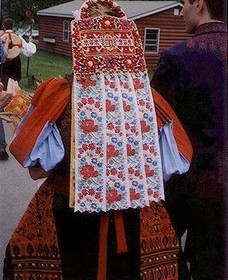



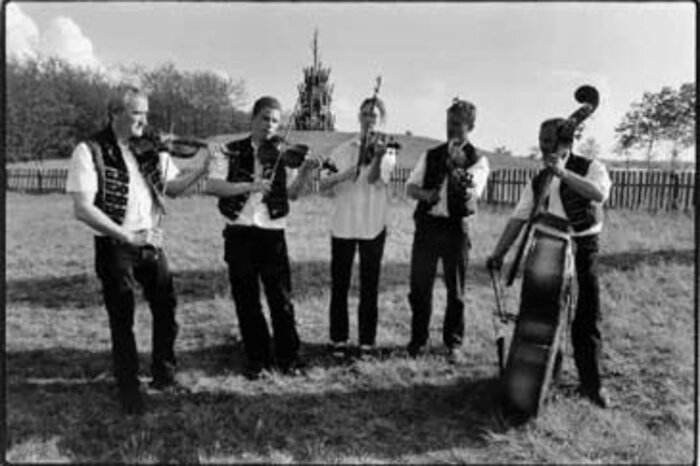
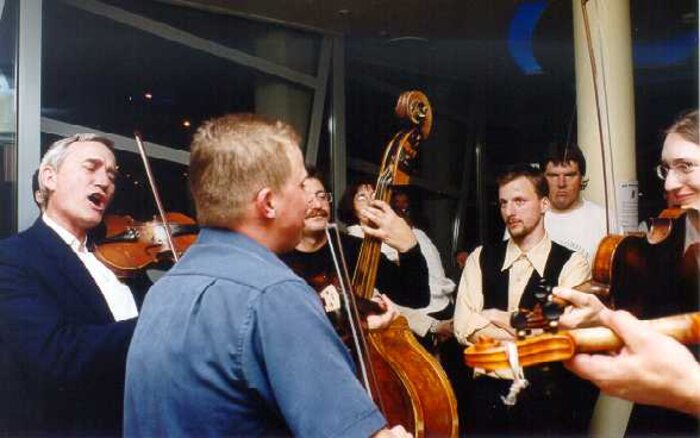
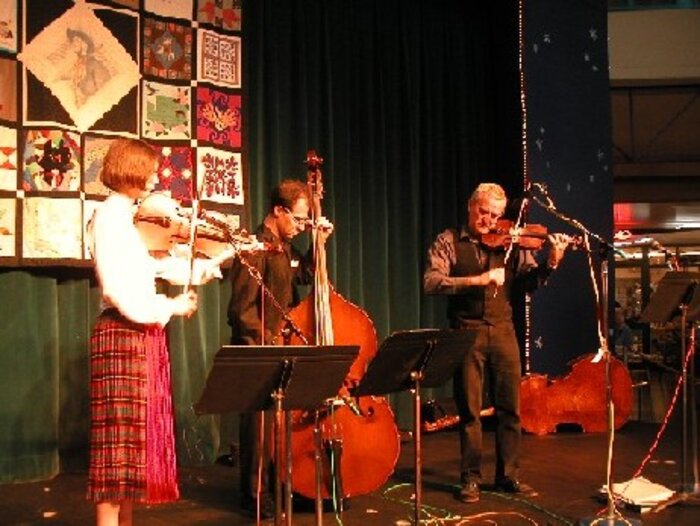
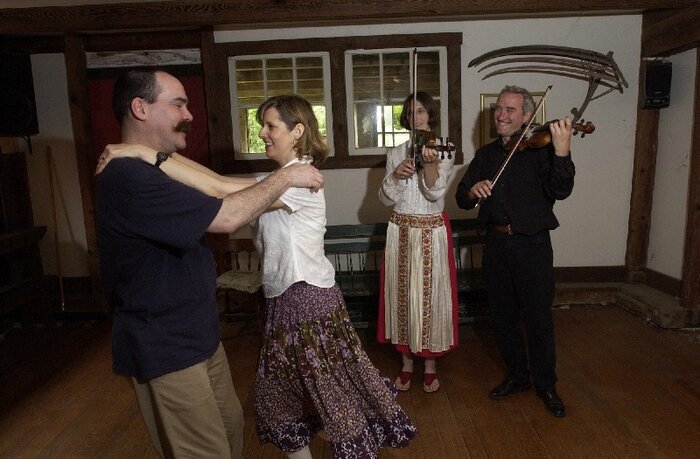
The Bodó Band (Bodó Banda) formed in Nagykálló, in eastern Hungary, in 2000. Its two permanent members — Béla Marssó and Katalin Tamás — have played together with numerous other musicians over the years, including violinists Antal Kerezsi and Edina Jakab, violist Pál Kocsán, and double bass players István Kocsán, János Erdei, Tamás Figeczki, and Sándor Oláh. During the first half of 2003 the band toured extensively across the United States, playing Hungarian folk music — Jewish, Gypsy, and Hungarian village tunes from Nagykálló, Szatmár, Dunántúl, Sárköz, Zemplén, Bonchida, and Kalotaszeg — in dance houses (táncház) and workshops.
The Musicians
Béla Marssó has played Hungarian folk music on his violin since 1972, after years performing with local symphonic and rock bands. He traveled widely at a time when travel was difficult under the political situation of the era, playing at Greek and German festivals, for Turkish nomadic people, and even for the mayor of Paris — touring with various bands to nearly every large city of the socialist bloc, from Rostock to Ohrid. In 1984 he and his band won a prize on the Bretagne Peninsula accompanying the Kállai Kettős Folkdance Group together with Gyula Rácz (viola), Zoltán Bogdán (cymbals), and István Kocsán (double bass). His hobby is gliding, and he has been a member of the Gliding Club of Nyíregyháza.
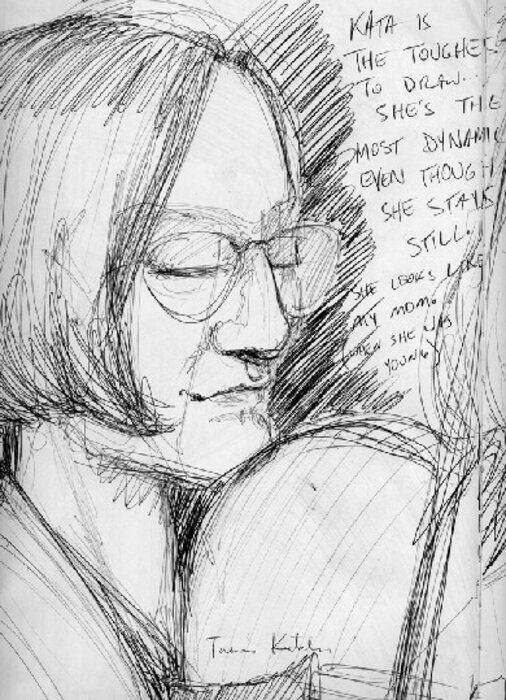
Katalin Tamás took up gliding in 1998 after graduating from the University of Miskolc. At an airfield she met Béla and his musician friends, who introduced her to folk music — she joined the band on three-string viola, learning the basics from Gyula Rácz, a Gypsy musician from Sarkad in southern Hungary. Katalin has performed in the Hungarian Embassy and the summer palace of Peter I in Saint Petersburg, Russia; at the Collegium Hungaricum in Vienna; and in Jerusalem. She later studied Business at Pennsylvania’s Bloomsburg University, where she organized the band of the Susquehanna International Folk Dancers and served on the board of trustees for Hungarian Folkradio.
Jeremy dePrisco has played bass since age 13, along with guitar and several other instruments, and writes songs. He played double bass with his local orchestra in Hazleton, PA, and studied double bass at Bloomsburg University, performing for several semesters with the University Community Orchestra. In 1998 he founded a web site showcasing collaborations across rock, pop, folk, and theatre genres, and has released two albums of original music on the Blue Buddha Records label. Jeremy met the Bodó Band while attending classes at Bloomsburg University in 2003.
János Erdei and Patrick Farrell recorded with the band on its debut CD. János was born in Nagykálló, where he played rock and folk music with local bands, and later lived in Florida. Patrick Farrell plays jazz and klezmer music in New Orleans, where he lived together with ten other artists — musicians, photographers, and scene painters — in a renovated warehouse. The band also thanks JoAnne Growney for her translation work.
The Music
On their debut CD, Over the Ocean, the band recorded the songs closest to their hearts: the Kállai Kettős (Couple Dance of Kálló), the Kiskállai Oláhos (Vlach Dance from Kiskálló), and Szól a kakas már (The Rooster is Crowing) — all connected to Nagykálló — alongside a Romanian batuta, a whirl dance from Bonchida, a men’s dance from Szatmár, several csárdások, and a dawn song accompanied by Patrick Farrell. The recording was made in New Orleans in March 2003 with the help of Alex Yusimov.
Szól a kakas már (The Rooster is Crowing)
Legend connects this song to Taub Eizik Izsák, the rabbi of Nagykálló — though accounts differ on whether he learned it from the townspeople, wrote it himself, or simply helped spread it as his favorite song. Whatever the truth, it remains a beloved favorite among Jewish and klezmer musicians. Taub Eizik Izsák served as head rabbi of the county after returning from rabbinical school in the capital of Moldavia. During his forty years as rabbi he introduced preaching in Hungarian and established schools, a hospital, and a synagogue from donations, earning deep respect — some believed he possessed a divine energy. He is remembered as the miraculous rabbi and the father of Hungarian Chasidism. He died in 1821 at age 70; each year on the anniversary of his death (Adar 7th), many Jewish visitors come to his tomb in the Jewish cemetery.
The rooster is crowing,
The dawn is coming,
In the green field, in the flat field,
A bird promenades.
Wait, bird, wait,
You must always wait,
If God chose you to be my mate
I will be yours.
What a bird, what a bird!
With its blue leg, with its green wings
It waits for me and sings.
The rooster is crowing,
The dawn is coming,
Adoneynu r’ey v’onyeynu,
Why is He not yet here?
© JoAnne Growney
Kállai Kettős (Couple Dance of Kálló)
According to legend, the couple dance of Kálló dates from the Turkish era, when a castle stood at Nagykálló. The guards there amused themselves by bundling Turkish prisoners in pairs and forcing them to dance together, sometimes fast, sometimes slow — giving rise to the Hungarian saying “I will make you dance the Kállai Kettős.” Another explanation traces it to the prison of the old County House of Nagykálló, where a cell floor covered in sharp iron pieces forced prisoners to shift feet constantly to avoid injury. The dance is first recorded in 1674, described as a student song in 1736, and appears in János Arany’s ballad about a Killing Angel. Zoltán Kodály recorded and transcribed the song in 1926, leading to a world-renowned choral and folk-orchestra arrangement in 1951 that toured the globe with choreography by Miklós Rábai. The lyrics trace the flow of feeling between a jealous lad and an unfaithful girl, from yearning to mockery.
The fall wind blows from above,
The leaves tremble on the trees,
Where have you gone?
The last two nights you failed to come.
I owe a debt to no one,
My wife’s mother and father still are alive
and her mother-in-law and father-in-law,
I have no care as long as my in-laws live.
The last two nights you failed to come—
Maybe you’ve fallen into a pitfall.
I did not fall into a pitfall—
I fell in love with you!
© JoAnne Growney
On Tour: New Orleans and the American South
The band’s spring 2003 U.S. tour brought them through New Orleans, where Patrick Farrell hosted them in his warehouse home. One memorable outing was a swamp tour north of the city, recounted in the band’s own account, “Gator Béla, the Party ‘Gator, Extends a Hand to Fred”:
Guide Stuart “the captain” Oliver Larmi ushered the band onto his twin-hulled pontoon boat some thirty miles north of New Orleans, past shrimp and crawfish boats, brown pelicans, and cypress trees draped in Spanish moss. Skeptical after several false alarms, the group finally watched Stuart toss a marshmallow onto the water calling, “Here… Fred! Here… Fred!” — and a pair of green eyes surfaced as an eight-foot alligator glided in and gently mouthed the offering. More gators followed, drawn by a chicken leg on a string. Béla, dressed in his New Orleans Party ‘Gator T-shirt, leaned over the rail and stretched a hand toward Fred’s snout as Stuart drawled a warning: “You…wouldn’t…do…that…in…the…summer…when…it’s…hot.” When it’s hot in New Orleans and the music is good, Fred is probably still out there listening for Hungarian folk tunes drifting down through the Spanish moss.
2003 U.S. Tour Schedule
The band’s spring–summer 2003 itinerary illustrates the scope of a working folk band’s life on the road, from Pennsylvania college towns to the West Coast and back to Hungary:
- January–February: Bloomsburg University folk dance classes, Golden Festival (New York), Philadelphia Jam, Bucknell University (Lewisburg, PA), Town Perk Coffee (Bloomsburg), house concerts, the Hungarian House (New York), Franciscan Monastery (Washington, DC), Bloomington University (IN), Greenwood Friends School (Millville, PA)
- March: Louisiana — Árpádhon, Bourbon Street and The Spotted Cat (New Orleans), HungarLa event, house concert in Bloomsburg
- April–May: Bloomsburg University events, Renaissance Jamboree, Earth Day, Roots Jam (Cloverleaf Village, PA), then a West Coast leg — the Sunset Tavern (Seattle), Red and Black Cafe and KWVA radio (Eugene/Portland, OR), Bruno’s and the Luggage Store Gallery (San Francisco), Storyville (San Francisco), West Linn Lutheran Church and the Upstage (Port Townsend), Northwest Folklife Festival (Seattle)
- June–August, back in Hungary and Pennsylvania: Hungarian Workshop and Watershed Festival, a Susquehanna Valley Winery party, a concert with Ferenc Lakatos and his orchestra, jam sessions in the main square of Nagykálló, a wedding in the Zemplén Mountains, and a performance in Bortó, Mád
- October: Tittling, Germany
Until July 2003, the band also played every Sunday for the Susquehanna International Folk Dancers in Bloomsburg, PA.
Contact
Band e-mail: bodoband@bigfoot.com
Address (Hungary): 102 Kemecsei u., Sóstóhegy 4481, Hungary
Phone: (+36) (42) 728-050 Cell: (+36) (30) 364-0364
Content and photos preserved from the band’s original website, bodoband.org.
Photo Gallery





 Mondák
 Vicc
Vicc Költő / Író
 Népdal