











Worcester MA, April 25, 1852.
The success of Franklin was aided by the hatred of France against England (…) But I trust (…) the love of liberty in republican America as copious (…) as hatred of Great Britain in monarchial France (…) .is there less reason for (…) America (…) to hate (…) absolutism (…) than for France to hate England ?..Perhaps I could say, poor Hungary has well served Christianity,..the cause of humanity. But you are generous enough..to recommend us to your affections in place of good service. It is beautiful to repay a received benefit, but to bestow a benefit is divine..
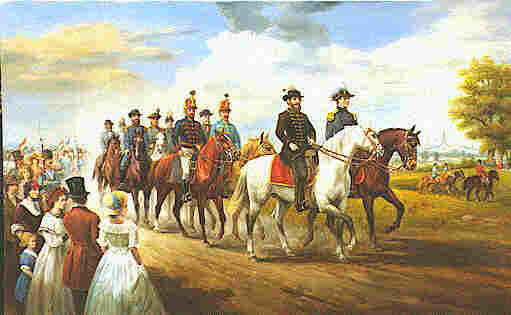 Kossuth en route to Boston, 1852 |
Boston MA Faneuil Hall, April 28, 1852.
(…) having had an opportunity to converse with leading men of the greatparties (…) on the eve of an animated contest for the presidency (…) informed of theprincipal issues (…) I could not forbear to exclaim: “all these questions (…) cannot outweigh the (…) importance of foreign policies.” Security and danger (…) peaceand war (…) life and death will be weighed in the scale of foreign policy (…). Inancient Rome, (…) old Cato (…) never spoke privately or publicly about whatevertopic without (…) these words: “However my opinion is, that Carthage must bedestroyed”.
Being charged with being in the hands of abolitionists, and from the otherside with being in the hands of slaveholders. (…) at a loss what course totake (…) these charges were giving me the satisfaction to feel (…) where it is myduty to stand, on a truly American ground.
Boston MA Faneuil Hall, April 29, 1852.
I have not seen (…) that mark of poverty (…) which in old Europe strikes the eyesadly at every step (…) .The cheerfulness of a comfortable condition, the resultof industry, spreads over the land. One sees (…) that the people workassiduously, (…) but they work with cheerful consciousness of substantialhappiness (…) And the second thing which I could not fail to remark, is thestamp of intelligence (…) upon the very eyes (…) of the people at large. (We) (…) haveseen them in factories, in workshops (…) in the streets (…) The orators of FaneuilHall were eloquent interpreters of the people’s enlightenedinstinct (…) Some (…) take me for a visionary (…) that man (…) a poor son of the people,took the lead in abolishing feudal injustices a thousand years old; created acurrency of millions (…) suddenly organized armies out of untrained masses (…) beatthe old, well-provided power of Austria; and in his very exile (…) feared byCzars and Emperors, and trusted by foreign nations as well as by his own (…) thatman must be a visionary (…) then I may be excused that I would like to look faceto face into the eyes of a practical man on earth.
Boston MA Legislative Banquet, April 30, 1852.
(…) a long thousand years (…) and with adversities to my countrymen ! Andyet (…) there was no period when the people of Hungary did not resistdespotism (…). Through the vicissitudes of a thousand years there was not amoment when the popular will and the legal authorities hadsanctioned (…) absolutism (…) .the wisdom of our fathers (…) laid down for Hungarianinstitutions a basis which (…) must remain true: Nil de nobis, sine nobis“nothing about us without us”. There is on record a speech of mine, spoken inthe Hungarian Diet (…) that either Austria must become constitutional, or Hungaryabsolutistical. That speech virtually fanned into flame the revolution of 1848 in Vienna.
Salem MA, May 6, 1852.
(…) I learned from your Shakespeare (…) that “there are more things in heaven andearth than are dreamed of in our philosophy”. Who knows what the future maybring forth ? I trust in God that all nations will become free (…) and in thatgalaxy of freedom I know what place the United States will have. When John Quincy Adams assumed for the United States the place of a power on earth, hewas objected to, because it was thought possible (…) (to) (…) give offense to theHoly Alliance. His answer: (…) “the United States must take counsel of theirrights and duties, and not from their fears”. The French Republic, instead ofprotesting (…) the interference of Russia, (…) interfered itself at Rome. (…) And theUnited States of America remained silent. Russian absolutism and Anglo-Saxonconstitutionalism are not rival but antagonistic powers (…) they can not holdequal positions. One or the other must yield (…) or the other must perish.
Lexington MA, May 11, 1852.
Prosperity is not always (…) a guarantee of the future, if (…) not accompanied(by) (…) the genius of the time. Nay, material prosperity is often the mark ofreal decline (…) Rome was never richer, never (…) mightier than under Trajan, andyet it had already the sting of death in its very heart (…). Whenever I standupon (…) sacred ground as this, the spirits of the departed appear like (…) prophets of future events. The struggle of America for independence wasprovidential: (…) a necessity. Those circumstances which superficialconsideration takes for (…) motives were but accidental opportunities (…) Hadthose circumstances not occurred, others would have (…) the revolution would havecome (…) The colonies of America had attained that lawful age (…) which claims theright to stand by itself (…) The immortal glory of your forefathers was, thatthey did not shrink to accept the trial, and (…) were devoted to their country’sdestiny.
 Mondák
 Vicc
 Költő / Író
 Népdal
