









by Meszaros Glenn
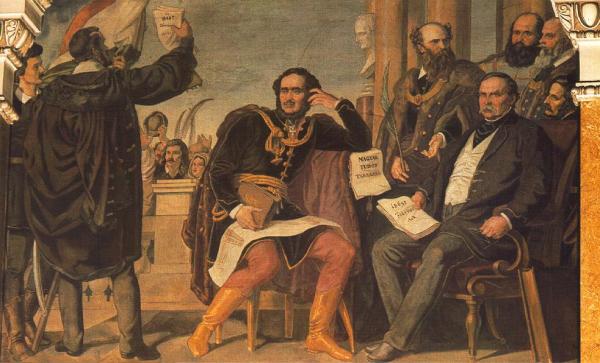
Having been perturbed at Webster Tarpley’s Conference Presentation of February 20, 1994, which charaterized Lajos Kossuth, the former Governor of Hungary, as an agent of Lord Palmerston and Guissepe Mazzini, I am writing this memorandum to better situate the policies and actions of this most famous Magyar.
Webster’s sweeping indictment of Kossuth mentioned that he 1) provoked ethnic strife by pushing the Magyar language over competing dialects in Hungary, 2) told the British that he supported free trade, 3) shared the platform in his American tour with the South’s leading slaveholders in one meeting in the south, 4) participated in a meeting with the American Ambassador to England in 1854 with Mazzini, and assorted other “revolutionaries”, (see Treason in America).
Since it was pointed out that Bolivar changed his policies later in his life, similarly it needs to be pointed out that Kossuth’s activities after the Hungarian defeat by Russian forces bailing out Austria are to be distinguished from his earlier, more stable personage in Hungary, when he was surrounded by the intellectual Magyar elite. This is especially true because you are dealing with a sovereign country’s most respected hero, not some mere agitator and provoceteur like Mazzini.
. However, first let me state my hypothesis, which is based, I believe, on knowing a great deal about the unique nation state of Hungary, or Magyar. I have visited Hungary and seen the poorest villages, the industrial towns, and the most magnificant Cathdral, Matthias Kirche, built by the Renaissance King Matthias in the 1490s upon the original church constructed in the mid 12th century. I have seen the crown given by Pope Sylvester II to St. Istvan (Stephan) in the year 1000 to celebrate the founding of Christendom among Magyars.
I watched the common people flock to the churches on Friday evening, and Sunday morning, saw the statues of Christ and the Virgin Mary in the fertile fields of the Hungarian Plain; I received the warmest hospitality from relatives who were complete strangers in the poor village of Bakonysarkony. (My personal relative lives in a tiny shack, with no plumbing, on the edge of town with her pensioner husband; her son farms with Belgian draft horses) I listened to schoolchildren seranade their teachers on the last day of school on the banks of the Danube, in Budapest, I attended the High Latin Mass in Matthias Kirche. I saw the kiosks of Budapest adorned with advertisements for Verdi operas.
I sat in the small highrise (like Washington Heights, NYC) apartment with the great Dr. Kovats Tibor, as his grandson recited the Magyar Nemzeti Dai (national song),
“Talpra Magyar, Hi a Haza”, Magyars, rise, your country calls you!”. Meet this hour, whate’er befalls you! Shall we freemen be, or slaves? Choose the lot your spirit craves! By Hungary’s holy God Do we swear, Do we swear, that servile chains We’ll no more bear!
Finally, I went to a concert of Handel’s Messiah, performed in halting English, (sounding like “all wo lik shep”) in the great cathedral, which was sacked by the Mongols, occupied by the Turks, and later the Germans as a fortress on Buda hill, and shelled by the Russians. Advertisements for concerts were forbidden by Communists. The orchestra had a tough time following the conductress, who once stopped them with her baton as they went way off the musical score. Tap, Tap, Tap. No one laughed or giggled, or even seemed the slightest bit perturbed or embarrassed. Parents stroked their children’s hair like they were locks of gold, and children looked deeply into the eyes of their parents as they conversed.. Contemplating the cultural wasteland to which I must return in several days, I just cried.
All of which is to make the point that I do not think such a nation could celebrate a Mazzini agent as her greatest national icon. Lajos Kossuth may have been a Thomas Jefferson, but he was no Mazzini. However, his illfated collaboration with Mazzini, which took place between 1851 – 1854, must be condemned.
The first misconception that most people, even in our own organization, have about Hungary is that it is a slavic nation, since it is surrounded by Slavic nations. However, this is not the case, and its language is agglutinative (many Magyars speak German because of later migrations from the WEST, but the languages are not at all similar) , and belongs to the Finno-Ugric language group, not Indo-European. At the time of the “Great Migrations of the Peoples” from the east in the period after the collapse of the Roman Empire, it also absorbed many Turkish words.
Dr. Tibor Etienne Barath writes in his “The Early Hungarians” of the discovery of three inscribed clay tablets near the river Maros in Tatarlaka (now Tartaria) in 1961, which he claims were used for solar observations, and later, solar calendars. “All three tablets appear to have been locally made, which the accompanying objects come from the Mediterranean and were either Cretan or Cycladic.” Barath says that they generated much interest in the archeological community, which dated them from between 3000 B.C. and 1700 B.C.; Barath, however, claims a more precise translation which dates them precisely at 1428 B.C.
At any rate, it is certain that Mesopatamian civilization, with its well known astronomy, had reached the Carpathian basin at a very early date. This basin is surrounded by a 1000 mile long circumfrence of mountain ranges, and drains several rivers into the 2000 mile long Danube River, which thence goes to to the Black Sea. Professor Barath claims that “Magari” (Magyars) or Ari (Aryans) peoples already occupied this basin during the Neolithic and Bronze Ages, practicing Egyptian type religions, and speaking Magyar. Magyar literally means farmer, and is allied to the German-Bavarian word Mayer or meyer, which means peasant.
The Roman Empire built its Limes Wall to encompass the western portion of Hungary, known today as Transdanubia, and to the Romans as Pannonia, following the Danube River as its contour, within which were well established communities. One such completely excavated settlement on the northern outskirts of Budapest, known as Aquincum, can be visited today. Emperor Trajan made forays into Transylvania, but as the empire collapsed, Aurelian withdrew all Roman subjects from this province in 271 A.D. The “Great migrations of the Peoples” took place in the next centuries, between the Byzantine christian empire in the West, and the Chinese empire in the East. After the Chinese defeated the great asiatic Hun empire (around the time of Julius Caesar), the Huns moved westward and forced various Teutonic tribes against the Limes Wall around the end of the 4th Century. As the Limes Wall gave way to various nomadic tribes, three distinct waves of migration took place, featuring Huns, Avars, and Slavs, who reached the Elbe River in the West, and the Balkans in the South.
In his History of the Hungarian Nation, Dr. Dominic G. Kosary, Eotvos College, Budapest, writes that a new Ugrian peoples of Turkic origin appeared from the East in the 9th century, the Magyars, who were forced Westward by another Turkish warrior clan called Petchenegs. In their nomadic migration, they sided with the Greek Byzantine Empire and fought against the Bulgars in an area north of the Danube Black Sea estuary, now Rumania. However, when the Greeks deserted them, their seven great tribal leaders elected Arpad, son of Almos of the Magyeri clan, to lead them. (I stayed on one of the many streets named after Arpad). The seven tribal leaders cut their veins and mixed their blood in one vessel to seal the pact. Arpad led his people from their exposed position through the Verecke Pass in the Carpathian mountains to the fertile plains below. Leo the Wise of Byzantium wrote of the Magyars, ” This people abounds in men and is independent. Aside from their love of pomp and abundant life, their chief aim is to fight bravely against any invader.” They were fierce horsemen, and from their secure Carpathian basin, they launched many raids into Europe, occupying areas as far away as Germany, Italy, Switzerland, France, and even Spain. Unlike the more barbaric Mongol horsemen of a later era, the Magyars concluded alliances with the peoples of Upper Italy, Bavaria, and Saxony, and established principalities to pay tribute to Arpad. Charlemagne’s collapsed empire was under seige from Norsemen, Moors, and Magyars at the same perilous time. According to Dr. Kosary, the reform movement of the great French monastery at Cluny saved western christian civilization. While previous conversion to christianity meant automatic inclusion into the Holy Roman Empire, the reform movement preached a more universal message of christian brotherhood, which allowed converting tribes to maintain their independence, while aligning with christian civilization. Prince Geza, or Geyza, the great grandson of Arpad, accepted this arrangement for apparently tactical reasons, and one of the church’s earliest Martyrs, St. Gellert, was sent to colonize Hungary. Pagans threw him off Buda hill into the Danube River. A statue today of St. Gellert overlooks the land he conquered with the christian faith.
However, the Christians fortunately prevailed, and some of the earliest churches north and east of the Alps are in Hungary. Geza’s son, Istvan (Stephan) was thoroughly educated by Christian missionaries, and when he became King, he forcefully converted the entire Magyar domain to Christianity, under pain of death to pagans. Pope Sylvester II sent the Crown of the Catholic Church to King Stephan, now St. Stephan, (Istvan) and the new Magyar king dedicated his kingdom to the Virgin Mary. The crown has been added to over the centuries, and hidden many times from invaders, the latest being the Russians. It was returned to Budapest around 1970. and resides in the national museum.
The first invaders were the Mongolian hordes still feared by Russians, who came in the 13th century, By then the Magyars had bequeathed to posterity their first written text, a funeral sermon, in 1200, and the Magyar noble lords had written and signed their “Golden Bull” in 1222, a Magna Carta for their country. The mongols completely overwhelmed all christian armies of the day in their campaigns. They had the swiftest cavalry troops which completely outflanked the stationery Christian armies. While the Christians sat in their heavy armor, the Mongols wore only silk shirts, which enabled them to pull out penetrating arrows with little internal damage and infection. (Later one of my “ancestors”, Lazar Meszaros, developed the silkworm industry in the early 19th century,which he learned while occupying Milan for the Hapsburg empire; my father worked in a silk factory in Paterson, N.J. in the middle 20th century – it’s a small world).
Fortunately, every time a great Khan died, the Mongol armies all retreated to their homeland to select a new tribal chief, and this occurred around 1263, shortly after the original invasion in 1241. The next Khan wanted to conquer Islam, and they sacked Bagdahd instead of Budapest. Unfortunately for the Russians, the Mongols never left the Kiev region for centuries.
The great Turkish Sultans first moved into the Balkans in the 14th century, and defeated the Serbians at the famous battle of Kosovo, for which the Bosnians are still suffering. The Turks had a much tougher time conquering the Magyars, and Europe owes the greatest debt to the brave Magyar warriors who held off the Turks until 1526, after the initial invasion in 1389. These battles included the famous siege of Egers, where the Magyar women fought on after the men died, and lured the rapacious Turks into a cellar stronghold, which they then proceeded to blow up in a massive explosion.
This century long struggle permitted the most fortuitous development in the History of Magyardom, which was the reign of the Renaissance King Matthias, from 1466 to after 1500. He married Beatrice of Aragon, and they imported the Italian Renaissance wholescale into Hungary, thus cementing forever the attachment of Hungary to morally superior Western culture, which was denied to the Balkans, and Russia until much later. Hungary did not produce any painters or sculptors or artists equal to the Italians, but at least they knew what to imitate, as the Christian Art Museum at Estergom attests. When I visited there, the little old ladies in charge give everyone shoepads to make sure the atmosphere stays respectfully quiet. The Archbishop Treasury in Esztergom has one of the richest collections in Europe, and this was one of the last cities occupied by the Turks, on the northern edge of their advance into Europe.
The story of King Matthias is of immense proportions which go beyond the scope of this paper, and cannot be overestimated in its importance for the people of Hungary, and Europe. It was only the legacy of King Matthias that allowed the Magyars to survive the 150 year occupation of the Turks, which occurred from 1526 – 1686. The Sultans primitive hoardes were far different from the more civilized Islamic culture which invaded Spain and left its handiwork in cities like Granada. The Sultan’s barbarians, governed by its stultifying Harem politics of succession, destroyed the advanced agricultural system of the fertile plains, and carried off so many tens of thousands Magyars to Turkey that a long line of Hungarian speaking communities existed in Turkey for decades. Hungary did not recover from this depopulation of its territory until the late 18th century, when its population doubled from 4.1 million from 1720 to 1790.
The Magyars could never have extricated themselves from such devastation, and fortunately the Hapsburg Empire was able to recapture great portions of Europe from the Turks, who were left hopelessly behind the technological revolutions of the West. Vienna was liberated in 1683 and Buda followed shortly thereafter in 1686. The next major development in Hungary revolves around its establishment as a modern European nation under the tutelage of Count Istvan Szechenyi, who dragged its ruling class kicking and screaming into the new era illuminated by the blazing light of the American Revolution, NOT THE FRENCH ENLIGHTENMENT. The impact of the American Revolution should not be underestimated on those countries of Europe which benefitted from the acculturation of the Italian Renaissance.
This also brings us to the polemic of this paper, that the acculturation of the Magyar people could not have produced in Lajos Kossuth a godless, morally groundless Mazzini agent. Mazzini himself was a pathetic figure, not unlike many of our contemporary leftist “revolutionaries”, except that he benefitted from a European education denied most Americans. His “organizing efforts” featured attacks on professional troop garrisons of the Hapsburg Empire with motley and ragtag “militias”, who were swept aside like so many bugs. His greatest conquests involved his closest collegues wives, who he complained, ‘threw themsleves at his feet”, during his many years in exile, hiding, and so forth. Most people only saw the carefully crafted image of Mazzini, not the real thing. Communists and facists alike have adopted this myth.
While Kossuth is known as the most famous Magyar, Istvan Szechenyi holds the undisputed title of the “Greatest Hungarian” , at least of modern times. The history of Count Szechenyi reminds us again of the long line of “individuals” who have changed history, through the power of having and implementing “a better idea”; like most of these “individuals”. Szechenyi was part of a Republican Elite. His father bequeathed him 70,000 acres, one third of his estate, an immense area even for the size of Hungary in those days, which was two thirds larger than it is today. In imitation of the famous example of Christ, his father once introduced his three sons to their serfs, explaining that only their sweat and blood was the basis for their wealth, and ordered his sons to kiss the hands of the oldest serf. The Young Count Szechenyi valued his father’s message, “It may be true that the way we receive a visitor depends on the clothes he wears, but the manner in which we see him to the door is determined by the way he had conducted himself”, that he bore it on his person at all times encased in a neck chain.
Szechenyi quickly established his reputation in the Napoleanic wars as a Captain of Hussars, with a heroic ride through French lines to alert the King of Sweden to join the Battle of Leipzig against Napolean. He was still only a youth of some 20 years of age. Shortly thereafter in 1820 he and another great Magyar from Transylvania, Count Wesselenyi, made plans to tour Europe and study ‘modern civilization”; they wanted to include America on their itinerary, but Prince Metternich personally denied their request, calling it “either a lark, or attempt to study new constitutions”.
Szechenyi made no secret of his study of constitutional law, translating Jean Louis Delolme’s The Constitution of England. He rejected Rousseau categorically, holding him more dangerous than useful. But Benjamin Franklin held the greatest influence over the maturing Count, who wrote in 1829, “Gelesen Memoires sur la vie de Benjamin Franklin – 2 Theile – Mir war alles schon bekannt – und doch las ich sie mit erneuertem interesse, Das wahrhaft Grosse und Einfache – ermudet nie.”
Szechenyi’s organizing his fellow nobles in the 1825 Diet featured the first ever speech in that body by a magnate in the Magyar tongue, as opposed to the official language of Latin in all parliamentary debates. The Count also donated 60,000 florins to establish an institute to promote the study of Magyar, which turned into the Hungarian Academy of Sciences, whose correspondence with Franklin’s Academy is appended to this report. To make a long story short, all this convinced Metternich, with whom Szechenyi had many intimate conversations, in December, 1825, that “In Hungary I encounter all those things on which during my whole public life, especially during the last ten years, I have made war.” All this in turn was carefully reported by British Ambassador Sir Henry Wellesley to George Canning. Since Hungary had been kept in a colonial, feudal, pastoral state by Vienna since its liberation from the Turks, Szechenyi had a great nation building task. The official parliamentary language was Latin, and most magnates (feudal lords) only knew Latin and German, not Magyar, and spent most of their time in foreign capitals. (One time a group of magnates visited Bologna, Italy and were addressed by the famous linguist, Cardinal Mezzofanti, in their native Magyar tongue – they didn’t understand a word of the whole greeting). Szechenyi developed a national set of social clubs, called “Casinos” (not like the modern gambling ones) which were the equivalent of Franklin’s Juntos. This allowed the magnates to stay at home to socialize, read foreign newspapers, and converse in Magyar. The Count did have to break the feudal lords of one bad habit characteristic of the semi civilized state of feudal oligarchism – they would pace around the houses of their pathetically poor estates, (700,000 nobles owned 9,000,000 serfs – again this included a much larger area than the post Versailles Treaty allocation of land to Hungary, when she lost 2/3rds of her land and 1/3 of her population in the Rape of Trianon) and spit tobacco on the rug for the serfs to clean up. There was no spitting allowed on the Casino floors.
Szechenyi came back from his “world tour”, including scenes of the industrial revolution in England, and remarked on the backward state of affairs in the Hapsburg domains, ” Feudalism does not like the smell of steam.” After many polemical battles with Prince Metternich, the Count declared “Metternich’s system ceases with his life. Mine will begin only after my death.” By this time Austrian secret police reports repeatedly characterized him as a dangerous radical and subversive. Under feudalism of Metternich’s regime in Hungary, 5/6ths of the cultivated land was reserved for the noble and magnate class, and thus completely exempt from taxation, which prevented any internal improvements. There was only one primitive boat bridge across the Danube river between Buda and Pest; when Szechenyi built his famous chain link bridge in 1848, he used it to charge tolls to everyone, including nobility, thus ending their tax exemption. Although half of Austria-Hungary lay in the Magyar area, only 1/10th of industrial plants were located in Hungary. Vienna’s tariff policy prevented Magyars from selling produce abroad, thus forcing them to dump cheap food only into Austria, which extracted raw materials from Hungary in true colonial fashion. Szechenyi used the magnates’ interest in horse racing to establish the Association for Animal Husbandry, which later became the Hungarian Economic Association. “While I am talking about the horse, the sheep, or the cow, I keep on rasping, step by step and very gently, the prejudices of our compatriots.” He had met Americans already in his travels, and he wanted in 1829 to go to America because “it is the land where the rights of mankind are the most equal and where the constitution is the best” and “it is the fountain from which this essence of justice springs.”
There were no banks in Hungary, and most of the nobility was in debt to clergy. They passed on this crushing debt to their serfs. In a classic feudal syndrome known throughout the world, 1/3 to 1/2 of the fields lay fallow every year, crop rotation was unknown, manure was used as fertilizer only on meadows, livestock was left outside year round, and ignorance of fodder plants, lack of storage facilities, and absence of transportation led to cycles of over abundance and famine. (that even a peasant can understand the problems of feudalism and free trade is seen by the letter of my relative, who on December 4, 1991 wrote me, “We can’t sell the milk pigs and corn, so no money. In other country they have nothing to eat, as in U.S.S.R. and otherwhere, We must drown in our crop, fruit and corn. Why is that? We can’t understand!!! We are just ten million in this land, and can’t sell what we are producing.”)
In January. 1830. Szechyenyi wrote his most famous book, which he called “Hitel” or “Credit” in English. (I have not yet located a copy of this book in English) He called lack of credit Hungary’s biggest problem, because “from the Throne down to beggar nothing else but the word keeps states together.” “this nameless science yet in its childhood; which, however, is in our judgement to develop amazingly in the future.” “credit in a stricter sense is the foundation of of agriculture, crafts, manufacturing, mills, and trade.”
His two major proposals were the establishment of a national bank, and complete revision of the mercantile code, whose infamous “law of entail” from the middle ages prevented serfs from owning land and allowed nobility to claim back land lost from their previous family lines. A few quotes suffice to show that he had studied Hamilton’s notion of physical economy: “The real power of a nation lies in the number of its scientifically educated heads. The number is the most interesting part of a country’s statistics. Public strength consists not of fertile plains, mountains, minerals, climate, etc, but of reason being able to make sensible use of them. There is no more genuine weight or strength than than of the human brain. More or less of it is more or less happiness for a nation. ” “We well to do landowners are the main obstacles to the progress and greater development of our fatherland.” Human beings have to be free to “develop their immortal human dignity on the basis of a sounder philosophy purified by Chrisitianity.” This would entail “emancipating all our compatriots through participation in civil rights.” Knowing that publication of this book would cause a firestorm of protest from the backward nobility, he concluded the book by saying, ” How can a born Hungarian magnate say such things and how can he expose his compeers to mockery, hatred, and ridicule all over the fatherland? What is his intention? To overthrow the good old order with his dangerous principles and to cause general confusion?” “The past has slipped from our grasp forever but we are masters of the Future. Let us not bother then with futile reminisces but let us awaken our dear fatherland through purposeful patriotism and loyal unity to a brighter dawn. Many think: Hungary had been; I like to believe: she will be!”
Hitel sold in five months 2000 copies, which was unheard of for Hungarian language books, the best of which could count on 200 sales. By 1832 there were four Hungarian and three German editions. Since these editions were followed by attacks from various magnates, he prepared immediately a sequel book to refute his opponents, called Vilag or Light, which is the name of our compatriots Magyar language paper in California today with its Larouche reprints. The sequel sold 3250 copies in late 1831. The Count followed this with the third book in this trilogy, called Stadium, which was more programmatic with specific proposals for development, especially making the Danube navigable all the way to the Black Sea (it was blocked by the Iron Gates (rocks) near Belgrade). Vilag concentrated on promoting the acculturation of Magyars in their own language, using their universal christian principles to avoid the pitfalls of nationalism. He proposed a Hungarian National Theater, and wanted to see a Magyar translation of the Bible into “every hut, hovel, cottage, and room.” In later debates in the 1840’s Diet over liberty and nationality, he asked his more radical opponents, “But if you want to achieve liberty, on the basis of what nationality do you hope to accomplish it? Slav or German?” He called his own home town of Cenk “the Post of our Hungarian Community in the West and thus, so to speak, a Defense Post of our Hungarian Fatherland.” He wanted a Priest there who was ” an honest man must also be an enlightened and moderate Hungarian with immaculate conduct and behavior.” This town is now called Nagycenk, which I visited, and is located in western Hungary, near the border town of Sopron. A statue of Szechenyi, its surrounding grounds being carefully tended, stands in front of his personal church, with the Count pointing East, towards Budapest, with his back to Vienna. Down the road lies his estate house, now a national museum; a troop of well behaved children carefully listened to their guide give them a five minute lecture IN EACH ROOM of his exhibits, which range from centralized heating ducts, to steamship displays, to railroads, pianos, paintings, etc. The Szechenyi family tree exhibit features a bright yellow sun (Szechenyi) surrounded by orbits of his descendants. Nearby Nagycenk, I also visited the Esterhazy Palace in Fertog, where Haydn lived and composed his music. The Poles rebelled in 1830, while a cholera epidemic infected 500,000 Hungarians in northern Hungary, and peasants also rebelled in Hungary. Thereafter, the authorities banned his third book, Stadium, which was published anonymously in Leipzig. Szechenyi laughed at this censorship, preferring to see donkey ears rather than devil’s horns in Vienna, and proclaimed, “I work diligently and with self reliance. If my wings are clipped, I shall walk on foot. If my feet are cut off, I shall move along on my hands. Should they be torn out too, I shall crawl on my belly.”
Stadium proposed the repeal of feudal law of entail and establishment of a modern commericial code, civil rights and property rights for all citizens, and publication of all laws, sentences, and orders in Magyar for them to be binding. These were the famous 12 Laws. Note that Law 10 stipulating the use of Magyar for legal documents is similar to the establishment of English as American’s national language, and did not mean discrimination against the 50% of Hungary who were not Magyar, despite others misuse of the language requirement later. There is nothing wrong with establishing a national language for a country with many minorities, and therefore Kossuth’s insistence on the Magyar language later on does not ipso facto mean that he was inciting Palmerston’s Zoo. Szechenyi said, “The greatest treasure of Hungarians is their national idiom; this is the only safeguard of their entity as a nation, for no nation can exist without a national langugage. Hungarian progress depends on loyalty to the dynsasty and on the promotion of national characteristics predetermined, however by the free development of the language.” Law 8 stipulated a nationwide system of communication, flood control, land reclamation, and water regulation, supported by general and proportional taxation. Later on Szechenyi personally blasted the Iron Gates north of Belgrade to make the Danube navigable all the way to the Black Sea, and commissioned an engineer to make 101 cross cuts in the meandering Tisza River to shorten travel time on this route. When you see four lines on the Magyar insignias, they stand for the four significant rivers traversing the country. Presaging Henry Carey, he called for a community of interests between lord and peasant to replace the “vampire” feudal classes which kept the peasants on the level of “vegetating animals”, which he called “spiritual as well as physical darkness and filth”. “the most heartless of all cruelties is to imprison the spiritual talents of a man”. He specified that he was talking about 9,000,000 peasants “who are loyal serfs, and how loyal! who are brave soldiers, and how brave! who, in short, are patiently carrying all the burdens and whose greater part is the last guarantee, hope, and preserve of Hungarian nationalty!” Hungary must consist of “placing all inhabitants in the common rights of mankind which means securing everybody’s political existence.” He dismissed the Holy Crown constitutional doctrine “which is de facto not true either in the physcial or the moral sense,”and wanted to see Hungary “at long last not merely de jure but also de facto as a regnum per se et pro se existens, et independens”. This was heady wine for the next generation of “radical intellectuals” , led by Lajos Kossuth, to digest, but it laid a sound basis for the legal, bloodless Magyar revolution of 1848, unlike the bloodbath in Paris and the absurd riots in Vienna, which saw workers destroying their own machinery in fits of blind rage. Szechenyi was however a builder and a doer, and after 1832, spent most of his time creating and directing his many projects, lining up capital, forming companies, directing construction and so forth. Many foreign artisans emigrated to Hungary to build these projects, especially from Italy and Germany, and they called Szechenyi “Landes Baumeister Csicsinyi” – the master builder of the land. He went to England to buy machinery and ask the American consul F. B. Ogden in Liverpool for information about bridge building, who does it, how is it financed, what kind of taxes, return on investment, toll collections, and a myriad of other questions. The appearance of his dredging machine in Vienna caused a major stir as all the archdukes and the ladies came out to see it operate in the Danube River. The Diet commissioned his chain link suspension bridge in 1836, and it was completed in 1848. Szechenyi wrote to engineer George Rennie to reveal that while the country needed good roads before the bridge, the imposition of tolls on nobility crossing the span would eliminate their tax exemption in the eyes of the public. The Count also established through the auspices of that ubiquitous Lazar Meszaros a milling industry in Budapest, with the expressed aim of replacing wheat as Hungary’s number one export with flour. This would create more work for artisans in building wooden staves for the flour mills, millhands for the mills, and coal miners in Mohacs to fuel the new industry.
While Szechenyi was away on building projects, Lajos Kossuth entered the diet as an absentee delegate. The Kossuth family has been traced back to 1263 in land title grants in northern Hungary (today Slovakia). Kossuth’s father spoke Magyar at the dinner table in reading the Protestant Bible, German to his wife, and Slovakian to his servants. Lajos was trilingual before he mastered Shakespearean English. Kossuth delivered his Lutheran high school valedictorian lecture in Latin and attended a Calvinist College, where he read Herder, Schiller and Rousseau. The 1832 Diet deliberated in Pozsony (present day Bratislava). (Interestingly, Bratislava is the only city where a bridge crosses the Danube River which comprises the border between Hungary and Slovakia – when I visited Ezstergom, I quickly noticed this problem, which clearly reflects that Hungary does not recognize the borders set at Versailles). Szechenyi, his old friend Wesselenyi, and Ferenc Deak (of whom we will hear more later) dominated this Diet as the leading intellectuals of the newly revived nation of Hungary. Kossuth started a literary journal here under the cover of reporting on the Diet’s activities for Magyars. He explained that the new and foreign term “liberalism” meant “truly moderate liberty”. His first speech, uncovered only after World War II, emphasized “the development and guaranteeing of liberal institutions on the basis of the established rights rooted in the foundations of society in order to avoid the licentiousness of the monstrous years of the last century and the repetition of the bloodstained events of 1830.” (referring to France and Poland). However, his militant pro magyar polemics created a conflict with Szechenyi, whom he could never please, and the wrath of the authorities who placed him in jail from 1837 – 1840 for disloyalty and sedition. Here he used an old grammer book and the works of Shakespeare to learn English, particularly enjoying the play, “The Tempest”. This flurry of constructing Hungary into a modern nation took place against the byzantine political machinations of the various empires in Europe, including the “policeman of Europe”, Nicolas I, the stationery immobile Metternich, and of course Lord Palmerston, who was assidiously cultivating contacts among ‘the liberals’ in various countries. England was launching her “free trade” movement in a big way, built on the foundation of absolute naval supremacy, i.e. British goods in British bottoms, with no reciprocity in this kind of free trade.
The Britisher McGregor said to the Austrian Kolowrat, on the Navigation Act of 1833, “with England the policy paramount to all others, is that of maintaining Naval supremacy: and this policy on the part of England is even of the highest importance to Austria, in the event of a general war in Europe…” Therefore, the Austrians had to open up their ports to British manufactured goods because otherwise British merchants could buy wool, flax, hemp, bristles, tallow, hides and skins from Russia.. In fact British imports of wool from Southern Russia increased from nothing in 1824 to 153,614 lbs in 1829, and 5.2 million lbs in 1835, since the Russians had no tariffs. When Britain and Austria signed a landmark 10 year trade pact in 1838 Lord Palmerston started paying a great deal of attention in that decade to Serbia, whose Prince Milos Obrenovic, he called resistent to “progressive improvements”. The Danube River flows from Budapest down to Belgrade, and then forms the border between Bulgaria on the south and Romania on the north (today), which was then controlled by Russia on the north and Turkey on the south. The Danube then flows entirely north into Romania where it creates a delta into the Black Sea, then controlled only by Russia. Metternich signed a treaty with the Russians in 1840 which guaranteed Austrian access to the Black Sea through Russian dredging committments and other regulations. This whole system was overthrown in 1848, and in 1856, and the post Crimean War Treaty of Paris took away Russia’s control of the Danube delta and placed it under a European Commission, which included …. Turkey.
Looked at from the perspective of the 19th Century, prior to Bismarck, is it easy to see how Britains Lord Palmerston had such an easy time of manipulating European geopolitics, while still appearing to most people as progressive and liberal. As Friedrich List emphasized, the Ottoman empire was a decaying collapsing hulk, whose end result was a foregone, if not exactly foreseen, conclusion. This would leave a large area smack in between the Orthodox world and the Catholic world up for grabs, with a large muslim population thrown in for the bargain.
A contemporary French observer described the Ottoman dominions in the Balkans, “tyranny, corruption and the absence of security for persons and property reign throughout the land … those who till the soil are continually subjected to injustice and opression. Government officials subject their victims to all the cruelty and rapacity of which they are capable. And industries, in so far as they have been established, cannot escape from the clutches of the local governor … this miserable system has plunged into barbarism some of the finest regions in Europe and in Asia, turning towns into villages and palaces into cottages … ” When one traveler named Kingslake left the town of Semlin to cross the River Sava into Belgrade, his friends “asked if we were perfectly certain that we had wound up all our affairs in Christendom, and whether we had no parting requests to make.” The Austrian and Russian empires had two large rebellious countries stuck in their throats, Hungary and Poland; although Poland had more of a republican elite and experience, they faced a real monster in that Russia was the emerging, feared superpower of the 19th century, and thus was already called the Policeman of Europe. They alone had chewed up and spit out Napolean, before the Prussians finished him off. Austria, however, was a paper empire, and they had never defeated anyone. Already in the 19th century, it was a fossilized shell, as the German Composer Robert Shumann wrote from Vienna, “the people here are exceedingly boring because they do not want to talk about anything important; however, the beautiful surroundings are a consolation.” This problem exists to this day, as can be seen from our lack of any organization in Austria.
Moreover, the late development of Hungary was posing a real threat to Metternich, and drove him to a mutual security pact with Russia and Prussia in 1833, which British envoys reported as “the game is not equal since the attitude of Hungary cripples the freedom of action of Austria and imposes upon her the necessity of keeping upon terms with her powerful neighbor.” i.e. Russia. Metternich knew that no British army was ever going to bail him out, and railed that there were now four Magyar factions who were attacking his authority, including “separatists, protestants, demagogues, and prejudiced weaklings.” However, he remarked that unlike Poland, the Magyars had no national army, no national bank, and no leaders of the stature of Prince Adam Czartoryski. (Metternich was proven wrong on all counts) He complained that he couldn’t touch the young magyar radicals because their parents were too well connected to the Palatine.
The Russian Czar Nicholas reacted to the 1831 Polish revolt by forcing the Uniate church in the Ukraine and White Russia to sever connections to Rome, and return completely to the Orthodox fold. They also stopped the Roman Catholic and Uniate prostelityzing in the border regions in Transylvania. The Russians were truly in a strong European position, and this explains why the much superior British fleet did not tangle with the Czar when he wintered his fleet in New York and San Francisco in 1863.
Meanwhile there was another person who had a plan for “MittelEuropa”: Friedrich List.
Having already established the Prussian Zollverein after his exile in America, where he cemeted his relations with Matthew Carey, List wanted to extend the Zollverein into “MittelEuropa”, with special focus on building Railroads all the way to India. List found two readly allies in this endeavor, Istvan Szechenyi and Lajos Kossuth. There were virtually no railroads in Hungary when Friedrich List made his first and only visit in late 1844.
Kossuth, upon his emergence from prison, started a militant journal called “Pesti Hirlap He also became a leader in the National Industrial Union in 1841, and personally initiated in late 1844, at the time of the List visit, an Association for Factory Founding, and the National Protective Union. These were all direct challenges to the Vienna government.
List had been advocating with some success large scale emigration of German farmers in Bavaria to Hungary, rather than to America. 1,400,000 Germans already lived within Hungarian Borders. When I visited Bakonysarkony, most of my relatives spoke German and Magyar, and the local Catholic Church listed many German names on the wall plaques. What was List’s plan? “When the Ottoman empire collapses – an event as certain as the falling leaves in the autumn – who will nature recognize as the heirs to this part of the Turkish inheritance?” “A mighty German-Magyar empire between the Black Sea and the Adriatic, inspired by the spirit of the Germans and Magyars.” List had two meetings with Metternich to try to interest him in his East-West railway project. However, Metternich privately regarded List as “one of the most active, crafty, and influential revolutionaries in Germany”, and had all his mail opened in Ischl. Nevertheless, List spent five months in Austria and Hungary in 1844 – 1845. Since the Emperor was, according to Lord Palmerston, “the next thing to an idiot”, a “secret inner cabinet” composed of Archduke Ludwig, Count Kolowrat, and Metternich ruled the Hapsburg domains. While in Vienna, List received a warn welcome from leading industrialists and bankers, who invited him to “dinners, suppers, and soirees”, as well as the country house of Louis von Robert, president of the Vienna Stock exchange. However, there was no official endorsement of his plans for railways and German emigration to Hungary. List went on to Hungary in November, 1844, spending a week in Bratislava (then Pressburg), and a week in Budapest. His National System of Political Economy had already been translated into Magyar, and he had been elected to the Hungarian Academy of Science in 1843. Kossuth welcomed him in Budapest as the man “who has most clearly revealed to the nation its true economic interests.” List complemented Kossuth and Count Betthyani for establishing their Protective Union, which urged a boycott of Austrian goods to build Magyar industries. List considered this premature however, since Hungary had only craft industries. List did formally submit two extensive plans to Metternich’s ministry of Transport, Kubeck, which detailed a 5 – 10 year plan for the construciton of roads, railways, and canals in Hungary. He proposed private companies would build these and then become public property. The State should guarantee the interest on shares in railway and canal companies, to attract foreign capital in Germany. In fact 242 kilometers of railways were built in 1848 in Hungary, which supplemented the many projects Szechenyi had already started. However, much of List’s Mitteleuropa proposals were not implemented because of Metternich’s opposition. Nevertheless Bismarck was an avid student of List, and based his “Blood and Iron” consolidation of Germany on List’s proposals for a strong industrialized economy. Bismarck’s methods of building a united Germany under the nose of Lord Palmerston and his successors are described in the appendices of a book written in 1904 by Irish Sinn Fein leader Arthur Griffith, entitled, The Resurrection of Hungary, A Parallel for Ireland.
This book will prove to be one of the most spectacular research finds of this decade, as in twenty short pages Griffith exposes the entire British geopolitical gameplan of the 19th century, summarized in four points: 1) England is absolute in its empire, with no sharing, 2) naval supremacy over all combined opposition fleets, 3) Low countries must be neutralized, 4) “No one continental power must be permitted to dominate the continent. Against any power seeking the hegemony of the continent combinations of other continental powers supported by the British fleet must be formed.” Griffith goes on to identify “List and Carey” as the major opponents to Adam Smith and the British theory of free trade. Germanys Zollverein. Palmerston carrying on Pitts policies. The Crimean War as Palmerston’s brainchild. British manipulation of the French revolutions of 1792 and 1848, and manipulation of the Italian revolution. Prussia’s rise to power under Palmerston’s nose. Concludes that in the twentieth century, (writing in 1904) Britain must go to war against Germany, as the leading continental power. In retrospect to all of Britains machinations of geopolitics, the only thing that has saved them in the twentieth century is not the Americans, but 10 miles of water in the English Channel. In conclusion, I need to make a few points about the events of 1848 – 1849, and then the post war period. First of all there was no apparent contact with Mazzini before 1850, and no contact between Young Hungary and Young Europe. Young Hungary did not participate in the pathetic gathering of 25 Mazzini agents in Switzerland where Young Europe was formed. Mazzini himself spent most of this time before he went to Britain in Swiss hideouts, including the same hut where Rousseau lived on an island in some lake. Kossuth used the Young Hungary movement, which was led by Hungary’s national poet Sandor Petofi, in his legal revolution to seize power after Vienna’s regime collapsed in early 1848, and Metternich fled the country disguised as a peasant. Sandor Petofi was the Tom Paine of his country, writing the national anthem, and he died heroically fighting the Russians; his body was never found. However, Kossuth immediately turned on Young Hungary when they presented their demands for universal suffrage as part of their 12 point program. As the legal Diet of Hungary sat in Pressburg, Kossuth proclaimed to the radicals in Budapest, “I recognize Budapest as the heart of the country, but I shall never recognize it as this country’s master, just as the word nation cannot be arrogated by one case, so it cannot be arrogated by any one city; the 15 million Hungarians, as an entity, constitute the fatherland, and the nation… this nation is so strong in the awareness of its rights, its vocation and its mission, that it can crush anyone who entertains the notion of indispensibility to the nation.” The Pressburg newspapers covered the speech with banner headlines. Universal suffrage was not adopted, but something much similar to America’s property owning males clauses. Kossuth immediately formed a national bank to unify the country and pay the bills to finance national defense. In fact, all these measures took place after Emperor King Ferdinand was presented with all the Magyar demands for self government, and he signed all the bills on April 11, 1848, making the Hungarian “revolution” completely peaceful and legal. Of course, several months later Ferdinand changed his mind and started organizing the national minorities, starting with Croatia’s Josep Jellachich, to attack Hungary. After the second Vienna “revolution” in October, Ferdinand abdicated, and the 18 year old Franz Joseph was put in charge of the counter revolution. He lasted until 1918. Meanwhile the Republican elite of Hungary formed a cabinet led by one of the richest landowners, Count Batthyany, who offered Kossuth Ministry of Finance, Szechenyi – Transportation; Meszaros – Defense; Deak – Justice; plus others. All aged 35 – 45, all trained in law, previous administrators, all large landowners. The newly elected Assembly were all noblemen. They passed all the laws formulated as the April, 1848 laws which had been Szechenyi’s decades long proposals, added to by Kossuth and others.
Szechenyi concluded his decade long polemical battle against Kossuth with an editorial in Perti Hirlap, on March 27, 1848, saying, “These men – more daring and courageous than we who have worked with antlike diligence – and who seem to be in alliance with a Higher Power – have succeeded in establishing the kind of foundation for Hungary’s future that the rest of us could perhaps never have accomplished, or only after the efforts of generations…” Unfortunately, the strain of events broke Szechenyi’s nerves, and he left Budapest later in 1848, and entered an asylum in Vienna, where he lived until 1860. He recovered in the late 1850’s enough to resume his writings, and then like Friedrich List, “committed suicide”.
The history of the short lived Republic is not complicated. The Austrians whipped up the Serbians and Transylvanias and Croats to attack Hungary, and sent in its own army as well. Kossuth’s financed army put down the rebellions and the Magyar Hussars beat the Austrians in a Spring offensive led by General Gorgey in 1849. The combination of the professional Magyar Hussar cavalry with the newly mobilized Honved militias motiavated by Kossuth’s song and speeches, and Petofi, swept the Austrian mercenary armies from the plains of Hungary by the middle of 1849. A contemporary account cited “the Hungarian Hussar, the best cavalryman in the world, overrode the enemy like a wild boar trampling corn.” (Defense Minister Meszaros provided factories which produced muskets and heavier guns.) The Austrian empire was revealed to the world, and Bismarck, to be a paper tiger, a house of cards, which crumbled in the wind. Only 300,000 Russian troops could bail out Austria, and defeated the 150,000 Magyar army. The speeches mobilizing the country by Kossuth are appended in this report to show that he knew that Palmerson did not support any “liberals” and that he condemned the Paris commune. Kossuth’s subsequent deranged behavior in dealing with Mazzini and other similar types resulted from his hysterical reaction to defeat, and rage at the Russian collossus. His proposal for an Anglo American alliance for “intervention to guarantee non intervention” was not much different from List’s proposal for an Anglo-German alliance in 1849. They were playing big power politics. While List at least knew what he was doing, Kossuth was out of his element when not surrounded by the Magyar elite and counselors.
Nevertheless, Kossuth toured the U.S. as a genuine Magyar leader, and was caught up in the 1852 American Presidential campaign, in which he intervened later in the most pragmatic way. Thus his public speeches, as especially represented in Lowell, Massachusetts, were Lincolnesque and Shakespearean, while his private connivings were pathetic, especially in his brief Southern stops. His American tour was the greatest foreign tour of America since Lafayette, and genuinely mobilized the Americans around republican principles, as any intelligent reading of his voluminous speeches will indicate beyond doubt. He did not take a position on slavery, which elicited personal attacks by William Lloyd Garrison and distrust by the slaveholders, especially Jefferson Davis. His entourage of several thousand Hussars all fought for the North in the Civil War, including two major generals, 5 brigadier generals, 15 colonels, 2 Lt. Colonels, 14 majors, and 15 captains. The 39th New York Infantry fought under the Hungarian tricolor, and was called the Garibaldi guards. Their blood and sacrifice for the Union Cause is the best testament to the legacy of Lajos Kossuth. Kossuth broke from Mazzini after 1855, and left England to live out his life in Turin, Italy. He made a mistake in not going back to Hungary when Ferenc Deak and others were allowed back in the country in the 1860s. As Griffith points out, Deak carried on the Magyar republican tradition by negotiating the 1867 compromise with Austria. When Francis Joseph was threatened by Bismarck. Deak told Franz Joseph that Magyars would not defend the Empire unless given back their constitution. Joseph sued for peace with Bismarck, who took the provinces he wanted north of Vienna, and Deak took over Hungary. Hungary continued to develop economically, while Austria continued to decline precipitously. Deak served as Minister of Cults and Education, and implemented an outstanding education system in Hungary in the late 19th century. Kossuth received entourages of Magyars in Turin until his death on March 20, 1894. He refused to ever set foot in an embassy emblazoned with the Hapsburg colors, and therefore even lost his Magyar citizenship. He received a hero’s burial in Budapest. He wrote a note the day he died which said, “The hand of the watch does not determine the course of time; it only marks it. My name is only a hand, but it shows the time that will come.” Talpra Magyar, hi a haza
Meszaros, Glenn 261 Yosemite Circle Golden Valley, Minnesota 55422 763-591-9329 gmeszaros6@mediaone.net born Passaic, N.J., 1950
 Mondák
 Vicc
 Költő / Író
 Népdal
