|
|
TEKERŐLANT
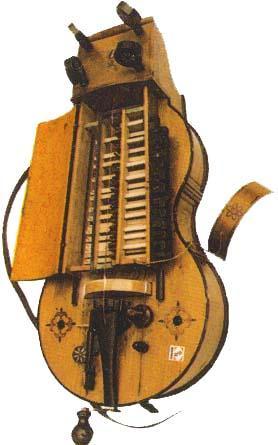
A tekerőlant (vagy: nyenyere) régi európai hangszer, már a X. századtól ismeretes organistrum néven. Magyarországon a XVI.századtól kezdve említik, amikor már Nyugat-Európában kezdett kikopni a “komoly” hangszerek közül. Egyre inkább a kóbor zenészek, koldusok és parasztok hangszerévé vált. A XVIII. században francia előkelő körökben a dudával együtt ismét divatba jött. Talán ennek köszönthető, hogy épp egy belga tekerős kezében láttam először ezt a furcsa vonós hangszert, amelynek húrjait egy forgó fakorong szólaltatja meg, s a dallamhúrt sem kézzel hanem fabbillentyűk közvetítésével lehet lefogni. Ez a belga művész adta meg nekem az utolsó magyar tekerőkészítő címét, aki azután nem csupán a hangszert készítette el, hanem a játékra is megtanított. Bársony Mihály, a népművészet mestere, a Szentes és Csongrád környéki (Dél-Alföld) tanyák egyikén lakott, ahol ez a régi hangszer kiegészülve az utolsó időkig a táncmulatság egyetlen hangszere volt.
HURDY-GURDY
The hurdy-gurdy (in Hungarian also called the nyenyere) is an old European instrument known from the 10th century onwards by the name of organistrum. In Hungary the earliest references to it are in the 16th century, at the time when in Western Europe it was already starting to lose ground as a “serious” instrument of itinerant musicians, beggars and peasants. In the 18th century the hurdy-gurdy, together with the bagpipe, came back into fashion in distinguished French circles. It is perhaps a lingering relic of those 18th century French fashions that it was in the hands of a Belgian hurdy-gurdist where I first saw this strange instrument whose strings are sounded by a rotating wooden disk, and the melodic string is depressed not by hand but by wooden keys. This Belgian artist gave me the addresss of the last Hungarian hurdy-gurdy maker. This was Mihály Bársony, holder of the Master Of Folk Art award, living in one of the homesteads in the vicinity of Szentes and Csongrád (southern Hungarian Plain), a region where this ancient instrument still survived as a form of folk tradition, and, together with the clarinet, served as the only instrument at dances. Mihály Bársony not only made an instrument for me, he taught me to play it as well.
By Sebő Ferenc
|
|
|
 .
Hosting, security, and maintenance for Hungarian cultural, educational, and scholarly projects — free to the organizations, funded by readers like you.
Support this work →
.
Hosting, security, and maintenance for Hungarian cultural, educational, and scholarly projects — free to the organizations, funded by readers like you.
Support this work →






 Mondák
 Vicc
Vicc Költő / Író
 Népdal