




Lipták Béla saját írása, megjelent a Wall Street Journal “Europe” rovatában, 1985. október 9-én.
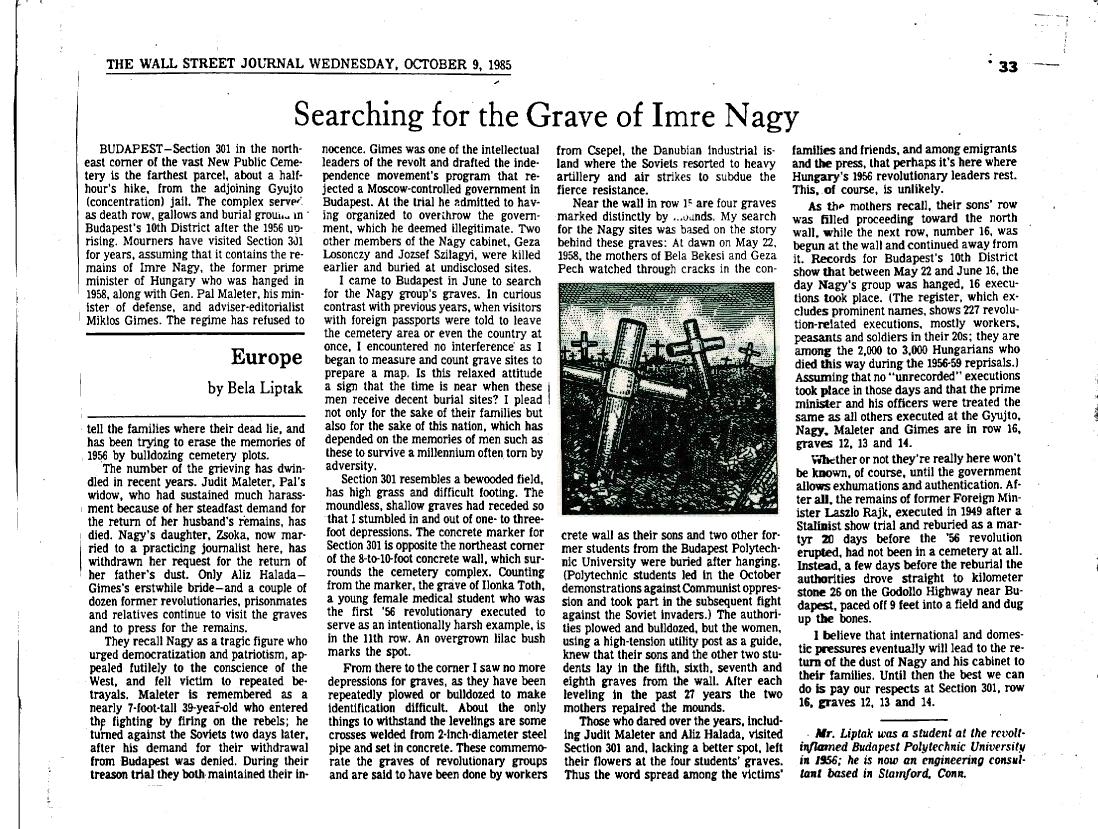
Searching for the Grave of Imre Nagy
By Bela Liptak
BUDAPEST — Section 301 in the vast New Public Cemetery is the farthest parcel, about a half-hour’s hike, from the adjoining Gyujto (concentration) jail. The complex served as death row, gallows and burial ground in Budapest’s 10th District after the 1956 uprising. Mourners have visited Section 301 for years, assuming that it contains the remains of Imre Nagy, the former prime minister of Hungary who was hanged in 1958, along with Gen. Pal Maleter, his minister of defense, and adviser-editorialist Miklos Gimes. The regime has refused to tell the families where their dead lie, and has been trying to erase the memories of 1956 by bulldozing cemetery plots.
The number of the grieving has dwindled in recent years. Judit Maleter, Pal’s widow, who sustained much harassment because of her steadfast demand for the return of her husband’s remains, has died. Nagy’s daughter, Zsoka, now married to a practicing journalist here, withdrew her request for the return of her father’s dust. Only Aliz Halada-Gimes’s erstwhile bride — and a couple of dozen former revolutionaries, prisoners and relatives — continue to visit the graves and to press for the remains.
They recall Nagy as a tragic figure who urged democratization and patriotism, appealed futilely to the conscience of the West, and fell victim to repeated betrayals. Maleter was remembered as a nearly 7-foot-tall 39-year-old who entered the fighting by firing on the rebels; he turned against the Soviets two days later, after his demand for their withdrawal from Budapest was denied. During their treason trial they both maintained their innocence. Gimes was one of the intellectual leaders of the revolt and drafted the independence movement’s program that rejected a Moscow-controlled government in Budapest. At the trial he admitted to having organized an effort to overthrow the government, which he deemed illegitimate. Two other members of the Nagy cabinet, Geza Losonczy and Jozsef Szilagyi, were killed earlier and buried at undisclosed sites.
I came to Budapest in June to search for the Nagy group’s graves. In curious contrast with previous years, when visitors with foreign passports were told to leave the cemetery area or even the country at once, I encountered no interference as I began to measure and count grave sites to prepare a map. Is this relaxed attitude a sign that the time is near when these men receive decent burial sites? I pled not only for the sake of their families but also for the sake of this nation, which has been trying to erase the memories of men such as these who depended on the memories of a millennium often torn by adversity.
Section 301 resembles a bewooded field, has high grass and difficult footing. The moundless, shallow graves had receded so that I stumbled in and out of one- to three-foot depressions. The concrete marker for Section 301 is opposite the northeast corner of the 8-to-10-foot concrete wall, which surrounds the cemetery complex. Counting from the marker, the grave of Ilonka Toth, a young female medical student who died after hanging, was the first ’56 revolutionary executed to serve as an intentionally harsh example, in the 11th row. An overgrown lilac bush marks the spot.
From there to the corner I saw no more depressions for graves, as they have been repeatedly plowed or bulldozed to make identification difficult. About the only things to withstand the levelings are some crosses welded from 2-inch-diameter steel pipe and set in concrete. These commemorate the graves of revolutionary groups and are said to have been done by workers from Csepel, the Danubian industrial island where the Soviets resorted to heavy artillery and air strikes to subdue the fierce resistance.
Near the wall in row 15 are four graves marked distinctly by mounds. My search for the Nagy sites was based on the story behind these graves: At dawn on May 22, 1958, the mothers of Bela Bekesi and Geza Pech watched through cracks in the concrete wall as their sons and two other former students from the Budapest Polytechnic University were buried after hanging. (Polytechnic students led the October demonstrations against Communist oppression and took part in the subsequent fight against the Soviet invaders.) The authorities plowed and bulldozed, but the women, using a high-tension utility post as a guide, knew that their sons and the other two students lay in the fifth, sixth, seventh and eighth graves from the wall. After each leveling in the past 27 years the two mothers repaired the mounds.
Those who dared over the years, including Judit Maleter and Aliz Halada, visited Section 301 and, lacking a better spot, left their flowers at the four students’ graves. Thus the word spread among the victims’ families and friends, and among emigrants and the press, that perhaps it’s here where Hungary’s 1956 revolutionary leaders rest. This, of course, is unlikely.
As the mothers recall, their sons’ row was filled proceeding toward the north wall, while the next row, number 16, was begun at the wall and continued away from it. Records for Budapest’s 10th District show that between May 22 and June 16, the day Nagy’s group was hanged, 16 executions took place. (The register, which excludes prominent names, shows 227 revolution-related executions, mostly workers, peasants and soldiers in their 20s; they are among the 2,000 to 3,000 Hungarians who died this way during the 1956-59 reprisals.) Assuming that no “unrecorded” executions took place in those days and that the prime minister and his officers were treated the same as all others executed at the wall, Nagy, Maleter and Gimes are in row 16, graves 12, 13 and 14.
Whether or not they’re really here won’t be known, of course, until the government allows exhumations and authentication. After all, the remains of former Foreign Minister Laszlo Rajk, executed in 1949 after a Stalinist show trial and reburied as a martyr 20 days before the ’56 revolution erupted, had not been in a cemetery at all. Instead, a few days before the reburial the authorities drove straight to kilometer stone 26 on the Godollo Highway near Budapest, paced off 9 feet into a field and dug up the bones.
I believe that international and domestic pressures eventually will lead to the return of the dust of Nagy and his cabinet to their families. Until then the best we can do is pay our respects at Section 301, row 16, graves 12, 13 and 14.
Mr. Liptak was a student at the revolt-inflamed Budapest Polytechnic University in 1956; he is now an engineering consultant based in Stamford, Conn.
Forrás: The Wall Street Journal, 1985. október 9.
 Mondák
 Vicc
Vicc Költő / Író
 Népdal