








For a thousand years, Hungary occupied an oval shaped central plane surrounded by the protective bulwark of the Carpathian mountains. Like the crust on a loaf of bread, the mountains encased the lowlands in a majestic arch from which all waterways converge toward the center. This perfect geographic unity was matched by complete self-sufficiency, until this harmonious symbiosis of the great central plain and its surrounding mountains was destroyed in Trianon.
For a millennium, Hungary was the eastern bastion of European civilization, a balancing and stabilizing power between Slavic and Germanic nations. Hungary's first king, Saint Stephen, wrote to his son, Saint Emeric, in 1036: Make the strangers welcome in this land, let them keep their languages and customs, for weak and fragile is the realm which is based on a single language or on a single set of customs (unius linguae uniusque moris regnum imbecille et fragile est.) Stephen's advice was respected and obeyed during the coming centuries: Hungary gave asylum to the Ruthenians in the north, the Wallachians (Romanians) and Saxons in the east, the Swabians and Serbs in the south. Eventually the kingdom contained 14 national minorities, of which the Magyars were only one, and in order not to hurt the feelings of any, Latin remained the sole official language of the kingdom until 1844.
Hungary became a constitutional monarchy in 1222; her Golden Bull is junior by only 5 years to the English Magna Carta. This constitutional monarchy was almost completely annihilated by the Mongol invasion of 1240-41, but through that enormous struggle it succeeded in protecting Europe and her civilization. Toward the end of the XVth century, during the realm of the renaissance king Matthias Corvinus, Hungary's population reached that of England, the court in Buda became a cultural centers of Europe, and the library of Buda was Europe's finest. In 1526 Hungary was once again annihilated, this time by the Turkish invasion, which cut her population in half and the kingdom in three. During the 150 years of Ottoman occupation, the west was taken by Austria, the center by the Ottoman invaders and Hungarian culture survived only in the east, in Transylvania.
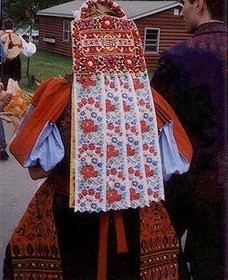
Even today, Transylvania is the land where the purest Hungarian is spoken, where Hungarian popular art has found its most exalted, most perfect expression, and where Béla Bartók collected his Hungarian folk tunes. Transylvania is also the place where the Hungarian diet at Torda, in 1557, declared the freedom of religion for the first time anywhere in the world. Transylvania provided an atmosphere of religious and ethnic toler ance and as such became the birthplace of the Unitarian and Sabbatarian religions.
After the Turkish occupation, Austria attempted to take over all of Hungary. This resulted in a series of uprisings. The fight for Hungarian independence of 1703-1711 was led by Francis II Rákóczy whose insurgent fighters were mostly Slovak and Ruthenian peasants. They proudly declared themselves to be Hungarians, as distinct from the racial term Magyar. The next fight for national independence was led by Louis Kossuth in 1848, and the Ruthenian and Slovak nationalities once more contributed masses of recruits for the Hungarian revolutionary army, which, while defeated by the combined forces of Austria and Russia, forced the Hapsburgs to accept in 1867 the formation of an Austro-Hungarian duality. It was Kossuth who later proposed to convert the Austro-Hungarian empire (of 24 million Slavs, 12 million Germans and 12 million Hungarians at the time) into a Danubian Confederation. Kossuth was also the second foreigner ever invited to address the United States Congress in January, 1852.
 Mondák
 Vicc
 Költő / Író
 Népdal
