











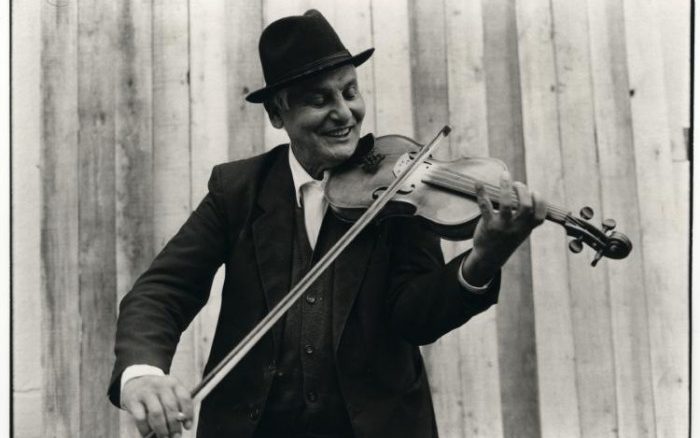
April 2, 1922 – October 20, 2004
In Memoriam
By Jim Cockell
Sándor “Neti” Fodor passed away on October 20, 2004. Neti was our last link to a bygone generation of great Gypsy violinists from Kalotaszeg — Ferenc “Csipás” Varga, Ferenc “Árus” Antal, Miklós “Hitler” Nónika, Simon “Buráló” Kovács, and so on. There may never be a consensus on who the greatest fiddler of this generation was, but everyone who knew and played with Sanyi bácsi found his charm and virtuosity irresistible.
Sanyi bácsi was a joyful, exuberant performer and personality. The sheer act of making music, and of being with other musicians, transported him to a state of pure glee, something borne out time and again in photos and video footage. In the glow of such images, it is all too easy to forget how the twin nemeses of poverty and persecution endlessly hounded him and his family. The fall of the Romanian police state in December 1989 brought scant relief; Sanyi bácsi may have been the most celebrated prímás alive, but fame gave little shelter from the harsh realities of everyday life for Transylvanian Gypsies, and those who found him a trifle sharp in his business dealings perhaps did not fully understand this. The most triumphant — and instructive — part of his legacy is that the grim undercurrent of desperation in today’s Transylvania never conquered his drive to make music and to bring joy to others.
More so than many of his counterpart musicians in other Transylvanian villages, Sanyi bácsi quickly grasped the importance of the Hungarian táncház movement and became one of its fountainheads. At a time of life which we would normally regard as retirement, he threw himself with boundless energy into the new roles of Recording Artist, International Traveller and Master Clinician. He particularly enjoyed teaching and took great delight in the young musicians who came each summer to Kalotaszentkirály, from as far away as South America, to learn from him. The year that I attended (2003) saw a definite preponderance of attractive young women in the class, and I will never forget the impish grin Neti gave me when I asked him how he enjoyed the job.
Sányi bácsi had a passing acquaintance with the world of Classical music as well, and not just because he was one of the very few Transylvanian musicians ever to set foot on the stage of a North American concert hall. He was fascinated with the processes of musical invention and adaptation, to the extent that he “composed” legényes melodies, motivically inspired by the works of Bach and other concert violin music. That he neither wrote nor read music was no impediment to his creativity. A few purists decried this introduction of foreign elements into traditional dance music, perhaps forgetting that Transylvanian music has been replete with such influences for as long as it has been documented.
The Classical world occasionally paid Neti a visit, too. He spoke fondly to me of one instance when a certain concert violinist — English or American? It didn’t matter — sought him out in his home town, so that they might “play jazz together.” The name, alas, had slipped Sanyi bácsi’s memory: Huhu néni? Dudu nini? Upon further questioning, the identity of the mystery guest turned out to be Sir Yehudi Menuhin.
The ripple effect of Neti’s passing will be profound and lasting. In person and through recordings, he has touched the life of practically every musician who has taken part in the táncház movement. He set the high watermark for all táncház musicians, not just for mere technical brilliance, but for the passionate love of playing and of bringing joy to an otherwise drab and difficult environment. That is something that the rest of us, regardless of ability, may aspire to.
In His Own Words
An interview with Sándor Fodor by László Kelemen (translated by Peter Laki)
Sándor Fodor or “Neti,” as he is known, is the great old man of folk music in the Kalotaszeg region. At 78, he is still active as a performer, teacher, and a frequent guest at folk-music camps and workshops. His playing can be heard on three CDs and countless field recordings. His repertoire is seemingly inexhaustible: every time I see him, he surprises me with a tune I have never heard before. He is a small, stocky man; his eyes are full of life and his mien extremely expressive. When I first saw him play, I noticed that he was making music with his face, with his body, with his whole being. When I first met him I was a student and I used to go to Kalotaszeg to collect music. During the breaks of the recordings I picked up the viola and we played together. Later he invited me to do weddings with him; I accepted, as this allowed me to learn the living Kalotaszeg music from the inside. We stayed in touch even after I moved from Transylvania to Hungary. We regularly invite him on tours and recordings with the Ökrös Ensemble. During the long years of our acquaintance I heard him tell many interesting stories about old Kalotaszeg, about musicians and his own life full of struggles and adventures. I wrote as he spoke:
“I was born in Gyalu (Gilău), Kalotaszeg, but I didn’t stay there very long, for my parents got divorced and we moved to Szucsák (Suceag). I have moved around in Kalotaszeg all my life. I even lived in Hungary for a while, near Székesfehérvár, when we had to flee during the war. We were very poor. I had to work. At twelve, I already played first fiddle at weddings. My father was also a musician but he didn’t care about us. I was named after my mother, who was named Neti. My uncle introduced me to Feri Csipás, the Left-Handed, who taught me, along with his own son. He was the best-known musician in the whole area; he played in the hotel restaurant at Bánffyhunyad (Huedin). He got the most recent sheet music from Budapest every month, and even played in a movie (The Madonna of Kalotaszeg). He was very strict and demanding. But the toughest lessons were the weddings where he took us with him: we had to sit on the musicians’ bench and watch the music. Then after we got home we had to play what we remembered. I was scolded very often, I’ll never forget: ‘Sanyi, you’ll never make a first fiddler’ — I did, anyway! I remember waking up in the morning under the musicians’ bench: we were full of dust from all the dancing, so that we couldn’t even open our eyes until we washed them. Well, that was my education, but it was a good one because I still live by it. My son’s fate was different: he went to a music school. We bought him all the instruments. He can play on these new-fangled instruments that I’ll never learn, but these days he often accompanies me on the organ, because the world has changed. This year I haven’t played a single wedding with viola accompaniment, only electric ones.
When I met you guys, I was surprised: why would these young folks, my son’s age, want to learn to play the old Kalotaszeg music on the old instruments? Why don’t they just go after their own music, why don’t they play the guitar, the drums, the organ, like the rest of the young people? Then I understood and now I’m glad to be able to pass along what I have in my head and my hands, as I learned it from Csipás and the other musicians of the old days. A lot of people come to my house — young people — I welcome everyone and no one has ever left me without a song for the road. Under Ceauşescu it was forbidden to put up foreigners; what’s more, I live right across the street from the police station. Even in those days, I had guests, so security came to tell me I’d be punished because I’d had foreigners stay at my house. I told him, this isn’t right that you can’t receive guests in your own house. One word followed another. I offered him a glass of brandy, I played some music, and at the end he said: ‘Uncle Sanyi, you put up who you want, just let us know so we can look the other way’ — and left. I was never pestered again, even though I had many visitors, even Japanese and Americans. Then Ceauşescu was finished, and now I can travel, too. I often go to Kolozsvár (Cluj) to the táncház (‘dance house’), to help out. I love to play for the young people, because they’re looking for the old things; I like to teach them so that this music may be preserved. I go to Hungary every year to teach at camps, or just to play. I’ll go for as long as I have the strength. It’s hard because I’m old and it hurts everywhere, but I’ve hardly ever been sick in my life, even though I’ve been smoking since I was a kid, and I eat and drink what I want. Other people have all these grains and mueslis for breakfast to stay healthy, but I start the day with a good shot of brandy, coffee, and a cigarette.
When I was young, I travelled on foot a lot. There were no taxis (in Kalotaszeg people called a car a taxi). The train was expensive, often I walked home three villages away after two or three days of exhausting playing.”
Uncle Sanyi, you’ve lived through a lot: war, Communism, capitalism. What do you think: has the world changed?
“Well, a lot has changed and nothing. When I was a kid, we were very poor. People had no money, so they gave you produce for playing: wheat, potatoes, or they would give you labor. Today’s young people have everything, yet they don’t always appreciate it. Nor do they always appreciate us musicians! Today, it’s this disco stuff everywhere: easy music, easy dancing, they turn on the tape recorder, they turn off the lights, nobody cares how they dance. Sometimes I come with ‘pig’ bands that I feel ashamed of: saxophone, drums, and organ. The older people pull away, they say: ‘Sanyi, Sanyi, what kind of band did you bring?’ But what am I supposed to do if that’s what the young people want? That’s how the world has changed.
Yet music is power even now, but only if you serve people. You have to cater to people, do as they wish. They valued me for my music, and they still do. But I keep learning even to this day. I learned a lot of songs from you guys. I don’t need much time — I hear it once or twice and I know it already. I teach a lot, too, because the more people know your music, the more people will talk about you. Poor Csipás has been dead for ten years, but people still know him through his music. Or Kömös of Tura is still known for his songs, even though he was a lead fiddler in the past century. If I have a chance to go into the world, I have to bring the songs of these long-gone musicians as well. I have to show Buráló’s legényes, Csipás’s csárdás or Nónika’s virtita. They are always with me, they guide my hand and hold my bow when I play. And maybe you guys, too, will say some day: ‘This is Neti’s legényes or csárdás.'”
Press & Performances
Csárdás! — BAM Opera House, New York City, Feb. 20 & 21, 1998
Part of “Masters of Folk Music from Hungary” at the Brooklyn Academy of Music, featuring Neti (folk violin) and Kálmán Balogh (cimbalom) with the Ökrös Folk Ensemble of Hungary, conducted by Robert Spano, alongside orchestral works by Brahms, Ligeti, Bartók and Kodály exploring the Gypsy and Hungarian folk roots of concert music.
Ökrös Folk Music Ensemble with Sándor Fodor “Neti” — North American tour
At age 77, Sándor Fodor “Neti” was billed as the last great violinist of the Kalotaszeg region of Transylvania, touring with Kálmán Balogh (cimbalom) and Ági Szalóki (vocals) alongside the Ökrös Folk Music Ensemble of Budapest. “There is a special relationship between Sándor Fodor ‘Neti’ and the Ökrös Ensemble. They have played at village weddings together, they have toured Western Europe and North America together and they have performed on many recordings… The members of Ökrös Ensemble are proud to consider themselves to be his disciples.”
Review — The Washington Post, September 1999
By Pamela Sommers
“Monday night at Paint Branch Unitarian Church in Adelphi, a packed house of folkies, nostalgic Hungarians and assorted lovers of world music were transported to a landscape of shepherds, Gypsies and three-day wedding celebrations by the stellar Okros Ensemble. Among Hungary’s most soulful and virtuosic folk revival bands, this chamber-size group of string players — two violins, three violas, bass and cimbalom, with legendary Transylvanian violinist Sandor Fodor (known as Neti) and ethereal vocalist Agi Szaloki — tore through a program of csardas, laments, rhapsodies and story-songs so sonorous and emotionally wrenching that one could barely keep one’s hands from clapping or one’s eyes from misting over.
Certainly the 77-year-old Neti, an impish fellow who can play fiendishly quick figures over and over for minutes at a time without missing a note, lent authenticity and spark to the proceedings…”
© 1999 The Washington Post Company. Not-for-profit educational use only.
 Mondák
 Vicc
 Költő / Író
 Népdal
