



By Géza Jeszenszky — “Hungary” Nation Profile and U.S. relations overview.
Nation Profile
- Alternate Names: Republic of Hungary
- Area: 93,030 sq km
- Capital: Budapest
- Population: 10,045,407 (July 2003 est.)
- Population Growth Rate: -0.29% (2003 est.)
- Government Type: Parliamentary democracy
- Date Founded: 1001 (unification by King Stephen I)
- Suffrage: 18 years of age; universal
- Literacy Rates (male & female): Male: 99.5%, female: 99.3% (2003 est.)
- Life Expectancy at Birth (male & female): Male: 67.84 years, female: 76.81 years (2003 est.)
- Religions (as %age of population): Roman Catholic 67.5%, Calvinist 20%, Lutheran 5%, atheist and other 7.5%
- Major Languages: Hungarian 98.2%, other 1.8%
- Internet Users (as %age of population): 12% (2001)
Hungary – U.S. Relations (key figures, early 2000s)
- GDP (real growth rate): 3.3% (2002 est.)
- Immigration to the U.S.: 1,284 (2002)
- Students in the U.S.: 1,200 (2002/3)
- Tourist Visits to the U.S.: 31,984 (2003)
- Major Trading Partners: Export: Germany 34.3%, Austria 8.5%, Italy 5.5%, France 5.4%, US 4.9% (2002)
- Membership in Major Alliances: NATO, OAS (observer), EU
Introduction
Hungary is among the oldest states of Europe and is one of the newest allies of the United States. The Hungarians (Magyars in their own language), linguistically a Finno-Ugrian people from the Euro-Asian steppe region, with a highly developed nomadic culture, moved into the Carpathian Basin, to the very center of Europe, at the end of the 9th century. Their first king Stephen (crowned in 1000 AD and canonized in 1083) adopted Christianity and created a strong state. Having fought German, Mongol, Ottoman Turk and Russian invaders and resisting the attempts of the Habsburg dynasty to absorb the country into their Empire, Hungary was on the losing side in World War I and lost two thirds of the territory of the historic kingdom in the Peace Treaty of Trianon (1920). Called "the unwilling satellite" of Nazi Germany, it was occupied by Hitler's army in March 1944, to be liberated and made a Soviet satellite by Stalin's Red Army. The national uprising of October 1956 was brutally crushed by the Soviet Union, but 33 years later Hungary played a leading role in the largely peaceful demolishing of the Communist system in Europe and the dissolution of the Warsaw Pact (1991). Together with Poland and the Czech Republic, Hungary became a member of the Atlantic Alliance in 1999 and was one of 10 countries that joined the European Union on 1 May 2004.
The United States often stood by Hungary in its many vicissitudes. It was ready to recognize its independence vis-à-vis the Habsburgs in 1849 before the Russian intervention crushed the Hungarian Army. Although on opposing sides in two world wars, Americans understood the predicaments that led Hungary to that unfortunate position and tried to draw more fair borders for Hungarians in both post-war peace treaties. The heroism of the Hungarians in 1956 galvanized the American people and many were ready to fight for the freedom of Hungary. The crucial role played by the United States in ending the Cold War is recognized and much appreciated in Hungary, and also the subsequent help to build a viable democracy, with a prosperous economy.
On the other hand the Hungarian contribution to the achievements of the United States is significant. Hundreds of Hungarians participated in the Civil War against the secessionists, followed by hundreds of thousands who helped making America prosperous in the mines, in the steel-mills and on the prairies. Hungarian scientists, escaping from tyranny, contributed to the great technological advances in building formidable weapons, making jets and rockets, inventing and improving the computer, and making discoveries recognized by ten Nobel Prizes. The history of the American film industry would be much poorer and musical life less rich without the Hungarian-Americans. Finally the old dream of Kossuth and so many other Hungarian leaders and ordinary citizens has come true: the two nations are facing the many challenges of the 21st century as friends and allies.
History of Relations with the United States
Until World War I
The ties between the United States and Hungary are as old as the Republic itself. Throughout the 18th century Hungarians were unhappy under Habsburg dominance, hence they were inspired by the example of the thirteen British colonies' successful fight for independence. An experienced Hungarian cavalry officer, Col. Michael Kovats, volunteered to join the Continental Army and together with his Polish friend, Pulaski, organized the first American cavalry unit. He was killed in action in what became a victorious battle at Charleston on 11 May 1779, his statue stands in front of the Embassy of Hungary in Washington DC.
The Republic in "the New World" has been seen by most Hungarians as a model. A Hungarian contemporary of de Tocqueville, Sándor Bölöni Farkas, wrote an account of his "Journey to North America," (published in 1834), which presented such a contrast with conditions at home that the authorities banned it. The book inspired generations of Hungarians to dedicate themselves to the values and practices that made the U.S. successful. During the Hungarian War of Independence against the Habsburgs (1848/49) Americans reciprocated the sympathy, and were on the point of recognizing Hungary when it was crushed by the intervention of the Russian Czar. Congress invited the leader of that struggle, Lajos (Louis) Kossuth (1802-1894), to the States and sent a warship for him to release him from his exile in Turkey. In a six-month tour of the country Kossuth, in about six hundred speeches, tried to convince his audiences, including both Houses of Congress, that the time had come for the U.S. to take an active role in international affairs, commensurate with its growing strength, to realize the interdependence of Europe and the U.S. and that freedom and democracy in Europe was also a vital interest for the American Republic, and, finally, that the two English-speaking countries must be allied so that they could jointly prevent tyrannical, authoritarian countries like Russia from suppressing the striving of subject nations for freedom.
Hungary achieved internal independence, a kind of Home Rule in 1867, and the Habsburg Empire was transformed into the Austro-Hungarian Monarchy. It was allied to Germany and the U.S. declaration of war on that country (April 1917) was followed by a similar one against the Monarchy in December. In his Fourteen Points (January 1918) President Wilson advocated "autonomous development" for all the eleven national groups of Austria-Hungary, but eventually endorsed the program of breaking it up in order to create a number of independent states in Central Europe. At the Paris Peace Conference (1919-20) the victors assigned 3.5 million Hungarians, a third of the nation, and two-thirds of the territory of the historic kingdom, to the newly-created or enlarged states of Czechoslovakia, Yugoslavia and Romania, in defiance of the Wilsonian principle of "national self-determination." The American representatives to the conference proposed a more fair delimitation of the borders, and the U.S. did not sign the peace treaties, but accepted the new borders, and in 1921 concluded a separate peace treaty with Hungary.
From Bolshevism to Communism
After a brief experiment with radical democracy leading to 133 days of Bolshevik-type dictatorship, Hungary became a Kingdom without a king and the last commander of the Austro-Hungarian Navy, Admiral Horthy (1868-1957) was elected Regent (1920). In the inter-war period all Hungarian governments strove at the peaceful revision of the borders. Between 1938 and 1941 some of the lost territories and most of the detached Hungarian populations were restored to Hungary with the help of Germany and Italy. That (and the still unexplained bombing of Kassa, a town in Hungary) made Hungary an ally of Hitler in the war against the Soviet Union, but the majority of the political elite remained "Anglophile," equally fearing and detesting Nazism and Communism. Following Pearl Harbor Hitler ordered Hungary to proclaim that "a state of war" existed with the United States, but Washington did not take note of an act made under duress and declared war on Hungary only in July 1942. Hungarian forces fought only on the Russian front, while Polish soldiers and civilian refugees, as well as allied POWs escaping from German captivity, were treated with great sympathy. As early as 1943 various Hungarian emissaries contacted the Office of Strategic Services (OSS) offering surrender as soon as allied forces reached the country. The parliamentary system, with opposition parties and a free press, was retained, and the almost one million strong Jewish population was not given up to the Nazis. In March 1944, however, Germany invaded and occupied its "unwilling satellite" (a term coined by F.G. Montgomery, the U.S. envoy to Hungary from 1933 to 1941) in order to prevent its planned defection from the fateful alliance. Regent Horthy, who thought that by staying in office he could mitigate the impact of the occupation, was compelled to appoint a Quisling-type government which was ready to meet all German demands. Supervised by the Nazi "expert" of the "final solution," Adolf Eichmann, half a million Hungarian Jews were collected and sent off to labor camps in Germany, which turned out to be gas chambers. Learning of the fate of the transported ones the Regent stopped the deportations and thus the majority of the Jewish population of Budapest escaped. With the campaign in Italy bogged down, the Anglo-American armies never reached Hungary, and the Soviet Red Army entered the country in September 1944. Following a failed attempt by Horthy to conclude an armistice and leave the war, the Hungarian Nazi rabble took over the government on 15 October. The Soviets chased out the Nazis and their Hungarian accomplices in bloody battles lasting until April 1945. The country now lay devastated and in ruins, all the bridges on the Danube blown up by the retreating Germans. Hungarians pinned all their hopes on the United States, on the principles of the Atlantic Charter and on the high-sounding phrases of the Yalta Declaration on Liberated Europe.
The first and only free elections in Soviet-occupied Europe took place in Hungary in November 1945, and the Communists barely managed to get 17 per cent of the vote. The coalition government headed by Ferenc Nagy, a brilliant peasant leader, hoped to create a viable democracy and expected support from the Western democracies. There was sympathy but real power rested with the Soviet occupation authorities. The U.S. and British representatives in the Allied Control Commission headed by Soviet Marshal Vorosilov were not in a position to prevent the Communists from gradually taking over power. The Peace Treaty signed in March 1947 in Paris restored the pre-war borders of Hungary. American proposals to modify them in favor of Hungary and to be more in line with ethnic realities, were brushed aside by Stalin. Soviet troops remained in the country and a new Left-leaning government was ordered to turn down the American offer of aid through the Marshall Plan. By 1948 Hungary became a communist dictatorship run by Mátyás Rákosi, a brutal and rigid servant of Stalin. Political parties were banned, their leaders exiled, the press muzzled, and tens of thousands imprisoned, interned or executed – on trumped up charges. Dignitaries of the various churches were also jailed. All properties were nationalized (without compensation), the peasants forced into Soviet-type collective farms, and insane economic policies introduced. American and British protests were of no avail, and the Iron Curtain sealed off Hungary from the Western world. The only way to gain real information was by listening to the (heavily jammed) broadcasts of the western radios, particularly Radio Free Europe, which started its services in 1951. The message, especially after the election of Dwight Eisenhower as President, was that there will be a "rollback" of Soviet power and liberation would come.
From “the Little October Revolution” to Democracy and NATO
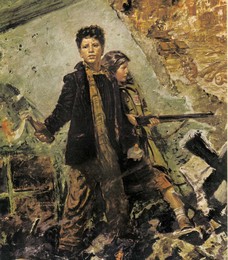
After the death of Stalin (1953) the dictatorship was eased, and following the revelations about his and the Hungarian Stalinists' crimes demands for political and economic changes became loud in Budapest. On 23 October 1956 a large, peaceful demonstration by students and workers demanding reforms was answered by the dreaded secret police firing into the crowd. Army units sent to quell the unrest joined the demonstrators, and then the government asked the Soviet troops stationed in the country to intervene. Following days of street fighting and having suffered heavy losses by the Hungarian insurgents (mainly young students and workers), the new Prime Minister, Imre Nagy (1896-1958), remembered as a milder and well-meaning Communist, negotiated the withdrawal of the Soviet units from Budapest and announced a return to the multi-party system. The Hungarian people expected the free world, led by the United States, and the United Nations Organization, to help the consolidation of democracy, in accordance with the will of the people and the promises of the western leaders.
The response on the popular level was immense, but disappointing on the level of governments. The U.S. did not want to risk a world war fought with nuclear weapons, and President Eisenhower sent a message to Moscow assuring the Soviet leaders that the U.S. did not expect Hungary and Poland (another communist country in turmoil) to become allies in NATO. It was naïve to believe that this would calm the Soviet Union and Hungary would be allowed to become a free and neutral country. With the Israeli-British-French attack on Egypt on 29 October, attention shifted to the Middle East and the Soviets decided to crush the revolt of Hungary. The attack, using fresh troops and heavy weapons, came on 4 November 1956, and after heavy fighting and thousands lying dead in the streets Hungary was again reduced to servitude. The U.S. and all the democratic countries denounced the Soviet aggression, the United Nations called on the Soviet Union to withdraw its forces and allow an investigation, but all this was of no avail. Now the whole world could see what the true nature of Soviet Communism was. Tens of thousands of credulous western Communists left their party in disappointment. Time newsmagazine decided that Man of the Year 1956 was the Hungarian freedom fighter. In Hungary brutal repression set in: about three hundred people, including Nagy and his close associates, were tried and executed, others received long prison terms. The new Soviet puppet, János Kádár, was despised by his people as well as by the western world.
Relations between Hungary and the Western democracies remained very cool, and the U.S. kept only a Chargé d'Affairs in Budapest. In 1963 a tacit agreement was reached between the two countries that political prisoners sentenced in connection with the 1956 uprising would be given an amnesty, and, in exchange, the U.S. would allow "the question of Hungary" to be removed from the agenda of the U.N., while the mandate of the Hungarian delegation would be recognized. In 1967, as part of détente and as a reward for the easing of the political atmosphere, diplomatic relations between the United States and Hungary were raised to the Ambassadorial level. In 1968 Hungary introduced reforms in the management of the economy, allowing some private initiative. With a modest rise in the standard of living Hungary became known as "the happiest barrack in the Communist bloc."
The Holy Crown of Hungary, a symbol of thousand years of history, had fallen in American hands in 1945 and was kept at Fort Knox. In 1977 President Carter felt that the time came to return it to the Hungarian people. A delegation of prominent Hungarian Americans, headed by the Secretary of State, Cyrus Vance, delivered it in January 1978. For many months people stood in line for hours to be able to see the Crown and the coronation regalia displayed in the National Museum. In the next decade, inspired by memories of a better past, and making good use of clauses of the Helsinki Final Act guaranteeing human rights, the demand for political changes grew. In order to break economic stagnation the Hungarian government – with Soviet approval – joined the IMF and the World Bank. The seeds sown by President Reagan in the minds of the "captive nations" – calling the Soviet Union what it really was, an evil Empire, and demanding the removal of the Berlin Wall – brought a great harvest in 1989. The Polish opposition successfully negotiated a semi-free election where the Solidarity movement won an astounding victory. In Hungary the roundtable discussions in the summer of 1989 ended in winding down the whole Communist system. The June visit of President Bush to Warsaw and Budapest gave a boost for the non-communist, formerly silent, majority. On 19 August hundreds of East Germans managed to break through the Iron Curtain on the Austrian-Hungarian border, and on 11 September Hungary announced that it would allow East German citizens to travel to Austria. With that there was no longer any sense in keeping the Berlin Wall closed, and it was opened on 8 November, only to be literally torn to pieces. Soon all the communist dominoes fell. Hungary was rightly held responsible for pushing them and thus for this happy ending of the Cold War.
The first free elections in the former Communist Bloc were won in April 1990 by the center-right Hungarian Democratic Forum. Its leader, József Antall (1932-1993), a long-standing friend of the United States, became Prime Minister, and his government led the transition from dictatorship to democracy and market economy. In October 1990 he was invited for a state visit to the United States. The U.S. became one of the major investors in the new Hungary. In less than a decade more than eight billion dollars were spent on buying or founding companies. General Electric, General Motors, Ford, IBM, U.S. West, Alcoa, Ameritech and other big names in American business set themselves up in the country. Hungary initiated close cooperation with Poland and Czechoslovakia, and this "Visegrád Group" successfully negotiated the withdrawal of Soviet troops from their territory, opening the gate for the dissolution of that alliance of the unwilling, the Warsaw Pact (1 July 1991). These very three countries announced their request to join NATO in their summit in May 1992, and their efforts came to fruition when they were invited to accede to the Washington Treaty in July 1997. With the U.S. Senate ratifying their accession they became allies of the United States on March 12, 1999.
By then Hungary proved its strategic importance for NATO with its conduct in the Balkan Wars and offering its air base at Taszár for the various efforts to restore peace in that unhappy peninsula. That role was reinforced during the air campaign to save the Albanians of Kosovo from "ethnic cleansing" in the spring of 1999.
A Key Ally
Despite the vast difference between the United States and Hungary in size, population and GDP, Hungary can be seen as a key U.S. ally in the heart of Central Europe. The strategic location of the country is significant as several European commercial thoroughfares, including the Danube, cross here, where also the major linguistic groups and religions meet. As one of the successful models for the transition from dictatorship to democracy, and from the command economy to a flourishing market economy, Hungary can play a pivotal role in turning Central Europe, once a region of tensions, into a region of stability, security and prosperity, committed to the maintenance of the ties that bind Europe and America together.
Perspectives on the United States
Traditionally Hungarians admired the United States as a model for enlightened government, for the spreading of civilization to "the Wild West" and beyond, winning two world wars, becoming a leader in science and technology, providing prosperity to such a large section of its population, also for its movies and popular music. They remember the moral support in their fight for freedom in 1848/49 and in 1956, and the victory in the Cold War over the "evil Empire" that kept Hungary subdued. Recently resentment is noticeable for American acquiescence in Soviet domination over the eastern half of Europe between 1943 and 1948, for the failure to live up to the pledges of liberation in 1956, and for not initiating a new Marshall Plan in 1990. Nevertheless 85 per cent of the voters in a plebiscite held in November 1997 on Hungary's accession to NATO (practically on the alliance with the U.S.) voted "yes," and most Hungarians are still eager to see the U.S. remaining engaged in Europe. Continued fear of Russia, the horrors in the Balkans, menacingly close to Hungary, the visible commitment of the U.S. to help the fight against crime and corruption (both having strong roots in Hungary's eastern neighborhood), and also the massive investments by U.S. companies, provide the explanation for Hungary being more pro-American than most countries in Western Europe. The International Law Enforcement Academy in Budapest, which has a regional role in strengthening the rule of law and the fight against organized crime, is an institution most welcome in Hungary. Although many Hungarians are critical of American mass culture including extremely violent Hollywood movies or fast food (the first MacDonald restaurant in Budapest was opened in 1988) and there is a tendency to put all the blame for the unpleasant aspects of "globalization" on the United States, the average Hungarian embraces mass culture, while remaining ignorant of how much art as well as civic values flourish in America.
Points of Criticism
There are some issues related to America which are viewed critically. The past treatment of the native Indian population, as well as slavery is often brought up. Charges of Hungarian anti-Semitism in the American press are much resented in a country where Jewish culture enjoys a renaissance and there have been no incidents against Jews. Environmentalist concerns about American policies find an echo in Hungary, too. Conversely quite a few consider that far too much attention is given to homosexuality, that permitting same-sex marriages is ridiculous, and that drug-use is taken too mildly while the campaign against smoking is too harsh. Many also find it hard to understand some decisions of the American courts, particularly enormous payments of compensation. On the other hand many Hungarians support the death penalty, outlawed in the European Union.
The terrorist attack on the World Trade Center shocked Hungary, too, and sympathy was as wide-spread as in the rest of Europe. Also like most other Europeans, Hungarians are keen to avoid becoming targets for Islamic terrorists, therefore would prefer to restrict the contribution of Hungary to "the war on terrorism" to humanitarian aid. There was no opposition to sending medical personnel to Afghanistan and, later, a detachment of three hundred soldiers to help stabilizing Iraq. But no one in Hungary (or in the other new allies of the U.S.) can understand why it has become so difficult and expensive to get a visa to visit the United States, and why so many applications are turned down without any understandable reason.
Changing Perceptions
Political polarization between the Left (former Communists who transformed themselves into respectable Socialists) and the conservative (Center-)Right has become very marked in Hungary. The government led by Prime Minister Viktor Orbán's Fidesz – Hungarian Civic Party (1998-2002) was a strong supporter of U.S. policies, particularly the NATO action defending the Albanians of Kosovo. Hungarians saw in that the protection of an endangered national minority – obviously thinking of the millions of Hungarians struggling for their rights and survival in the states surrounding Hungary. In April 2002 the Socialist Party – defying all the polls – narrowly defeated the government. Many conservative voters believed (most probably erroneously) that the U.S. administration, or at least some of its officials like the Ambassador to Hungary, was instrumental in the result. They found it especially hard to understand that Prime Minister Medgyessy, a former covert officer of the Communist secret services, was warmly received in Washington. The policy of the Bush administration in the Middle East: the unconditional support for an Israel holding on to the settlements built on Arab land and applying harsh measures against the insurgency in the occupied territories is widely criticized in the Hungarian media. So is the war in Iraq, especially since the upsurge in violence. The political opposition did vote for sending a Hungarian contingent to Iraq, but following the revelations about the mistreatment of prisoners it wants to bring the soldiers back. The recent formation of a Congressional caucus on Hungary (comprising 23 members) and the Hungarian-American Coalition, as well as the Center for Hungarian American Congressional Relations (C.H.A.C.R.), two independent, nonpartisan lobby organizations striving to empower 1.5 million Hungarian Americans to voice their opinions, particularly in the U.S. Congress, can play an important role in keeping relations between the two countries close and informing both publics.
A Firm Atlanticist?
On the whole Hungary continues to remain an Atlanticist country, but the government tries to please both the Americans and their European critics, while the opposition disapproved the government's signing the "letter of eight," which supported the war policy. From a wider point of view the Hungarian public still loves American life-styles, but elements of the old anti-American, anti-capitalist propaganda often prop up, both on the Left and on the Right. Legitimate criticism of Israel's policy towards the Arabs is in line with the arguments of many western Europeans. So there is clearly a need for a more effective American public diplomacy, including the scrapping of the untenable and unwarranted visa policy, so that the warm feelings of Hungarians towards the United States could be maintained.
Source: Géza Jeszenszky, “Hungary” — nation profile and U.S. relations essay, Berkshire Encyclopedia (2004 est. data).
 Mondák
 Vicc
Vicc Költő / Író
 Népdal