








Kárpátok Hungarian Folk Ensemble was founded in 1965 by a group of young Hungarian immigrants wishing to preserve their heritage. From its beginning, the ensemble’s goal was to familiarize audiences with the rich and exciting beauty of Hungarian folk dances through performances and concerts. Opportunities were many and by 1970 the group was well established in both American and American-Hungarian circles.
The Carpathian mountain range provided a natural border for greater Hungary, and even though the Treaty of Trianon after World War I reduced Hungary to one-third its original size, folk material from those regions presently not part of Hungary is included in the overall Hungarian dance dialect. The name “Kárpátok” was chosen as a symbol of greater Hungary, and the ensemble’s repertoire includes examples from all three dance dialects: Transdanubia, the Great Hungarian Plains, and Transylvania.
In the ensemble’s first thirty years, more than 400 members participated — no member receives any monetary benefit. Mandatory practices run 10–12 hours a week, and costumes are hand-embroidered by the dancers themselves when necessary. Membership is open to all youths interested in Hungarian folk dancing; while most dancers are of Hungarian origin, the ensemble is especially proud of its American members who have perfected their knowledge of the dances and learned to sing and even speak Hungarian.
A choir and an orchestra have been in organization, and a children’s group has already begun to partake in concerts.
Photos
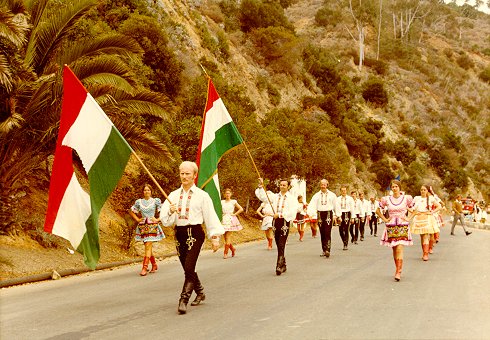


Artistic Director: János Zsolt Oláh
János Zsolt Oláh was born on June 25, 1970, in Sátoraljaújhely, Borsod-Abaúj-Zemplén County, in the northeast region of Hungary. His family lived in Cigánd, a town of 5,000 on the banks of the Tisza River. His father was a supervisor for a regional chain of stores, and his mother managed a large retail store in Cigánd; his brother Krisztián is also an accomplished folk dancer.
Oláh’s folk dance career began at age 6 and continued to age 14 with the Zemplén Children’s Dance Ensemble, under Artistic Director and Choreographer István Nagy — years that included numerous tours and festivals throughout Hungary and travel abroad to Czechoslovakia, Yugoslavia, Bulgaria, Turkey, Austria, and Germany. He continued his education in Miskolc at the Berzeviczy Gergely Vocational School, graduating in 1988, while participating in the Avas Dance Ensemble, the largest of its kind in Borsod-Abaúj-Zemplén County, touring Czechoslovakia, Switzerland, France, Germany, Greece, Poland, and Egypt.
He began his professional dance career at 18, in 1988, with the Hungarian State Folk Ensemble under Sándor Tímár, touring the Netherlands, Germany, France, Belgium, Canada, and the United States. In 1990 he was invited to join Kárpátok as a guest artist in an exchange program with the Hungarian State Folk Ensemble; sharing his talents as soloist, teacher, and choreographer, he was appointed Artistic Director. He also makes guest appearances, teaches, and choreographs with the Croatian group Kolo and the Pannonia Dance Ensemble in San Diego, and is invited annually to UCLA and the Hungarian teaching camp in Mendocino as a guest teacher.
Repertoire
The Kárpátok are proud to include dances from several areas of Hungary, past and present, as part of their extensive repertoire. All dances are executed in the costumes of the area depicted.
Rábaközi dus and karéj — The program often opens with this recruiting dance for young soldiers. The men’s karéj is a recruiting dance for the cavalry dating back to medieval times: when recruiters came to town and danced the verbunk, they brought excitement and entertainment, and many young men went off to a new career. Choreography by János Oláh.
Girl’s Wine Bottle Dance of the Alföld region — Shows the women’s response to village life. After the grape harvest and wine-making, hauling the flasks — made easier by carrying the vessels on their heads — also let the women show their grace and dexterity, a skill accomplished only through much practice. Choreography by Tibor Toghia.
Stick Dance from Szatmár County — The original weapon of dexterity spawned the Stick Dance. Since the 18th century the dance has lost much of its military character; shepherds of the Upper Tisza region have best preserved its original form, in which masterful manipulation of the props — particularly the twirling of the sticks — reveals the dance’s essence. Choreography by János Oláh.
Men’s Dance from Mehkerék — A young men’s dance typical of the Romanians who live in this region of Hungary, its movements influenced by motifs from Hungarian lads’ dances. Clapping and stomping give the dance its unique character and rhythm, along with the sound of the jaw harp accompanying it. Choreography by János Oláh.
Kartali Karikázó — A girl’s round dance in the costumes of Kartal in Central Hungary, danced only to the accompaniment of the dancers’ own voices. Choreography by Marianne Toghia.
Dances from Magyarszovát — Dance scholar György Martin called the Mezőség region of Transylvania, lying between the Maros and Szamos rivers, among the most important and archaic regions for music and dance research. It was one of the first areas where táncház-movement scholars began collecting and preserving dances on film, material later reproduced by young people in Budapest at the táncház, or dance-house. The dances from Magyarszovát form a suite progressing from slow to fast couple dancing — some of the fastest found in Transylvania. Choreography by Ricardo Salas.
Széki verbunk — Szék is a small village in the Mezőség region of Transylvania where many ethnic Hungarians still live, their traditions preserved despite many hardships. Choreography by János Oláh.
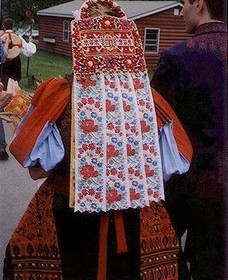
Legényes and couple’s csárdás of Kalotaszeg — Kalotaszeg is well known for the high standard of its folk art — magnificent costumes, embroidery, wood-carving, and intricately decorated houses — and equally for its intricate dance forms. The legényes, or lad’s dance, is the peak of Kalotaszegi dancing, followed by the couple’s csárdás, beginning slowly and progressing to the fast csárdás, or szapora. Choreography by Don Sparks.
Press & Reviews
- “Karpatok Folk Troupe, Bouyant, Ingratiating” — Los Angeles Times, Calendar Section, November 10, 1992
- Kárpátok Hungarian Folk Ensemble — Presenters’ Reports, Summer 1992
- “Hungarian ensemble provides dynamic end to concert season” — The Ramona Sentinel, March 28, 1991
- “Karpatok Ensemble in Step With Hungarian Rhythms” — Los Angeles Times, Calendar Section, January 28, 1991
- “Folk dancing Is Too an Art Form” — Los Angeles Times, Calendar Section, January 24, 1991
- “‘Kaleidoscope’ Folk Program” — Los Angeles Times, Dance Review, July 24, 1990
- “Karpatok dance troupe brings Hungarian folk culture to U.S.” — Daily Sun / Daily News, Special Section, February 2, 1990
- “Dancers bring Hungary to the Bowl” — Redlands Daily Facts, August 2, 1989
- “Hungarian Dancers delight PAC crowd” — Big Bear Life & The Grizzly, May 4, 1989
- “Dance Reviews: Karpatok Folk Ensemble at El Camino College” — Los Angeles Times, Calendar Section, December 15, 1987
- “Folk group remains true to its traditions” — The Desert Sun, Palm Springs, CA, November 17, 1987
Kárpátok Visits Colorado (1997)
The Kárpátok Hungarian Folk Ensemble of Los Angeles was invited to Crested Butte, Colorado, as part of the Crested Butte Chamber Music Festival. The company took ten dancers and gave a children’s concert and full show on Thursday, August 7, 1997, joined in concert by Jómóka, the premiere táncház band of the Rocky Mountain region. The following Saturday night, Kárpátok performed two numbers as part of the 1997 Chamber Music Festival’s final concert — a tremendous success for the ensemble.
Spring Táncház Festival, Los Angeles (April 17–19, 1998)
Three days of Hungarian dance, song, and live music at the historic Hungarian House in Los Angeles: dance instruction with three former members of the Hungarian State Folk Ensemble (Állami Népi Együttes) — Szabó István “Kovács,” Tóth Tibor, and Oláh János — the first time in North America that all three came together to teach. Additional teaching staff included Deanne Hendricks, Tóth Luci, Marian de Sumrak, and Ricardo Salas, with music for the weekend provided by Jómóka of Salt Lake City. Dances presented were from the regions of Szatmár, Kalotaszeg, and Székelyföld, with Deanne Hendricks leading vocal sessions with songs from the Kalotaszeg area of Transylvania.
Ricardo Salas had studied with some of Hungary’s leading dancers and choreographers, traveling and living in Hungary and Transylvania, where he conducted field research in the village of Méra in Kalotaszeg.
 Mondák
 Vicc
Vicc Költő / Író
 Népdal