









Written by Béla Lipták for the 75th anniversary of the Treaty of Trianon. Thanks to the Washington Post-Los Angeles Times Syndicate it was read by many; thanks to József Balogh, publisher of the Connecticut-based Magyar News, it was reprinted with maps; and thanks to Ödön Sándor, a copy was mailed to each member of the U.S. Senate, Congress, and Government.
The Lessons of a 75 Year Old Tragedy
by Béla Lipták
The 4th of June was the 75th anniversary of the Treaty of Trianon, the peace treaty which in 1920 mutilated and dismembered an ancient European nation: the kingdom of Hungary. At Trianon Hungary was deprived of 63.6% of her inhabitants and 71.5% of her territory. This essay has three parts. I will first discuss the history of Hungary through the end of World War One, culminating in the Treaty. Next I will outline the Treaty, its architects, goals and consequences. I then will discuss Hungary’s “guilt” and the events of the last 75 years to show that, just as Nazism was not born in Germany but in Versailles, so the tragedy of Bosnia and the evolving tragedy of the Balkans (some of it yet to occur) can all be traced back to Trianon. I conclude by outlining a concept which would reconstitute the Danubian Basin and could stabilize the whole of Central Europe.
Pre-Trianon Hungary
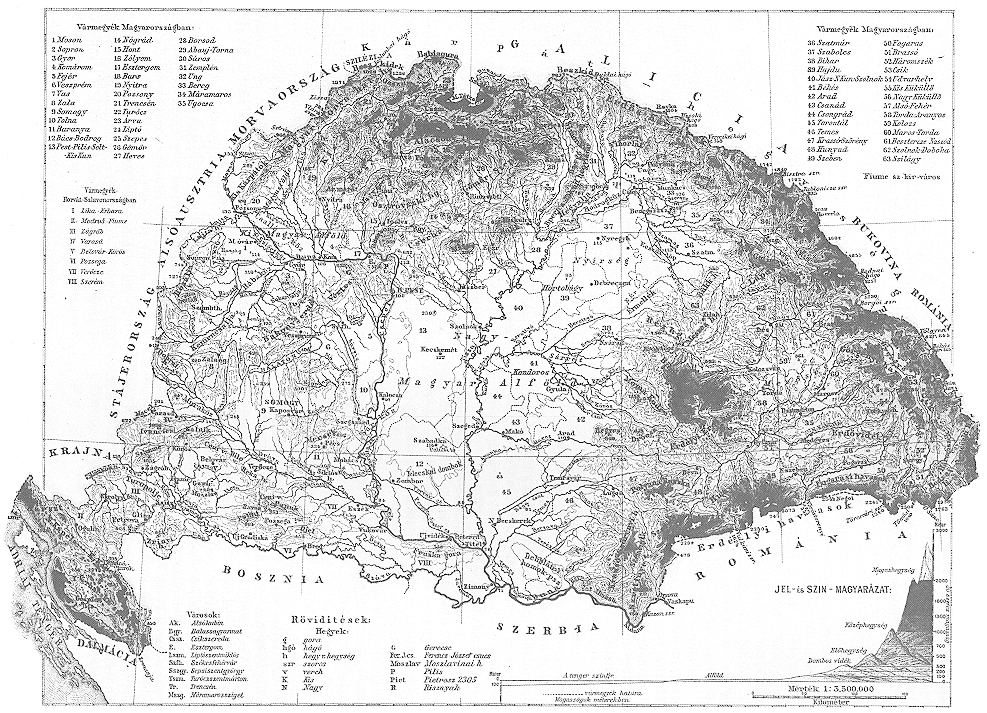
For a thousand years, Hungary occupied an oval-shaped central plain surrounded by the protective bulwark of the Carpathian mountains. Like the crust on a loaf of bread, the mountains encased the lowlands in a majestic arch from which all waterways converge toward the center. This perfect geographic unity was matched by complete self-sufficiency, until this harmonious symbiosis of the great central plain and its surrounding mountains was destroyed at Trianon.
For a millennium, Hungary was the eastern bastion of European civilization, a balancing and stabilizing power between Slavic and Germanic nations. Hungary’s first king, Saint Stephen, wrote to his son, Saint Emeric, in 1036: “Make the strangers welcome in this land, let them keep their languages and customs, for weak and fragile is the realm which is based on a single language or on a single set of customs” (unius linguae uniusque moris regnum imbecille et fragile est). Stephen’s advice was respected and obeyed during the coming centuries: Hungary gave asylum to the Ruthenians in the north, the Wallachians (Romanians) and Saxons in the east, the Swabians and Serbs in the south. Eventually the kingdom contained 14 national minorities, of which the Magyars were only one, and in order not to hurt the feelings of any, Latin remained the sole official language of the kingdom until 1844.
Hungary became a constitutional monarchy in 1222; her “Golden Bull” is junior by only 5 years to the English “Magna Carta.” This constitutional monarchy was almost completely annihilated by the Mongol invasion of 1240–41, but through that enormous struggle it succeeded in protecting Europe and her civilization. Toward the end of the 15th century, during the reign of the renaissance king Matthias Corvinus, Hungary’s population reached that of England, the court in Buda became a cultural center of Europe, and the library of Buda was Europe’s finest. In 1526 Hungary was once again annihilated, this time by the Turkish invasion, which cut her population in half and the kingdom in three. During the 150 years of Ottoman occupation, the west was taken by Austria, the center by the Ottoman invaders, and Hungarian culture survived only in the east, in Transylvania.
Even today, Transylvania is the land where the purest Hungarian is spoken, where Hungarian popular art has found its most exalted, most perfect expression, and where Béla Bartók collected his Hungarian folk tunes. Transylvania is also the place where the Hungarian diet at Torda, in 1557, declared the freedom of religion for the first time anywhere in the world. Transylvania provided an atmosphere of religious and ethnic tolerance and as such became the birthplace of the Unitarian and Sabbatarian religions.
After the Turkish occupation, Austria attempted to take over all of Hungary. This resulted in a series of uprisings. The fight for Hungarian independence of 1703–1711 was led by Francis II Rákóczy, whose insurgent fighters were mostly Slovak and Ruthenian peasants — they proudly declared themselves to be “Hungarians,” as distinct from the racial term “Magyar.” The next fight for national independence was led by Louis Kossuth in 1848, and the Ruthenian and Slovak nationalities once more contributed masses of recruits for the Hungarian revolutionary army, which, while defeated by the combined forces of Austria and Russia, forced the Habsburgs to accept in 1867 the formation of an Austro-Hungarian duality. It was Kossuth who later proposed to convert the Austro-Hungarian empire (of 24 million Slavs, 12 million Germans, and 12 million Hungarians at the time) into a Danubian Confederation. Kossuth was also the second foreigner ever invited to address the United States Congress, in January 1852.
From Sarajevo to Trianon
At the beginning of this century, Russia sponsored pan-Slavic agitation in the region. Archduke Francis Ferdinand was the main opponent of the creation of a Greater Serbia. His murder on June 28, 1914 in Sarajevo had been encouraged by Russia and engineered by Serbia. The only member of the Council of Ministers of the Dual Monarchy who was opposed to a war of retaliation against Serbia was the Hungarian Premier, Count Stephen Tisza. When he was voted down, Hungary occupied Serbia and by 1915 would have considered the war over, if Russia did not have scores to settle with the Ottoman empire, France with Germany, Italy with Austria, and so forth. Therefore the war went on.
During the war, the Czech allies of Serbia, Eduard Beneš and Thomas Masaryk, transformed themselves from consultants of the allies into architects of allied policy for Central Europe. They organized a deceitful propaganda campaign for the dismemberment of Hungary and in their efforts succeeded in obtaining the support of two criminally ignorant French politicians, Georges Clémenceau and Raymond Poincaré.
President Wilson refused to cooperate in this conspiracy. He wanted Europe’s new borders to correspond with her ethnographic boundaries and he wanted the principle of self-determination to prevail, but his views were disregarded. On January 24, 1919, he protested the illegal Serb and Romanian occupation of parts of Hungary, and on March 31, 1919, he called the proposed dismemberment of Hungary “absurd,” but his objections were overruled by the French. As a result, the United States Congress refused to approve the Treaty of Trianon, but this product of Neronian insanity — unjust in substance and tragic in consequence — was implemented anyway.
The Treaty of Trianon
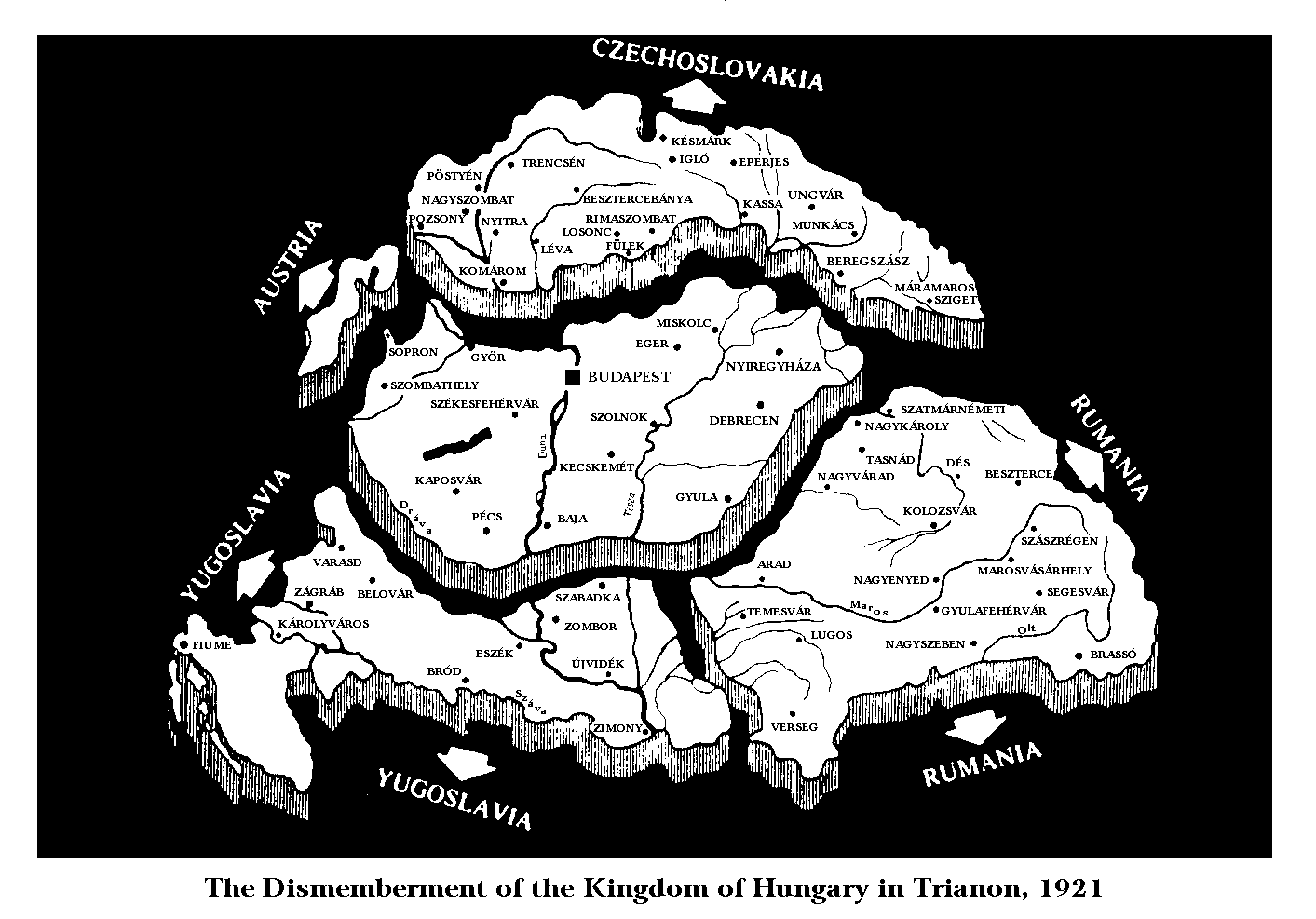
On the 4th of June, 1920, one of the cruelest treaties of human history was signed. Never before had a peace, imposed by violence, been more brutal in its bias, madder in its destructiveness, more forgetful of the lessons of history, and better calculated to create future upheavals. The treaty cut mercilessly into the flesh of compact Hungarian populations. Hundreds of towns were separated from their suburbs; villages were split in two; communities were deprived of their parish churches or cemeteries; townships were cut off from their railroad stations and their water supplies. A thousand-year-old European country was made into an invalid as its territory was reduced from 325,000 to 93,000 square kilometers. In the process, 35% of all Hungarians were turned into foreigners within the towns built by their fathers, as the borders were redrawn around them. In this way the Hungarians became Europe’s largest minority as Hungary’s territory was reduced by 71.3%. In comparison, the leader of the central powers, Germany, lost only 9.5% of its territory. The outrage of this mockery of justice is illustrated by the fact that even Austria lined up at the carcass and received some parts of the dismembered Hungarian Kingdom.
From the fragments of Hungary, the unnatural successor states of Czechoslovakia, Yugoslavia, and greater Romania were created. These artificial entities forced Croats to live with Serbs and Czechs to live with Slovaks, demonstrating both the arrogance and the ignorance of Trianon’s architects. These successor states were not only geographic monstrosities but also economic absurdities, and therefore their self-destruction was just a matter of time. As of this writing two of the three successor states have already disintegrated. One purpose of this writing is to suggest a plan to construct a healthy federation from the disintegrated pieces, and to achieve that transformation without violence.
Self-Determination Through Plebiscites
The very foundation of the 14 Wilsonian Principles was that people have an unalienable right to determine their own destiny. Yet at Trianon the application of self-determination and the use of plebiscites in drawing the new borders was totally disregarded. When the recommendation of one of the delegates to the Peace Conference, Field Marshall Ian Smith, to hold plebiscites in Transylvania, Slovakia, Ruthenia, Croatia, and Slavonia was rejected, he was correct in declaring: “A plebiscite refused is a plebiscite taken.” By not allowing plebiscites, the dismemberment of the Austro-Hungarian empire and the redistribution of her 48 million citizens resulted in the creation of 16 million oppressed ethnic minorities. These were not emigrants who voluntarily left their “old country,” but people who never in their life moved from their home towns and became foreigners simply because Clémenceau and Beneš decided to redraw the borders around them.
When the Wends and Slovenes of the Muraköz protested their separation from Hungary, when the Ruthenians expressed their desire to remain part of the kingdom which they shared for a thousand years, when the Swabians of the Banat protested their annexation into Romania and Yugoslavia (Vojvodina), the answer of Clémenceau was always the same: no, no, and no. There was only one exception to the arbitrary drawing of the new borders (mostly by Eduard Beneš) — the single case where President Wilson’s principle of self-determination prevailed was the city of Sopron, which was allowed to hold a plebiscite and voted by a majority of 65% to remain part of Hungary and not join Austria.
The “Guilt” of Hungary
Hungary was dismembered because she could not defend herself and because her greedy neighbors decided to help themselves to the unprotected carcass. Naturally, the architects of Trianon could not admit this, and therefore invented the theory of “Hungary’s Guilt,” claiming that (1) she started the First World War, and (2) she was a historical German ally and as such a destabilizing force in Europe. Neither was true.
It was the Serb para-governmental organization Narodna Obrana which, with the encouragement of Russia and with the goal of a Greater Serbia, assassinated Archduke Francis Ferdinand in 1914, and it was the Premier of Hungary who, alone in the Austro-Hungarian Council of Ministers, voted against a war of retaliation against Serbia.
As to the claim of being a “natural” German ally, history proves just the opposite. Whenever Hungary was independent, she acted as a keystone of balance between the Germanic and Slavic peoples and prevented attempts at both Pan-Germanic and Pan-Slavic expansion. In the first 500 years of her existence, starting with the battle of Lechfeld in 955, Hungary fought to block the spread of German influence and created stability by filling the power vacuum of the region. When under Germanic (Austrian) occupation between 1688 and 1867, she twice rose against the Germans and eventually gained her independence from them.
Tacitus: “We Hate Whom We Hurt”
In any society, the acid test of civilization is the respect for minority rights. The Great Powers attempted to guarantee these rights by making the successor states sign “minority treaties,” which outlined the language, religious, cultural, and property rights of the minorities. For example, the minority treaty signed with Romania on the 9th of December, 1919 in Paris — a treaty guaranteed by the United States, Britain, France, Italy, and Japan — stated the following:
Article 8: No restriction shall be imposed on the free use of any language.
Article 9: Equal rights to establish, manage, and control religious institutions, schools, and other educational establishments.
Article 11: Roumania agrees to accord to the communities of the Szecklers (Hungarian Székelys) and Saxons in Transylvania local autonomy in regard to scholastic and religious matters.
Article 12: Roumania agrees that the stipulations in the foregoing Articles constitute obligations of international concern.
Similar treaties were signed with the other successor states, but none were ever enforced. In fact, the Great Powers looked the other way while the successor states attempted to “solve” their minority problems, first through denationalization, then by ethnic cleansing through deportations, expulsions, transfers, dispersions, and other forms of uprooting. Hungarians had to choose between their nationality and their property. Because of the savage oppression, intimidation, and coercion, 350,000 Hungarians decided to leave all their possessions behind and flee to rump Hungary.
The institutions and possessions of Hungarian communities were also targeted. In Transylvania alone, the Hungarian community lost 1,665 of her schools, including the world-famous János Bolyai University, named after Einstein’s predecessor, the inventor of the new (non-Euclidean) geometry.
The Paris Peace Treaty
On February 10, 1947, the Great Powers had another opportunity to enforce the until-then-disregarded minority treaties. This was expected because on August 14, 1941 the Atlantic Charter was signed, and it too (like the earlier Wilsonian principles) emphasized the right to self-determination and to plebiscites. Yet not a single plebiscite was allowed. In fact, rump Hungary was further violated by the transfer of additional land to Slovakia. This transfer later made possible the construction which unilaterally and illegally transferred the Danube, Hungary’s border river, onto Slovak territory (in 1992) to build a hydroelectric dam, thereby destroying Europe’s oldest wetland region.
At the end of the Second World War, the worst crime of legalistic hypocrisy occurred: Eduard Beneš, with the scandalous connivance of the Western Allies, invented the concept of “collective responsibility” and used it to confiscate the properties of the Hungarian minorities in Slovakia and later to deport them in cattle cars. To understand the hypocrisy of this deed, one must realize that wartime Slovakia under Tiso was a protectorate of Nazi Germany, while it was the representative of the Hungarian minority in the Slovak parliament, János Esterházy, who cast the only dissenting vote against the Jewish laws passed by that body. Yet, after the war, Esterházy died in a Czechoslovakian jail, and the Hungarian minorities he represented were collectively sentenced as war criminals. Thus, when the deported Jewish Hungarians returned from the death camps, they found their properties confiscated because of their “collective responsibility.”
The Last Decades
By the late 1940s, the last protection left to the Catholic Hungarian minorities was their churches. In 1948, 600 Hungarian Catholic priests and all six of their bishops were arrested in Transylvania. Rome later agreed to gerrymander the Catholic sees and to appoint Romanian bishops to lead the all-Hungarian church, as the Romanians belong to the Eastern Orthodox faith. The fate of the Hungarian Catholics in the other successor states was similar. In 1949, in Ruthenia, the bishop of the 500,000 Catholics was murdered and the parishioners were forced to merge into the Orthodox Church. In Slovakia, in April 1950, the bishop of 320,000 Catholics was arrested and his parishioners were also forced into the Orthodox Church.
After 1956, when the Hungarian Freedom Fighters of Budapest succeeded in mortally wounding the Goliath of Communism, the rulers of the successor states used the uprising as a pretext to speed the forced assimilation of their Hungarian minorities. It was after the Revolution that the remaining autonomous Hungarian regions — Transylvania in Romania and Vojvodina in Yugoslavia — were abolished. Today, the more than 3 million Hungarians have no autonomy at all, although it had been guaranteed by the Great Powers in 1920, again in 1946, and once more by the European Parliament in 1993, in Article 11 of Recommendation 1201.
After 1989, there was a short period of hope, when, for example, the Hungarian bishop László Tőkés was temporarily heralded as an all-Romanian national hero for leading the successful revolution against Ceaușescu, or when Miklós Duray, the Hungarian leader of Charter 77, was released from jail in Slovakia. Unfortunately, this did not last. By 1991, the formerly Communist leaders of the successor states — Milošević in Yugoslavia, Iliescu in Romania, Mečiar in Slovakia — once again started to use nationalistic and anti-Hungarian propaganda to distract public attention from the pressing economic problems of their nations.
In September 1995, for the first time ever, Hungarian students who speak no other language but Hungarian were not allowed to be taught in their mother tongue by their Hungarian teachers, in their Hungarian schools. In addition to this cultural genocide taking place in Romania and Slovakia, Serbia and Croatia are fighting over the possession of Hungarian villages in Eastern Slavonia, which has been part of Hungary for 1000 years. Yet the worst of all tragedies is occurring in Vojvodina, where Serb refugees from Krajina are “ethnically cleansing” the native Hungarian population, which had nothing to do with the fighting in Bosnia.
One wonders if there is a limit to the patience of this, the largest minority in Europe, and what will happen when that limit is reached.
The Lesson
It takes time for historic events to reveal their consequences. It took nearly 75 years for the creations of Trianon, Yugoslavia, and Czechoslovakia to self-destruct. It took some 75 years until it became clear that it is the legacy of Trianon which is destabilizing and “balkanizing” Central Europe. By now we see that Trianon did not eliminate the causes of the 1914 murder in Sarajevo, and we also realize that no unjust “solution” can stand the erosion of time, and Trianon did not provide justice.
But what is justice? In this relativistic age — when my terrorist can be your freedom fighter, when the life of one UN soldier can be more valuable than that of a thousand Bosnian children, and when the Chechen or the Kurd nations are less deserving of self-determination than some others — it is desirable to remind ourselves of what justice is. On the pulpit of the Notre-Dame Cathedral, Father R. P. Gratry put it this way: “Every nation’s homeland is sacred. If you destroy one of them, you mutilate the entire human race.”
Therefore, the main mistake of 1920 was that it attempted to satisfy the desires of a Beneš and a Clémenceau, instead of attempting to apply just principles to solve the nationality problems of Central Europe. Unfortunately, this approach has not changed during the last 75 years. The only thing that changed are the names of the architects of injustice. Today, the goal of international efforts is to appease a Milošević and a Yeltsin, instead of establishing some general principles and applying them to everybody. The principles of a permanent solution must involve self-determination through plebiscites, autonomy for ethnic minorities, and a Danubian or Central European Federation as the ultimate goal.
The United Nations should declare that all national minorities anywhere in the world (exceeding some minimum number, say 100,000) have the right to hold UN-supervised plebiscites and receive cultural and linguistic autonomy, if the majority so desires. It should make no difference how these minorities evolved, how long they lived in the particular area, or what their language or religion is. Regardless of all that, they all have the right to maintain their heritage and the right to determine their own cultural destiny. Once cultural autonomy is guaranteed, the main cause of tensions between Central European neighbors will also diminish.
When the Hungarians enjoy the same autonomy in Romania as the Romanian minorities in Hungary, when the Serb, Russian, Turkish, Albanian, German, or any other minorities of the region are also treated equally, the tensions will disappear and the rebuilding can start.
The Danubian Confederation
It is the wrong goal for the Danubian nations to rush into NATO or the European Community individually. A much better first goal is the establishment of an economically self-sufficient, politically stable, militarily neutral, and geographically large enough federation, which by itself is able to fill the power vacuum of the region.
It should by now be obvious that neither Western Europe nor the UN can fill the present power vacuum in Central Europe, and therefore they are not competent to resolve the problems of the region. History teaches us that the Balkans became unstable whenever a power vacuum evolved in the Carpathian Basin. The wise learn from history, instead of repeating its errors. We should learn from history that the tragedy of Trianon will not be corrected and justice and stability will not be obtained by maintaining the status quo. What is needed, once the minority problems are solved through autonomy, is to build a strong Danubian Federation — one that can be crystallized around the nucleus of Hungary, Slovakia, Ruthenia, Slovenia, and Croatia — a Federation that later could expand to include Romania, Yugoslavia, or even Poland, the Czech Republic, and Austria.
History does not solve problems accidentally. Those who want a better future must first have a plan, a concept of that future. For the stability and prosperity of Central Europe, that plan should start with autonomy for all the minorities and should end with a voluntary federation. It would be fitting if, on the 75th anniversary of the dismemberment of the Hungarian Kingdom, after the unnecessary and undeserved suffering of three generations of innocent ethnic minorities, we would start the process of rebuilding — not a nation state, but the Federation of Central Europe.
 Mondák
 Vicc
Vicc Költő / Író
 Népdal