





About the The Slavonian Circle Dance
by Gyorgy Martin
In the pockets of Hungarian folk culture in Slavonia, there are villages with old-style culture in which the girls' dances are known as kalalázás, rezálás, derenkázás, and karikázó or karikatánc. The tradition of the four villages deviates to a greater or lesser degree in the names of the dances, the song repertoire, and formally, as well with respect to the place which dance occupies in the life of the people. There is also a difference in how intensely they preserve the tradition. In Szentlászló they have the fullest memory of the dance material; in Kórógy it is already less, although the girls' dance survived the longest here in a secondary function. Our data concerning the girls' dance in Haraszti is fragmentary, and because of the proximity of Osijek (a city), the village of Rétfalu became urbanized and mixed, so that now no trace of the girls' dance can be found.
The kalalázás of Szentlászló primarily referred to the walking around the village, while the rezálás, a circle dance, was an integral part of it. During Lent, on Sundays after church, the girls used to walk, while singing, all the way to the end of the village: "They would go up Little Street, Big Street, they even went as far as the furthest streets. The important thing was that they made a tour of the whole village."
(Here are printed many verses of the song which begins "Széna van az ólban…")
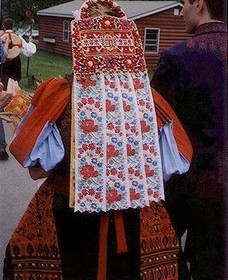
The girls joined hands with their colorful silk scarves held at shoulder height, and the long, richly-colored line slowly, festively, would wind at a walking pace all the way to the end of the village. Occasionally the two girls at the front of the line would make a gate with their arms held high. The rest of the line would curve under this, and the whole chain would go through the gate. In this way they would continue to the main square of the village (the dancing place), in front of the tavern, where they began the circle dance, the rezálás.
(Here are printed many verses of the song which begins "Hat nap van egy hétben…")
They also danced the kalalázás in the autumn, at the time of the guarding of the grapes. "When the grapes ripen, every girl is out in the vineyard from morning until night. They sing and chase the starlings. They announce the new couples, telling who will get together in November. They shout: Palkó Józsi – Pap Mári are a couple!" In the evening they headed home, talking and singing the so-called grape-guarding songs and as they approached the edge of the village they began the kalalázás.
(Here are printed many verses of the song which begins "Ágas-bogás suru tolgyfa…")
At such times the boys also sometimes joined in the line. Boys and girls, alternating, held hands with the scarves. The richly-colored procession drew the interested attention of the entire village. "So pretty were the many colorful scarves that the people stood out in their gates to have a look. The boys and girls walked for a little bit and then made a circle where they felt like it and began the dance. When they danced like that in a circle, that was the rezálás."
(Translated from Gyorgy Martin's book The Hungarian Circle Dance and its European Relatives.)
 Mondák
 Vicc
Vicc Költő / Író
 Népdal