








In 1848 the Hungarians happily joined the trend of revolutions sweeping through Europe (though some Hungarian extremists feel ashamed even today by the fact that the otherwise "loyal and subdued" Austrians managed to get their revolution done days earlier: in fact, the news arriving from the revolting Vienna urged the young revolutioners in Pest to start acting.)
For a few months everything seemed bright, but then revolutions failed elsewhere and the Hungarians stayed alone, their leaders facing not only the military threat from the reactionary Habsburgs but for the first time in the country's history also the rebellion of some national minorities, who began looking at the Hungarians the same way as the Hungarians treated the Habsburgs: their oppressors.
In the beginning the Hungarians surprised the world as – against the odds – their newly organized army inflicted defeat upon their enemies by early 1849. This led to the intervention of the Russians, who were apparently better trained to handle such rebellions. Hungarian resistance lasted for a few more months, but by the end of the summer the Russians and the reinforced Austrians finished their job: the freedom war was over.
Kossuth was Governor of Hungary during fight for independence and democracy which was eventually defeated by the union of the royalist Austrian Habsburg and Russian Czarist Armies (1848 – 1849). Kossuth envisioned a federation in the Kingdom of Hungary in which all nationalties participated in a vibrant democratic system based on fundamental democratic principles such as equality and parliamentary representation. The bloody conflict eventually led to a partial victory for Hungary – a great compromise known as the "Austro-Hungarian Empire," in which Hungary gained some autonomy.
Petőfi (1823-1849) is probably "the" Hungarian poet and hero of the 15th March revolution. His Nemzeti Dal (National Song) written for the revolution (yes, he wrote it especially for this occasion! Funny times, when writing a poem is part of conspiracy…) has become sort of an unofficial anthem for Hungarians. During the freedom war Petőfi was fighting in the revolutionary army. He was last seen in the battle of Segesvár (31th July 1849).
Victories in spring 1849
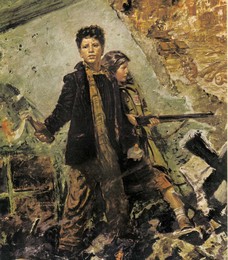
The battle of Tápióbicske was one in the series of Hungarian victories over the Austrians during spring 1849: by the end of May the revolutionary army controlled most of Hungary. (A painting by THAN Mór).
 Mondák
 Vicc
Vicc Költő / Író
 Népdal