






· Párta Home
· Párta Making – A Confession
· Párta – Origins and History
· Párta in the Play of Live & Death
· Autobiography of the Author
By: Evelyn Domján
The forbidding silver-grey rocky mountain still towers over the village. The iron, silver and gold mines, a source of former wealth, have been closed long ago. It is a ghost town now; its youth had gone to far away cities for work and a better life. In its golden age the village was teeming with life, full of color as villagers gathered for the Lord’s Supper at Easter. Cherry trees in bloom, girls like bouquet flowers in white and red and blue, and gold coronets. Again, on St. Michael’s day in the fall, the countryside resounded with song at grape harvest. Roses, dahlias, geraniums in their last bloom, and the girls in their extremely elaborate folk costumes with more pieces to it than any other. White pleated linen skirt, white blouse, embroidered on the shoulders of the full sleeves and the cuff in bright red. Red gathers, embroidered bodice, elaborate gold rope jeweled belt with gold buckle, crocheted white lace collar with black edging. Green felt or silk apron with bobbin lace. Their laces, written needlework, exquisite. A silk fringed silk kerchief folded in triangle tucked into the belt at front, gold tassels. High pink boots in heart shape up front, with high heels and the pointed toe turned upward in oriental fashion. Pleated cape or richly embroidered lamb-skin coats with red fox collars.
The gold Párta coronet made with gold passementerie over black velvet background had a set of ribbons different from other coronets. The pale rosy-green-ivory flowery ribbons were used by upholsterers of Biedermeier furniture. Here, the ribbons were fixed from side to side at the back of the head and hung to shoulder-length, folded so the reverse side did not show. The gold Párta was worn by the bride for the last time on her wedding day. Next day she wore a tight black lace bonnet and above this a silk embroidered netted veil. Small copper disks were sewn on her garment in closely fitting rows between the embroidery. She wore this for about a year until her first baby arrived. At that time, bonnet and copper-embroidered gown joined the golden coronet in her chest, waiting for her daughter or younger sister to wear them. She covered her head with a kerchief.
For three days I was bargaining for a golden Párta headdress. I paid the high price and returned with it to town. I tried it on and it was heavy. The village used to produce iron asked for a noble posture. It was majestic, the royal crown of peasant princesses, to wear it was ecstasy. My joy was short lived. The owner appeared and asked twice the price, or else she would take it back. I returned it speechless.
Later, back home, feeling the loss, I decided to make a coronet for my enjoyment, at least I wanted to try. The black velvet and gold passementerie I used were almost identical to the original, but in spite of my efforts I was not satisfied with it. It was a copy and it did not radiate the spirit of the original.
Many years and a dozen headdresses later, in a dream, the towering mountain appeared to me, radiant in a golden sunset and I made a new Párta, on black velvet ground, gold bead-flowers, clusters of pearls and gold and silver beads, gold sequins, silver stars. I made the bead-embroidered ribbons to it, black and white and gold. Pieces of broken mirrors and the golden radiance of Torockó sparkle in the light.
A pale rose light appears above blue shadows of early dawn that softly cover the village, when out of the silence come sweet sounds of a flute… A young shepherd playing his flute ever so lightly like drops of morning dew, like dripping water of the stream. There he goes on the road; following him come large black water buffaloes and a cloud of dust behind them. Slowly the women of the household awake and silently tend to their chores. The old woman throws grain to the chicken, feeds the geese, prepares mash for the pigs. The boy pulls water from the well and brings the horse out of the stable to drink. The sleepy girl brings in a bucket of icy cold water and with strongly perfumed pink soap washes herself, then combs her hair.
It is a great day; she will go to church in her glorious folk costume and sit with the other girls, all in snow-white shining beaded Pártas and ribbons and later in the afternoon she will attend a wedding. There will be singing and dancing and a feast with no end to it. While she is braiding her hair, interlaced with a ribbon she dreams of her own wedding that will come one day.
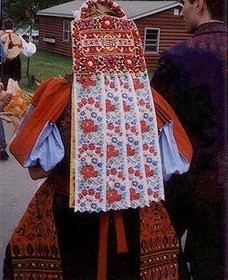
Still in her white chemise and white pleated petticoats she opens her painted wooden chest. From it, she takes out her PÁRTA. It was made just for her out of the old one her mother used to wear. It is higher than the other girls’ and has tiny red stars sewn over gold metal disks between the white shiny snail beads; just to see it sets her in festive mood. She puts the PÁRTA on the table, selects the rose ribbons she is going to wear. She puts on a blue blouse with red bobbin lace embroidery from shoulder to the cuffs, written needlework on the shoulders of the pleated sleeve, she ties the collar with a red cord ending in red tassels. She takes a pleated rose-patterned cashmere skirt with rows of rose ribbons. Roses, roses, rose ribbons, even her name is Rozál (Rose). Her mother is here to help her with her tight embroidered bodice, puts sequin-decorated, fringed rose ribbons on her shoulders, a string of bead-embroidered balls to hang from her neck. She is a rich girl: there are three big balls on each end of a red silk cord and tassels of silver beads. Another rose ribbon, tied in a bow, is added at the neck up front. And one long white silk tassel hanging on a rope to the end of her skirt on the back will swing with glittering beads and sequins as she goes on the road, it will fly up high and ’round as she turns in the dance.
Her richly ornamented apron is tied over the skirt. A green cotton apron, likewise pleated and edged with rose ribbons. The rose ribbon is gathered in round rosette-form, such rosette decorates the lower edges of the apron both sides, the rosettes framed with more rose ribbons and sewn with beads and sequins. Three times the length of the fabric was used to make the apron and where the fabric was sewn together, two magnificent ribbons of superb embroidery, different from any other costume, run along it.
It is these two ribbons we are most interested in. I got two such left-over ribbons, they were unfinished, not lined, so I could study the method the way these were made. Glittering, exotic, extremely colorful, 30 inches long, 2 inches wide. Because of the bad quality of the thread it needed instant restoration. I was working on it back home on long winter nights; the colors warmed my heart. It was on folded paper and home-spun linen base, and on this, strangely, the long ribbon was broken up into 2×2 inches of squares and each square covered with wool of a different color: ultramarine blue, cadmium yellow, pale purple, red, white and bright leaf green. Then it was embroidered with small beads of all colors, and bugle-beads. The “empty” spaces were filled with small metal disks, each fixed to the base with a little bead. Each small square a picture by itself; there were flowers, tulips, daisies, violets, stems and leaves, crosses and stars. Red- white-green, the Magyar colors were used a lot: a tulip of red-white-green bugle beads, a sun-flower of red and white bugle beads and green metal disks with a red bead to hold it to its yellow woolen background. All this just a detail of a costume. I kept it for years as an objet d’art. But I learned this technique and one day was inspired to make a Párta out of it, a coronet Rozál would have been proud to wear.
Will I ever hear the shepherd’s flute again? I don’t know, but I recollect it all: the sound of the flute, the water buffaloes in their dust cloud, the rosegarden of the opened peasant chest. Rozál, rosy cheeks and a smile on her face, standing in front of her mirror, her mother gently adjusting her rose ribbons. I put more beads on my thread, and as I sew them, the needle going in and out, a drop of blood from a pricked finger as I follow the needlework, I fantasize of a Vista woman of long ago.
 Mondák
 Vicc
 Költő / Író
 Népdal
