




· Párta Home
· Párta Making – A Confession
· Párta – Origins and History
· Párta in the Play of Live & Death
· Autobiography of the Author
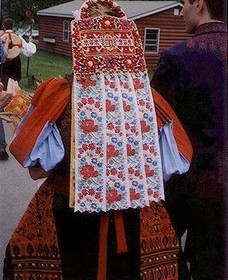
Párta: The Crown Jewels of the Village
By: Evelyn Domján
This is an aggregation of thoughts, ideas and facts about Hungarian folk art and Hungarian artists. The name “DOMJÁN” is known and respected all over the world. The woodcuts József Domján made have become known in practically all parts of the western world. On the other hand, fewer people know that Evelyn Domján, his wife, is an excellent artist in her own right. Her paintings, decorated eggs, Hungarian headdresses and ribbons have been created in the spirit of Hungarian folk art and reflect the Domján artistic philosophy.
Many believe that folk art is static and unable to develop any further. On the contrary, folk art is dynamic and changes according to the artist’s talent and background. Even though it continues and maintains a traditional form, the final result is tailored to the interpretation of the artist. No two folk art objects are the same. No two folk dance sequences are ever the same. No two folk songs will ever be sung the same way. Every folk artist must contribute to the art form his or her own interpretation in order to assure freshness and excitement and individuality. Evelyn Domján’s “párta”-s (“ceremonial head dress”-es) and ribbons also carry on these dynamic aspects of folk art. They become gorgeous and enchanting creations of art of an extremely talented artist. The Hungarian Folk Museum / American-Hungarian Folklore Centrum is proud to have captured a moment in the development of this dynamic and exciting art form.
Evelyn and József Domján are dedicated to Hungarian folk art and they always approach it with great respect and ever-refreshing enthusiasm.
This book and the exhibit staged at the Hungarian Folk Museum in the 1983–1984 season focus on the work of Evelyn Domján and especially on her ceremonial headdresses (“párta”-s) and embroidered ribbons (“hímzett szalagok”). She developed the decoration of these essential paraphernalia of the Hungarian peasant girl into a unique art form. To our knowledge Mrs. Domján is the only person in America who seriously practices this art.
The financial support of this book and exhibit by the National Endowment of the Arts is hereby graciously acknowledged. This not only validates the importance of Hungarian folk art in the United States, but gives recognition to Evelyn Domján as a respected folk artist in America.
— Kálmán Magyar, Sr.
About the Magyar Folklór resource
A “Magyar Folklór” abból a célból jött létre, hogy tevékeny módon támogassa a magyar folklórt gondolatcsere, tapasztalatcsere és ötletcsere révén.
“FOLKLÓR” is to actively perpetuate Hungarian folklore by exchanging thoughts, experiences, and ideas. The Hungarian FOLKLÓR list is a mixed-language (English & Magyar) online resource.
Hungarian FOLKLÓR objectives:
- Increase exposure of the Hungarian Traditional Culture (HTC);
- Offer “on-line” planning, organizing & disseminating of HTC events;
- Strengthen & facilitate a world-wide internet HTC community;
- Invite constructive discussions on HTC-related topics;
- Promote & advance HTC world-wide.
FOLKLÓR célkitüzések:
- A Magyar Népi Hagyományok (MNH) ismertetése, leírása;
- A MNH-hoz kötött események tervezése, megszervezése és közzététele megsegítése az interneten;
- A MNH iránt érdeklődők internet közösségének erősítése és fejlesztése;
- A MNH-hoz kötött témák konstruktív diszkutálása;
- A MNH promótálása világszerte.
From the 1983–1984 exhibition and book at the Hungarian Folk Museum / American-Hungarian Folklore Centrum. Copyright © 1998–2000 FOLKLÓR CENTRUM · AHFC.
 Mondák
 Vicc
Vicc Költő / Író
 Népdal