





· Párta Home
· Párta Making – A Confession
· Párta – Origins and History
· Párta in the Play of Live & Death
· Autobiography of the Author
By: Evelyn Domján
Hungarian folk art is unique in its marvelous richness and variety of motifs. How did it become so? It is in our blood. When our ancestors crossed the East Carpathian mountains at Verecke Pass more than a thousand years ago, they brought horses caparisoned with silver filigree harnesses, their women wore gold jewelry. Masterpieces of goldsmith art, like the Miraculous Stag, go back to the remote past. The wish and talent for decoration was already there. Certain stitches in folk art embroideries show an Asian origin. The shaded satin-stitch embroidery, in which the two sides of the fabric are almost identical, is used on Chinese imperial robes and Kalocsa embroidery alike. The other shade stain-stitch embroidery, in which, economically, the silk is only on top, held with small stitches to the fabric’s back, can be found both in Bochara and on Matyó aprons. The use of mirrors and tinsel in Hungarian folk art is more than a child-like reach for shiny things. It relates to an Asian origin, to the mirror embroideries made in India. Even more mystic ancient Asian roots lead to the ritual robe of the shaman, the priest-healer-reader of cosmic messages, who advised the nomadic hunter-warriors. The shaman’s gown had shiny metal disks sewn onto it to reflect the light of the sun, the moon or sacrificial fire. Queen Gizella, Bavarian Princess and wife of Saint Stephen of Hungary, worked on a most valuable piece of textile, the coronation robe of the Hungarian kings. She embroidered it with gold thread, pearls, and precious stones. Her embroideries depicted saints, churches, and ornaments. Agnes the Chatillon, French princess, wife of King Béla III. Brought her entourage with her from France and led a lavish court at the new royal residence at Esztergom. Beatrice, princess of Naples, Italy was the wife of King Matthias Corvinus (Mátyás Király), who built a new, magnificent Renaissance palace, the Buda Castle. She brought fabrics and fashions from Italy. Thus, Hungarian culture received myriad influence from the West. It was influenced from the East as well. From Byzantine came the golden mosaics of Ravenna, San Vitale, with Empress Theodora in her high golden crown with pearls, precious stones and cabochons. Wives and daughters of landed aristocrats spent time at court and returned home to their fortress castle or manor house to continue the embroideries they had learned. Servant girls from the villages learned the embroider, worked on the trousseaus of marriageable daughters of the wealthy and on sumptuous costumes for special occasions. Then they returned home to their villages and made the peasant-variety of what they remembered stitching, using the materials aveilable to them there. The one hundred and fifty years of Turkish occupation left its mark: Turkish slave girls had worked in the manor houses on their gold embroideries. The Hungarian peasant assimilated these varieties of influences and developed their own robust and original style. Thus, the richness of decoration came to be found in interiors, in embroideries and all objects produced by the folk artist. There is variety as well, as one move through different geographical and folk areas and even from village to village within a single region. Párta, the prominent decoration of the festive peasant costume, differs in various parts of the country and it may come from any of the folklore areas.
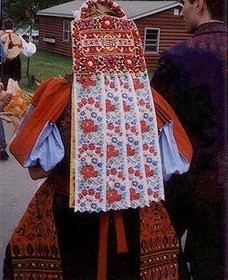
Every Párta is the result of thousands of hours of work and the best costly materials. On the Párta, we find piled up, crammed lace, embroidery, ribbons, trimmings, beads, artificial flowers, tinsel, mirrors, wire, gold and silver thread in the most astonishing combinations. These materials are not used in a haphazard way either, for each folklore area has its own style and each Párta has been according to strict rules.
Matyo costumes of Northeastern Hungary, worn mostly in the villages of Tard, Mezőkövesd and Szentistván, have a Gothic character. Their long pleated skirts, fringed shawls, narrow silhouette and pointed headgear is from a peasant variation of a medieval chatelaines. This area alone could be the subject of a separate study. A girl of Szentistván wears a beaded Párta that is rounded, encircling her face in a most becoming manner. The Párta is made of large round beads, like berries of various color. On top of the Párta is a round flat dessert-plate sized decoration. Starched ribbons are gathered in a horizontal rosette.
The Matyó girls’ hair is never cut. It is combed and braided, the braid tied with a ribbon. The girls of Tard braid their hair starting at the very top of the head and tie a big fan-shaped bunch of rose ribbons that up high in the center of their heads. The Matyó Párta is fan-shaped and extremely high in center front. It is very ornate, all white, made of artificial flowers. An earlier style had dark blue cornflowers and blossoms of all kinds of white flowers. It is worn by Mária-girls, who carry holy pictures and statues of Mary in processions. They use the Párta every Sunday.
Earlier Matyó Pártas were made of rows upon rows of red roses, yellow sunflowers, blue cornflowers with silver ears of wheat, called “rezgő” vibrant. Framing the face was a row of away from the peasant robust taste, toward the ‘Rococo’. After her wedding, the young woman, who had no younger sister, took apart her Párta and used the flowers for her various fancy headgear. For example, the flowers could be made into a bouquet, affixed to the small bouquet and attached to the front of the bonnet, making the face of the young girl who wore it as if it were a vase in which that bouquet was arranged. Another young woman might continue to wear her beaded ring Párta, with the extremely long pointed cap, at the end of which hangs a veil. The Párta is made of artificial flowers, roses, blossoms and green leaves. Characters in a Bethlehem play, put on before Christmas also used the long pointed headgear. There, it was decorated with flowers, large colorful glass balls and ribbons that hung from it.
A Palóc coif of Northern Hungary, like the Párta, is made of artificial pink, blue and white flowers, mirrors and green leaves. It is framed by white passementerie, embroidered with silver, red, blue and green shiny beads. Rose ribbons hang from the back. Kazár Párta (Nógrád country) is made of many rows of lace, one on top of the other, with a final crowning ring of artificial flowers. This Párta is crown-like, round and tall and the white madeira lace is starched on bright. The girls wear white blouses with pleated full sleeves and white aprons of madeira lace over their pleated cashmere skirts and boots. The young wives’ bonnet is same as the Párta with the only difference, it is closed on the back; the hair does not show; it is made of rows of beads, passementerie; on the back of the bonnet a flower bouquet, from here braided and embroidered and fringed wide rose ribbons hang to the waistline. They have full gathered brocaded skirts below the knee and many underskirts, lace blouses and aprons.
A bride of Boldog (Transdanubia), wears a Párta of artificial flowers. Rows of small myrtle in sprays, composed of waxed flowers, hard balls and little blossoms. The headdress of the city bride is also made of these, but the peasant bride has an additional row of flowers, red and silver strings and bits of glass. Many artificial flowers were used for Pártas, florists made these.
It was also the Golden Age of Millinery art: the hats of our grandmothers. On a wide platform silk flower, all sorts of artificial flowers and fruit, silk and velvet bows, ribbons and lace trimmings were placed in an arrangement. Whole birds were attached. I can imagine how a peasant girl, serving as a maid in a city, got a used hat, took it home, discarded what was not acceptable, but retained the artificial flowers which then entered the wide spectrum of art material of the peasantry.
A Siógárd (Tolna County) bride wears a sky-blue brocade dress. Long sleeved blouse with lace edgings, full skirt, apron and Párta. Her Párta is of wax flowers, blossoms and silver pine branches. Above it rows of silk roses, pink and green leaves. The silver pine branches are arranged in a star shape on top, center, like the star of a Christmas tree. Buják (Tolna) Mária girls are dressed in white and tall, all-white Párta-s of white artificial flowers.
The District of Sárköz (Tolna County) can boast of dressing its daughters in utmost luxury. The girls have very full skirts of silken brocades with many lace-edged petticoats, which swing as the girls walk. Skirts are decorated with rows of rose ribbons of various colors. Rose ribbons and silk fringes, too, frame their brocade aprons. On their shoulders, four silk shawls are worn. These have homemade silk fringes in fancy patterns, each row of fringe a different color. The layers of fringes undulate with every movement.
The precious piece of the wardrobe is the Sárköz triple Párta. It is worked on a hard core. It starts with three ribbons center front, of black-green-red taffeta or a ribbed fabric. It ends in half rosettes on both sides of the head, at the temples. The center of each rosette is decorated with the commonly used three millimeter silver beads. From the temple to the nape, taffeta ribbons are sewn on, gathered, pulled and also decorated with a row of beads. This is the first band of the triple Párta. Above the ribbon band comes a band of embroidery and beads. Above this is the third band, which consists of artificial flowers, predominately white and red. A big bunch of these artificial roses and blossoms stand out center front. This Párta is worn from confirmation until wedding. The rich Sárköz bride looks like a rose in her flowery Párta. Wide red rose ribbons hanging from the nape, ending in long silk tassels, black tassels for red ribbons.
The wealthy landowner peasants of this region wanted only one or two children and if an only daughter died young, they built her a mausoleum in the cemetery. She was buried in the Párta. Along the coffin a row of cloth was placed. This absurd custom only proves the importance of the wardrobe.
The Párta that plays such a dominant role in the varied folk costumes is not limited to the Hungarian peasantry. If we are looking for its origins we must think or royal crowns, jeweled, diadems, medieval flower wreaths and the Párta of the Hungarian noble ladies’ gala-dress. Recently, at an exhibition of costumes of Austria-Hungary in the Metropolitan Museum of Art in New York, the Párta was shown as part of the dress. In the center of the first hall there was this ensemble: a white moiré silken-brocade gown with a long full skirt and train. The skirt was edged with gold lace, rich embroidered in gold with flower garlands and leaves, strewn with gold tinsel. A blouse of tulle lace with gathered, pulled sleeves and gold embroidery, including gold lace pulled around the neck. It had a bodice of dark wine colored velvet, covered with gold passementerie, pulled tight with a gold cord. The apron was white tulle lace with gold embroidery. Like the hussars’ uniforms, the ladies’ costume had a short coat thrown over the shoulder. This one was a wine colored velvet pelisse with gold passementerie and sabre fur collar. A white beaded Párta finished off this splendid traditional Hungarian gown. Countess György Majláth wore it at the coronation of Franz Joseph I. 1867, then in 1896 at the Millennial festivities of the founding of Hungary and finally in 1916 at the coronation of the last king of Hungary, Charles IV. The that coronation, the Countess Zichy wore a green ceremonial gown of gold satin bodice trimmed in gold lace and a dark green tulle lace blouse with puffed sleeves over a pale green and gold brocade silken skirt from the eighteenth century and a tulle-lace apron. She wore a green brocade Párta on her head.
Visitors to the exhibit were puzzled by the presence of the Párta as part of these costumes. The Párta looked neither a hat nor a crown. It could not be a bridal headdress, since no occasions would have more than one bride. What is then? The only answer is that the Párta is a typical piece of a Hungarian woman’s dress. The Párta of the nobility was worn by married women on special occasions. The Párta of the peasantry was worn by virgin girls up to and through the wedding day. The noble women’s Pártas are about two-and-one-half inches high in front and diminish at the sides. They tie in back and are neither as heavy, nor as hard as the peasant version.
When I was six years old I received my first traditional “Magyar” dress. In it, I recited a poem at school. Originally this kind of dress was used for grape harvest in the nineteenth century. My dress was white batiste, with a full gathered skirt, puffed sleeves, red brocade apron with lace around it and a red velvet bodice with passementerie. I had a red velvet Párta with gold and white beads. Ribbons of the national colors, red, white and green were used generously. There were wide red-white-green ribbons to tie the Párta at the back and hung. There were narrow red-white-green ribbons to frame the apron, made a triple line the hem of the skirt and also to tie the puffed sleeves and the apron and the neck.
About the Magyar Folklór resource
A “Magyar Folklór” abból a célból jött létre, hogy tevékeny módon támogassa a magyar folklórt gondolatcsere, tapasztalatcsere és ötletcsere révén.
“FOLKLÓR” is to actively perpetuate Hungarian folklore by exchanging thoughts, experiences, and ideas. The Hungarian FOLKLÓR list is a mixed-language (English & Magyar) online resource.
Hungarian FOLKLÓR objectives:
- Increase exposure of the Hungarian Traditional Culture (HTC);
- Offer “on-line” planning, organizing & disseminating of HTC events;
- Strengthen & facilitate a world-wide internet HTC community;
- Invite constructive discussions on HTC-related topics;
- Promote & advance HTC world-wide.
FOLKLÓR célkitüzések:
- A Magyar Népi Hagyományok (MNH) ismertetése, leírása;
- A MNH-hoz kötött események tervezése, megszervezése és közzététele megsegítése az interneten;
- A MNH iránt érdeklődők internet közösségének erősítése és fejlesztése;
- A MNH-hoz kötött témák konstruktív diszkutálása;
- A MNH promótálása világszerte.
From the párta exhibition and book at the Hungarian Folk Museum / American-Hungarian Folklore Centrum. Copyright © 1998–2000 FOLKLÓR CENTRUM · AHFC.
 Mondák
 Vicc
 Költő / Író
 Népdal
