




Slovak Demands
On May 10 a Slovak assembly met at Liptószentmiklós (Liptovský Svätý Mikuláš, Slovakia today) to formulate demands for certain autonomous rights. The ethnic Slovak population at that time was estimated at 1.6 million, or 12.4% of Hungary.*
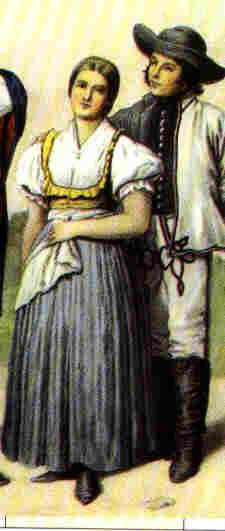
There were 14 claims approved, including land ownership for all, freedom of the press, release of Slovak political prisoners. Flying the red-white Slovak flag next to the Hungarian tricolor, demands were made for a regional parliament elected based on nationality, a Slovak militia with Slovak officers, national administration and education — including a Slovak university.
Curiously they also demanded Polish autonomy within the neighboring Austrian province of Galicia. The movement got fractured due to a Czech revolt against Austria, which failed. Also contributing was the gap between the leaders (largely Protestant clergy) and the (predominantly Catholic) Slovak peasantry, whose primary interest was liberation from serfdom — already in the Hungarian program.
The leaders of the assembly then expressed a desire to join Austria, which was ignored not only by Hungary, but by much of the Slovak peasantry. Lacking armed support, the movement did not revive in the 1848-49 time period.

* The Slovaks’ origin is generally attributed to the westward migration of Slavic tribes in the fifth and sixth centuries AD. They settled in the northern part of the Carpathian basin, on the edge of the Roman empire. Around 833 AD, under Duke Mojmir I, they were incorporated into the Moravian empire, which fell apart during the reign of King Svätopluk, partly as a result of battles with Hungarian tribes. Their homeland hence became part of the Kingdom of Hungary. During the Turkish occupation of most of Hungary in the 16th to 17th century, the Slovak-inhabited areas assumed added importance as a Hungarian redoubt. The capital of Hungary was moved to Pozsony (today’s Bratislava), where the Kings of Hungary were crowned in St. Martin’s Cathedral until 1867.
Back to Milestones of 1848-49
 Mondák
 Vicc
Vicc Költő / Író
 Népdal