






It was eight o’clock in the evening. We were on Saint Stephen’s Avenue, on the Pest side of the bridge. People living in the surrounding buildings had opened their windows and placed their radios there. Therefore we could hear the hated voice of the general secretary of the Communist Party, Ern_ Ger_: “We condemn those who organize nationalist demonstrations and who strive to spread the poison of chauvinism among our youth,” he was saying. Our mood changed. Men_ turned to me: “The dirty, lying skunk! This quisling fears all patriots, and with good reasons, too!” Now our march was no longer silent. I heard Laci Zsindely’s voice from far back: “Down with Ger_!”1 The slogan spread, and then new ones, like “Hungarians, come with us!” took over. The one slogan that spread the quickest was “Russians go home.” The walls of the avenue echoed with this rallying cry.
On Alkotmány Street I saw a pub. I had not eaten since the morning, so I ran in: “Give me something to eat, a roll, anything.” The mustachioed bartender gave me a French roll. I pulled out my still intact 140 forints, two twenties and a one-hundred-forint bill, and handed him one of the twenties. He took it, looked at my tricolored armband, hesitated for a second, and then returned the twenty saying, “I will close down the pub and join you!”
By the time we arrived at the parliament, there must have been a quarter of a million people on the square in front of it. We heard a lot of yelling as people demanded that the illumination of the red star on the dome of the building be turned off. When the light finally went out, a thunderous ovation rose to the sky. A moment later all the lights in the immense Kossuth Square went off. Now it was total darkness. This was a less than subtle hint by the Communists implying that it was time for us to go home.
Now, somewhere far, far away, at the other end of the square, somebody put a match to a rolled-up issue of the party paper, the Szabad Nép (Free People). Others followed this example, and within a few minutes thousands of flickering torches illuminated the plaza. It was a serene and unforgettable sight. As we stood hypnotized by the flickering of thousands of flames, a deep voice somewhere in the back started singing the national anthem. The quarter-, perhaps half-, million people in this gigantic square stood to attention as the hymn spread, filled the square, and then rose to the sky. As our voices blended in this prayer for our homeland, our souls filled with a new unity and determination. The paper torches were still burning when Kossuth’s favorite song began to thunder through the plaza:
Louis Kossuth sent the message,
That his army is a wreckage,
If he needs us, we are coming,
The enemy can start packing,
Long live Hungary!
Finally, from the balcony of the Parliament, Ferenc Erdei announced that Imre Nagy, one of the remaining few Communist leaders who was still respected in Hungary, was going to speak.2 There was no sound amplification, so we could barely hear what he was saying. But we all heard the first word he said, “Comrades!” That was the ultimate insult. We did not want to hear any more. We did not want to listen to any more speeches. Enough of listening, enough of talking, it was time to make our own decisions. It was time for action. (Later it was reported that he said, “My friends, there are no more comrades!” In any case, what mattered at the time was what we thought he said.)
It was about nine o’clock. Our junior class of mechanical engineering was still in one group when Gyuszi Perr found us. He arrived on his motorbike with the little blonde athlete Marika on the back seat. The news he brought was that in Hero’s Square people were trying to topple Stalin’s twenty-four-foot-tall bronze monument.3 At the radio station, the ÁVH had been reinforced, and the station’s director, Valéria Benke, was holding our delegation captive. The situation was very tense there. Trucks were arriving, bringing workers from Csepel to the radio station. They were in a fighting mood.
We held a brief meeting. Some suggested that we go to the radio station; others wanted to help topple Stalin’s statue. Gyuri Egry said, “We should do something that others are not doing. Let us go to the Szikra publishing house and print a strike proclamation.” We agreed on that. So, Gyuszi Perr went back to the station, and we, the whole junior class of mechanical engineering, still in a disciplined, orderly formation, marched to the Szikra publishing house.
The workers at the printshop offered no resistance. They asked only for a written statement that we had requisitioned their facility, and from that point on, their questions involved only the text, letter sizes, margins, and the like. It felt too easy. In about an hour the strike proclamation was printed. We were about to leave with the still-wet leaflets when Gyuszi Perr—with Marika still on the back seat of his motorbike—arrived once more. This time Gyuszi was unnerved, shaken. His report explained why: “At the radio station, the ÁVH first used tear-gas grenades but later started shooting with live ammunition. People have been killed. There is chaos at the station. Also, Stalin’s statue has been knocked down in the park. The trucks of Csepel are dragging it through the city.”
It must have been about eleven o’clock when we decided to break up. The majority of our class of two or three hundred was starving and tired, so they went home. I joined the group that was headed for the radio station. It must have been about midnight when we got there.
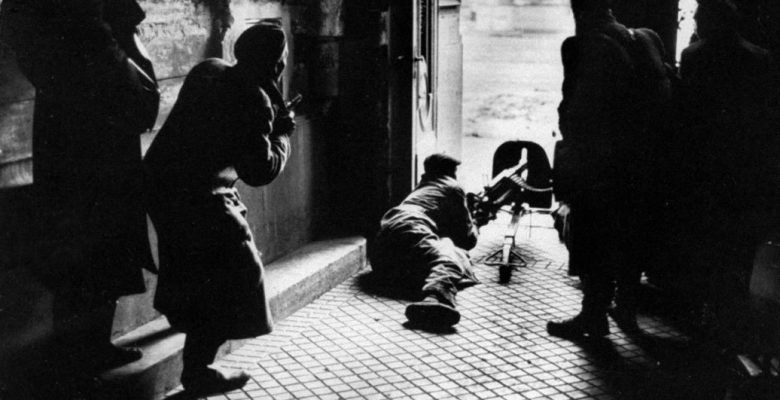
The radio building was on Bródy Street. We were still several blocks away when the rattle of gunfire became audible. As we got closer, we could also smell the gunpowder. I was frightened, my heart was pounding, but I could not turn back. As we reached the corner of Museum Boulevard (which we called the Small Boulevard) and Bródy Street, I saw three Hungarian tanks. People were surrounding them, talking to the officers. It was obvious that these soldiers were not going to shoot at other Hungarians.
As we turned into Bródy Street, it seemed empty. There was smoke in the air. People nestled in the doorways. My corduroy jacket rubbed against the wall as I ran toward the radio building. I passed some abandoned Red Cross ambulances in the middle of the street, then stopped at the next doorway. “What are these ambulances doing here?” I asked.
“The ÁVH task force arrived in them. These bastards, the ÁVH reinforcements were wearing the white coats of doctors over their uniforms. They were also bringing more ammunition to the ÁVH thugs inside. The demonstrators overpowered them and took their arms.” The voice was familiar. I leaned closer. It was Zsuzsa, the bride of my friend Gábor Illés. “Don’t tell Gábor!”—she pleaded when she recognized me. She had a submachine gun in her hand.4
“Where did you get that?” I asked.
“From them,” she replied, and she pointed to a young soldier standing next to her. He was an enlisted man. I could tell that he was from the Great Plains region of Hungary, because in the middle of all this madness he held out his hand for a handshake and politely introduced himself.
“How did you get here?” I asked.
“Our unit was sent to reinforce the ÁVH, but when our commander saw what was going on, he refused the order. Some of my mates gave their arms to the people, like her. Others, like me—we joined them.” He spoke slowly, precisely, without a single unnecessary word, without overstatement, without theatrics. He spoke like all farmers do anywhere in the world. And he spoke with the accent of the region of Szeged.
Now I noticed a group of demonstrators marching toward the radio building. They were not running, were not clutching against the wall (as I did), but were marching in the middle of the street. They marched behind a giant of a man with a large Hungarian flag. The man must have been a blacksmith, someone whose work made him very strong, because he was able to hold the immense flag in one hand. They must have been a hundred yards from the building when the ÁVH started firing. In that narrow street the echoes of the explosions were amplified, and the resulting racket was almost unbearable. Yet I saw no bullets hitting the pavement. They must have been shooting into the air. The demonstrators froze to a standstill but did not run, and once the shooting was over, they started slowly to move again.
Suddenly, I heard another burst of firing. This time the bullets struck the pavement like lumps of ice in an ice storm. When a bullet hit the pavement it made a high-pitched phing sound. When it hit flesh, it made a much deeper thud sound. The wounded were screaming, those demonstrators who were not seriously wounded were running away, but the blacksmith still stood, took another step forward, and then slowly, like a falling oak tree, started to topple to the ground, still holding, lifting, the flag.
Next to me, I heard the enlisted man talking to Zsuzsa: “No, you first release this. Yes. Now you look through that.” And now came a deafening burst. A window shattered on the radio building. Now the pavement was sparking in front of our doorway. “Only people with guns, please!” the enlisted man said. I stroked Zsuzsa’s back and started running away from the radio station, close to the wall, in the direction I had come from.
As I got to the corner of Museum Avenue, I saw a truck with a crowd around it. “What’s happening?” I asked. The man next to me was well informed: “They are from the Soroksár Street arms factory. You know, the one that is officially called the United Lamp Factory. They brought rifles and ammunition.” I pushed my way to the truck to get hold of a rifle and some bullets. The rifle was slippery; they must have been stored in grease. My first reaction was Oh God, this rifle will mess up my beautiful corduroy jacket. So I moved over to a garbage can and started rubbing the grease off the rifle with old newspapers.
As I was rubbing away, I heard somebody call out, “Öcsi!”
I looked up. It was my older brother, Péter. “What are you doing here?” I asked.
“Oh, we came in from the Agricultural University of Gödöll_.”
“So you changed your mind?”
“No, not at all. This is madness. The ÁVH will butcher you all. You don’t stand a chance with that ancient rifle. All it is good for is to mess up your jacket! Besides, if the ÁVH cannot handle you, the Russians will.”
“OK, OK. So, you still feel that way. By the way, I just talked with Zsuzsa, Gábor Illés’s bride. She is fighting at the radio building. She just learned how to use a submachine gun.”
At that point a truck pulled up next to us and a young man yelled out, “This truck is from Újpest (one of the newer districts of Pest), and we are on our way to the Károly Barracks in Budaörs to get more arms. If you want to help, get on.” As I started climbing onto the truck, Péter yelled at me to stay. It felt good that he was worried about me, but my mind was made up. It was made up when that blacksmith with the big flag fell.
“See you soon!” I called out to Péter as the truck took off.
There were two wooden benches on the truck. I wiped the seat with my handkerchief to protect my favorite jacket. On my bench there were two other young men; on the opposite side of the truck were three boys and two girls. I was the only student on this truck. The others, from the way they dressed, the way they talked, I could tell that they were all factory workers. We all were holding on to the same grimy rifles. The second boy on my right was in the process of loading his gun. It never occurred to me to do that. I got the rifle only because that appeared to be the ticket to taking part, to being there, but it never occurred to me that I could use it. As far as I was concerned, my bullets were just fine in the pocket of my corduroy jacket.
The truck was heading for the Pet_fi Bridge. From Museum Boulevard (Small Boulevard on the map) it turned onto the deserted Üll_i Street. We must have been doing close to sixty miles an hour. The boy on my bench had finished loading his gun, and the butts of our rifles were all resting in front of us on the truck’s floor. Suddenly—we must have run over a brick or something—I felt a big bump. Our rifles all jumped into the air, and as they fell back, the loaded one went off. The boy next to me fell forward, blood streaming from his right ear.
I grabbed him as the truck came to a screeching halt. Because I was a student and because I was wearing the tricolored armband, the others automatically expected me to decide what we should do. The Haynal Clinic was only a few hundred yards from us, and when we got there the night watchman opened the door and called for emergency help. In a few minutes the wounded boy was taken away on a stretcher, and we were back on the truck. The right side of my spotless favorite jacket was bloodied now.
We should have turned right on Ferenc Boulevard (Grand Boulevard on the map) to reach the Pet_fi Bridge, but there was a long row of Russian tanks coming from that direction. So we stayed on Üll_i Street, then turned left on Hungária Boulevard. A big crowd was at the HÉV railroad station near Baross Square. They told us that the director of the Ruggyanta rubber factory refused to take part in the general strike—refused to shut down the plant. We drove to the main gate of the plant. “Where is the emergency loudspeaker?” I asked the confused gatekeeper. He looked at my armband and without the slightest hesitation flipped a switch and pointed to a microphone. I spoke into the mike: “A general strike been declared in Budapest. This factory will shut down immediately!” I repeated this twice, and as we left, the porter said, “The shut-down procedure takes some time, you know; these are chemical processes, you know!”
Earlier we learned that Sándor Kopácsi, the police chief, had instructed the precinct police chiefs not to resist the requisition of arms. So our next stop was the police station on Baross Square. It seemed that they were expecting us. The policeman on guard duty even helped load their spare guns onto our truck. Back on Baross Square, we distributed the guns, and as the young people got their weapons, they automatically climbed up onto our truck until it was completely full; there was absolutely no room left. So I continued on foot.
It must have been about 2:00 A.M. on this Wednesday, October 24, when I suddenly remembered Ágnes. It was an impossible hour, but I had to go there immediately and let her know that I was safe. It was a long walk. The apartment house was dark, the door was locked, and the mailboxes were on the inside. I did not dare call at that hour, so I slipped a note under the front door and left.
As I reached the corner of Rákóczi Street and the Grand Boulevard, I could hear intense gunfire at the main offices of the Communist Party paper, Szabad Nép. The massive bulk of Stalin’s bronze statue was resting in the middle of the road. As the firing intensified, I decided to seek protection behind the twenty-four-foot metal casting of Stalin’s body. As I hit the pavement, a voice next to me remarked, “This is the first time that our beloved leader did something for me!” The speaker was a skinny little guy with a blue beret and a massive hammer in his hand. He continued: “I was trying to take home a piece of Stalin as a souvenir when the fighting broke out. There is a large ÁVH contingent inside the Szabad Nép building, but the Hungarians have already occupied the ground floor.” This was the first time that I heard somebody implying that the ÁVH thugs were not Hungarians. I had always thought of them as traitors or collaborators, but never as disowned outcasts.
On my way back to the radio building, I saw Russian tanks approaching on Museum Boulevard. They were not firing. An officer was standing in the open hatchway of the first tank. The boulevard was empty. People were hiding in the doorways. “Don’t show your gun!” I heard from one of the doorways as I jumped into the semidarkness. The tanks roared by, and I continued on my way, back to the university. It was about 5:00 A.M. when I crossed the Freedom Bridge back to Buda and reached Saint Gellért Square. The scene I found there was surreal.
The square was full of people. Some were fully dressed, while others were in their nightgowns or pajamas. They were in the process of building barricades. Some were carrying old bedsprings; others brought chairs or bricks. One group was digging up the cobblestones of the pavement, using crowbars and other, less likely, tools. They intended to block the bridge so that the Russian tanks could not come over from the Pest side. When they saw my rifle, the armband, and the blood on my jacket, they respectfully gave way. A policeman, twice my age, asked, “What do we do now?”
Without thinking and without hesitation I answered, “We push them out of the city!”
At that point, three trucks arrived from the direction of Móricz Square. “Let us help the people on the Pest side!” shouted a young man from the first truck. Unarmed people started climbing onto the trucks. I saw two elderly ladies in their dressing gowns—they were probably sisters—carrying a heavy cobblestone. I gave them a hand as they struggled to lift it onto the truck. “Just in case you might need it,” one said, “Just in case, you know!” I jumped onto the second truck.
As we turned onto the bridge, I looked back. The people on the square had come to a standstill. They were watching our trucks. Some were crying, some took off their hats, and a nun was on her knees, praying. We were about halfway across when the tanks at the Pest bridgehead started firing. The first truck was hit and burst into flame. Our driver tried to make a U-turn and crashed into a pole. The cobblestone flew forward; people were falling and jumping off. It was chaos. We were all running back; nobody made it to the Pest side.
I got back to the university at about nine o’clock in the morning. It was hard to believe that twenty-four hours earlier I was checking identity cards at these gates. Ages had passed during those hours. Now, everything was empty; not a soul was to be seen. As I walked through the main aula, I could hear the echo of my footsteps.
The door of the DISZ office opened. It was Jancsi Danner with a submachine gun on his shoulder. He was just as dirty and tired as I. “We must be the first ones. I just got back from the Corvin Cinema. We beat back the Russians there. They lost some tanks,” he said.
“This place looks abandoned. Let’s check the military department,” I suggested.
As we were walking over, I notice that the sole of my sandal was coming off. Jancsi’s shoes were big and rugged; they would last longer than mine. He was from Szeged, very tall, dark blond with grayish blue eyes. He took life seriously. He was about to get married to a girl named Gabi—short for Gabriella. I was different. I used to think of life as an opportunity to have fun, but now I was not sure. Now I felt that these solemn Jancsi types might just have a point.
As we looked up at the windows of the military department, we saw no movement or light inside. The main door was open, so we entered. As Jancsi opened the door of Colonel Marián’s office, there was some movement in the background, and a voice asked, “Who is that?”
“It’s János Danner and . . .” Jancsi looked at me, and I finished his sentence: “Öcsi.” I still did not dare to use my real name.
The colonel and two of his officers stepped out from the back of the room. They were in the process of putting away their pistols. “Why didn’t we see you from the outside?” I asked.
“We have been crawling under the windows on all fours,” replied a lieutenant.
Marián’s eyes were bloodshot and the corner of his mouth was twitching as he said, “We came back here after the march and have been here ever since. I expect to be arrested any minute.”
We tried to cheer them up. We told them that the regular army and the police were on our side. We told them about the general strike, the heavy fighting at the radio station and at the Kilián Barracks, but their gloom did not lift.
“Have you eaten?” Jancsi asked them. They shook their heads, so we went to the cafeteria and got a pitcher of stale coffee, apples, and some bread. They still looked paralyzed. They still bent down before passing in front of the window. At that point I thought of Memi and Aptyi. They had to be worried, so I decided that it was time for me to go home and reassure them. So I left.
My mother’s younger sister, Duduke, lived at 1 Béla Bartók Street. Their apartment house used to belong to my grandmother’s family; now, of course, it belonged to the state. It was built when Budapest was the elegant capital of the dual monarchy. The marble stairway was wide enough to carry up a grand piano. The mahogany banister was supported by richly decorated wrought iron. The turns were so sweeping, so gentle, that one could slide from the fourth floor all the way to the street level on it. As a child I tested that many times. The stone was carved, the ceilings were tall, and the building radiated the confidence, pride, and defiance of a thousand-year-old kingdom.
That building would still be standing when the Red Empire had already faded into a bad memory. It would prove that a European city cannot be pushed into Asia. The buildings would not allow that. The spirit of that one building was more powerful than all the secret police of that slave empire. The soul of such a city can never be conquered.
After I rang the bell, Uncle Feri opened the door. Even in the semidarkness of the hallway, he was dumbstruck at the sight of me. The vestibule was full of Feri Bácsi’s hunting memorabilia; antlers and tusks, hunting knives and horns covered the walls. In his time he chased big game in the Carpathian Mountains, hunted for fox in Transylvania and for partridge near the Adriatic, without ever leaving Hungarian soil. Today, because of such artificial new states as Czechoslovakia and Yugoslavia, he needed a visa to visit his birthplace, Kassa (today Kosice). Today he was a different man; today the main challenge of his life was to find his dentures in the morning.
As we entered the living room, I left my rifle and the bloodied corduroy jacket in the foyer. Duduke was in the process of changing the baby. It would have been her third child if one had not starved to death at the end of the war because she had had no milk. Péter and I tried to help. I will never forget: I was trying to steal some milk for the baby by creeping on my belly, with a saucepan in hand, among a herd of kicking cows guarded by Russian soldiers. That was scary for a nine-year-old.
Now, in Duduke’s apartment, the radio was on. It said that the deadline for laying down our arms had been extended until 2:00 P.M. We could hear the explosions through the window. They seemed to come from the direction of the Kilián Barracks. I did not know what to do. Duduke left the room for no obvious reason, and a few minutes after her return, my father’s older sister showed up. She did not explain how she knew that I was at Duduke’s. She just said, “You must be hungry!” With that she handed me some of my favorite sausage. The sausage tasted funny. The more I ate, the sleepier I got. Later I learned that her doctor husband, Uncle Tivadar, had injected some barbiturates into the sausage.
It was midafternoon when I woke up. I felt woozy and had a splitting headache. As I put on my jacket in the vestibule, I had a blurry sense that I was missing something, but I did not remember what it was, and since I did not see anything else, I left as I was.
On the way home I saw that the curfew was ineffective. Russian tanks were stationed at the main intersections, but the rest of the city was controlled by the freedom fighters. The ÁVH resistance had subsided, but one could still hear some sporadic firing. The general strike seemed to be in full force. I again went to Ágnes’s house. Her family was not home. According to the superintendent, they probably had gone to Lake Balaton.
Kerepes was about fifteen miles from Budapest. By the time I got home, it was dark. As I opened the gate, Bukucs was all over me. He kept bouncing in total ecstasy. The family was in the kitchen listening to Radio Free Europe. When I entered, there was a lot of crying and excitement followed by endless questions. Hours later, Aptyi finally called it a day. As we left the kitchen, he turned to me and said, “Remember that we are all alone. We can only lose and I do not want to lose you!”
Back to Testament of Revolution — Table of Contents
 Mondák
 Vicc
Vicc Költő / Író
 Népdal