











Was this Thursday night or Friday morning? In any case, it must have been about midnight. The streets were dark, deserted, and the echo of my footsteps reverberated in the night. I felt a bit scared, a bit forlorn, and very, very tired. I had to walk only a couple of miles, but it seemed to take an eternity. When I finally got to the hospital, the windows were dark and the door was locked. It took me some ten minutes and a lot of banging before they even let me in. It had to have been about 1:00 A.M. when I started walking back to the university.
I moved like a sleepwalker on Bartók Street. My legs were hurting from climbing a million stairs at ÁVH headquarters. I was faint from hunger. I did not even remember when I had eaten last. Drinking I did remember, because I tasted the French cognac while researching the porno magazines in the ÁVH general’s office, but it had not quenched my thirst. The submachine gun was pulling on my shoulder, and my legs were weak, rubbery. The city was quiet and dark.
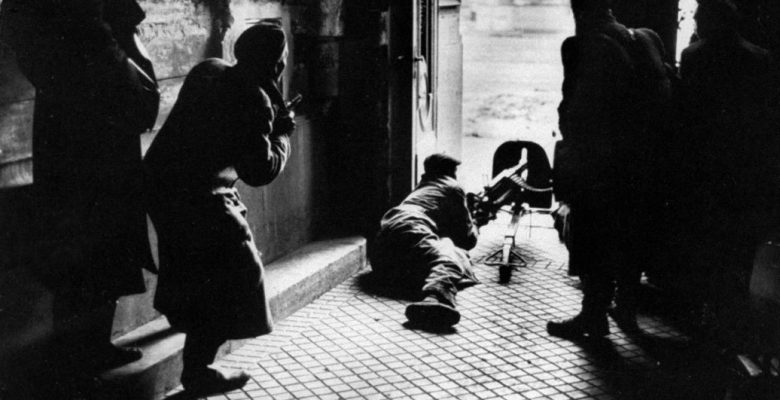
I heard some shots in the night! They came from the Pest side of Freedom Bridge. I was near the Buda side of the bridge, approaching Saint Gellért Square. Suddenly I was fully awake. I could hear the approach of racing automobiles. Two cars were tearing over the bridge, the first small and gray, the second large and black. As the first car got off the bridge and turned left toward the university, it was racing at such a speed that its left wheels lifted off the pavement. There were four people in the car, and in that instant I realized that the car was our own Skoda. Imre Majoross was at the wheel, and Jancsi Danner was sitting next to him in the front.
Now, new shots rang out. I could see the muzzle flash of the submachine gun of a figure leaning out the window of the second car, a Russian Pobjeda, the type used by high Hungarian Party officials. The blasts were deafening, but I could still hear the whistle of the bullets. They seemed to pass right next to my ear. I was startled, frozen with fear, yet this picture, this split-second image, is permanently etched in my memory: Imre, the driver, is leaning forward onto the wheel; Jancsi is sitting up straight. A submachine gun is hanging on Jancsi’s shoulder; he has not even bothered to take it off. The people in the back seat are bending down and forward as low as possible.
The driver of the Pobjeda was a blonde woman in ÁVH uniform. There were two ÁVH officers in the car. One was sitting in the passenger’s seat in the front, the other in the back seat. They were both firing through their open windows on the right side of the car. The Skoda was racing toward the main entrance of the university with the Pobjeda right behind. I saw the two cars just for a moment, then they disappeared behind the chemistry building.
For a few seconds I could not move. I was paralyzed by fear. Then I heard firing once more. It was coming from the direction of the main entrance. I started running in that direction. While I was running, I knew what I needed to do. I was concentrating on looking at the ground to make sure that I did not fall in the darkness. I turned right after the chemistry building. The main entrance was about two hundred, possibly three hundred, yards from me. I could cover that distance in about twenty or thirty seconds. In an unconscious act I took the submachine gun off my shoulder. I had no idea what I would do next, yet I was running as fast as I could. The gun was in my hands, pointing forward.
As I approached the entrance, the darkness cleared a bit, and I could see a little more. The Skoda had turned over. It was on its right side. Jancsi was beneath Imre, who was in the process of climbing out through the door on the top. Jancsi did not move. The Pobjeda had left and was now racing toward Pet_fi Bridge. A dripping sound and some moaning were coming from the Skoda, so I ran toward the disabled car. As I did, I heard another car coming. As I looked up, I saw that the Pobjeda had turned around at the Pet_fi Bridge and was now racing back toward the university’s main entrance.
I jumped behind the trunk of a chestnut tree as the Pobjeda braked to a stop and the goons of the ÁVH jumped out and sprayed the Skoda with more bullets. The flashes of their guns illuminated their faces in the darkness. They were so close that I could see the whites of their eyes. I lifted my submachine gun, rested the muzzle on the tree trunk, aimed, and then tried to pull the trigger, but I could not. I did not know what was happening. I knew they were firing at the Skoda and that I could save Jancsi’s life, yet I could not pull the damn trigger! I checked the safety latch, but it was open. It was not that; it was something else.
It was something in me, some hateful, ugly weakness that made me incapable of protecting my friend, of stopping those animals. It was a frightfully terrible moment. It was a moment when you learn something about yourself. A moment that you will hate for the rest of your life. A moment that you will forever remember, one that will keep you up at night for decades. Something that you will be able to correct only in your dreams—in those glorious dreams in which you act like a man, in which you do what any decent human being should and would do—in those dreams from which you wake drenched in sweat and cold from the realization that it was only a dream, that the moment when you should have pulled that trigger has long passed and will never return.
Suddenly the assassins noticed me, and, like a spring hale, the bullets began pouring down all around my chestnut tree. As the bullets hit the pavement, little puffs of dust rose. I was filled with terror. I could not think at all. I was only an observer watching the actions of my own body as it flew over the six- or seven-foot iron fence of the university—boots, gun, and all—and landed on the other side behind the brick base of the fence. (I will never know how I was able do that. I jumped much higher than ever before, and in full gear.) I peeked out over the low brick wall and saw that the ÁVH murderers were now throwing hand grenades at the entrance. Each time they pulled out the safety latch of a grenade, the igniter spark would illuminate their faces from below. I saw these hate-distorted faces. It seemed that they were not the faces of ÁVH officers, but Satan’s own.
Finally, the Pobjeda left. I was still trembling behind the wall. The thousands of students who were sleeping inside the buildings were beginning to wake up, and now there were some lights in the windows. I heard a tremendous rumbling noise. It sounded as if a thousand garbage cans were rolling toward me. As I climbed over the fence, I saw that tanks were coming from the direction of the chemistry building. The road itself was shaking from their thunder. An officer was walking in front of the tanks. Now he started screaming at the top of his lungs: “Stop or I’ll shoot to kill!” I had no idea who he was yelling at, but I was relieved, because the yelling was in Hungarian. I finally realized that these were our own tanks. Now I heard footsteps running toward me, two soldiers grabbed me, and I was under arrest. A few minutes later, they realized who I was and let me go.
The soldiers surrounded the Skoda, but I did not want to see it. Instead, I delivered the tranquilizers to Pista. His office door was open now. He was awake and was writing something. When I handed him the sedatives, he gave me a long look and said, “They were after me! Jancsi died because of me! I was supposed to be in that car.” I said nothing, but I knew that Jancsi had died because of my inability to kill. After that, he handed me the order to bring blood for the Péterfi Hospital from Vienna. His eyes were bloodshot and his hands were trembling. Kati was trying to make him take some sedatives.
Before we left for Vienna, I had to say farewell to Jancsi. I went looking for him. He was already in the aula. Jancsi Danner’s face was calm, serene. The inescapable moment he had talked about, “the inevitable moment of all heroes,” had arrived. This tall, blond German-Hungarian from Szeged had played his role well. His blue eyes were now closed. He would not go on any more patrols with me. He would no longer talk about the need for a society that brings the best out of people. His act was over, but the play had to go on.
Gabi, his young bride, did not know it yet. She should not see him like this. Jancsi’s body was a mess. We counted twenty-seven bullet holes in it. According to Imre Majoross, the Pobjeda had followed them all the way from the ministry of defense.1
We had to build a bier for him. It was about seven in the morning on this Friday, November 2, when we moved a conference table into the middle of the aula, the very place where the Revolution had started. It was there that I first heard Jancsi’s voice, when he demanded that the MEFESZ delegate from Szeged be allowed to speak. That moment I will never forget! I remember our scared and deadly silence, the paralysis of our souls, and I remember the arrogance of the DISZ penguins with their red neckties and the lonely voice that changed it all, the trembling voice that dared to say, “Let him speak!”
Jancsi’s six-foot, six- or eight-inch body was already stiff, yet I had not, I could not, accept that he was gone. Gyurka and Imre were lifting his body at the shoulders, Sándor Varga and I were lifting his feet. As we carried the body, one of his size twelve or thirteen tattered shoes slipped off. I tried to put it back on, but the foot was stiff. Now my denial was shaken; now I was beginning to fear that this was final, that Jancsi was truly dead.
I made a bewildered, delirious effort to put the shoe back on his foot. I was convinced that if I could do that, somehow everything else would fall into place. If I could only put his shoe back, all other things could still be fixed. If I could put it back, his body would not be so stiff, he could still sit up, he could still tell us the outcome of that meeting he had come from, and most importantly, he could still tell us that there was hope, that it was not over. But the foot was too stiff, the shoe could not be put back on, and under the enormous Hungarian flag, which covered the whole bier, one of Jancsi’s stiff feet remained covered by only a torn sock.
I must have been shaking, because Gyurka brought me the black officer’s raincoat I had left in the MEFESZ office and made me put it on. I also must have looked dazed, because he shook me and slowly asked, “Have you got the orders?” When I nodded, he put his arm over my shoulder and took me to our truck.
The ÁVH and the Russian tanks were gone, the national strike was over, and people were sweeping the streets, filling the bullet holes, and replacing the broken glass in the windows. The capital was getting ready to resume its normal life on the coming Monday. Armed freedom fighters were patrolling the streets and were helping to distribute the food that was brought in by the lorries and trucks of the villagers. The streets of the liberated capital were now flooded with newspapers. They were the first swallows of freedom and democracy. Yet it was hard for me to be happy. Deep down I did know that Jancsi had not died in vain, but it was still hard to truly believe that.
The big bear Gyurka did his best to cheer me up. First, he turned on the radio, which reported that the Soviets had agreed to remove all their troops from Hungary. Because of that, the security council of the United Nations had decided to delay their discussion of the Hungarian situation until Monday, November 5. “You see, things are fine, the Russians are leaving,” Gyurka said. When I remained mute, an unusual state in my case, he changed the subject. He told me that he could not fire at human beings, either—that in all wars some 90 percent of all soldiers fire only into the air. The more he talked, the more I knew that if Gyurka had been in my place, Jancsi would be alive, and the murderous careers of the ÁVH assassins would be over. Eventually, he just let me be and suggested that I read the agent albums I had taken from ÁVH headquarters.
I did what he told me. I picked up the first album and started looking at the photographs of the ÁVH informers of Budapest. The names in this volume started with C and went to F. This single volume must have contained some two hundred to three hundred photographs. Under each photo was the usual personal data, followed by a listing of the types of information that spy had already provided. Some entries were underlined and included such things as “Willing to give false witness.” A few of the informers were homosexuals, and some were members of the previous ruling class, but there were also alcoholics, gamblers, former Nazis, and a surprisingly large number of average people who were just scared or weak but who had nothing to hide. I quickly read all the names, and to my great relief I found no friend or relative in the volume. Afterward, I felt ashamed that I had thought it possible that I might.2
While I read we also listened to Radio Free Europe. We learned that Imre Nagy had fired Peter Koós as Hungary’s UN representative, but Koós had refused to step down. Imre Nagy had also asked the United Nations and the leaders of the four great world powers to guarantee Hungary’s neutrality. Gyurka was very happy to hear that. “This was the formula the UN used to defend South Korea,” he explained. “This is our only security blanket against a new Soviet attack, and it is a good one, too.” He had barely finished the sentence when we saw Russian tanks blocking the road in front of us.
We stopped. Assisting the Russians were some Hungarian ÁVH officers. One of them studied my orders to bring blood from Vienna. He slowly read every word of my order, including the imprints of the stamps. When he saw that the chief of police, Sándor Kopácsi, had also authorized our trip, he said, “Yours is the first truck I am letting through, but they might turn you back at the next roadblock, in Budaörs.” Then he waved us on. I took the paper back but did not reply. I could not bring myself to talk to a turncoat like that. I could not even imagine how he could look at himself in a mirror.
We were still within the city limits of Budapest. Other than our truck, there was no traffic on the road. The ÁVH man was wearing a warm, quilted jacket of the type worn by the Russian soldiers, called a pufajka. The Hungarian ÁVH officers and other renegades who had sided with the enemy were all issued pufajkas by the Russians, who used this as a way of distinguishing their loyal supporters from the rest of us Hungarians. These people we still refer to as the “Pufajkas.”3
As the ÁVH man had predicted, at Budaörs we came to the second roadblock. Wherever I looked there were Russian tanks. The subservient Pufajkas were tagging behind the Russians like tailless dogs. As they checked our travel permit, the Pufajka in charge gave a subservient smile to a Russian tank commander and tried to make conversation with him as he walked by. The Russian spit on the ground and did not reply. He was an older man; perhaps he remembered their own traitors who worked for Hitler during World War II.
I hated those skunks so much that I had even forgotten to be scared. Gyurka had not. When they finally let us through, I noticed that one cigarette was burning in his mouth while he was taking out another and searching for his matches. I guess that was the first time I smiled on that ugly Friday.
There was no traffic on the road. We were around Tatabánya when we finally saw a bus approaching from the opposite direction. It stopped, and some people got out to talk with us. The bus was carrying a delegation from Gy_r. They were on their way to Budapest to meet with Imre Nagy. Gy_r is the center of the northwest region of Hungary, and its Revolutionary Council was in control of the area between Gy_r and Austria. The delegates were surprised to learn that two circles of tanks surrounded Budapest. They did not know that they had to pass through those roadblocks. With our urging, and after a short debate, they decided to go ahead anyway.
As we reached the outskirts of Gy_r we came across another roadblock. This one was manned by Hungarian freedom fighters. When they saw my tricolor armband, national guard certificate, and travel documents, which were signed by both Police Chief Kopácsi and Colonel Marián, they became very interested. We must have been the first people they had seen from Budapest. They wanted to know everything that had happened in the capital. They wanted to know what we thought, what we had heard. It was not easy to leave them. “You must see our leader, the president of the Transdanubian National Council, Attila Szigethy,” said one of them, and he offered to guide us to the city hall.4
It was about noon. There was a lot of traffic on the street leading to city hall. I saw a number of foreign license plates. On our way to meet Attila Szigethy, we walked through crowded corridors, we met crews of Western reporters, and we saw a lot of tumult and confusion. In Szigethy’s office the people looked tired and unshaved. The conference table was full of empty coffee cups and overflowing ashtrays.
There was no question about who was in charge there. It was self-evident who Attila Szigethy was. He was like Colonel Marián in that he, too, was surrounded by a revolving circle of delegates, messengers, and assistants, but he stood out head and shoulders. He was calm, collected, and organized; he was in full control. He led us into his inner office, looked at our papers, wrote down our names, and asked a lot of questions. He was most interested in the Russian roadblocks, in the number of tanks we had seen, and whether we had noticed any movements of the military. He was also interested to learn whether the tanks we had seen had been the old-style ones that were stationed in Hungary or new ones, which had recently arrived from Ukraine and Romania. We told him as much as we knew, including that some of the tanks appeared to be clean and unused. On a slip of paper he wrote down his telephone number and urged us to give him another report when we were on our way back from Vienna.
As we left Gy_r, I started reading the other album, the blue one, that I had taken from the ÁVH headquarters. It dealt with an English military attaché. The material was presented in chronological order. The story started in 1949. Its main subject was an English colonel who had been transferred to Budapest in 1949 but had also traveled a lot outside the country.
The colonel’s first contact with the ÁVH was made through a former Hungarian aristocrat who easily befriended him because the colonel was a monumental snob. For a year they played tarot and socialized. Then after a year, during one of their tarot games, the aristocrat mentioned that he had lost his Swiss-made wristwatch and could not get a replacement in Hungary. The colonel gladly offered to bring him one from his next trip abroad. The blue-blooded ÁVH informer then discretely slipped the colonel an envelope containing twice the purchase price.
A few months later, another of their tarot partners (also an ÁVH operative) repeated the same exercise, but he asked for two watches, one for himself and one for his wife. Photographs of the watches and the envelopes were pasted in the album right next to the narrative.
According to the blue album, by 1951 the colonel was bringing Swiss watches for whole graduating classes and making more on those transactions than his regular salary. At that point a new tarot partner was introduced to the colonel. He made some vague hints suggesting that the colonel’s smuggling activity was not completely unknown to the authorities. The regular tarot game broke up. The ÁVH was watching the colonel to see if he would contact the English Secret Service or if he might harm himself. Other than exhibiting a bit of depression and drinking, the colonel did not do anything else, so in 1952 the Hungarian aristocrat suggested to the colonel that he should hire the aristocrat’s cousin as his maid.
By that point the colonel had a pretty good idea of the reason why this cousin wanted to be his maid. Yet he allowed himself to be drawn into a rather well-documented love affair with her, and in exchange for the female tenderness, or because of fear, he did not notice that she was photographing the documents on his desk.
By 1956 there was no more acting. The aristocrat disappeared, and the maid became the boss and threatened or intimidated the colonel into carrying out spying assignments. The colonel contemplated suicide. He was drinking heavily and had fallen into a permanent state of depression. Whenever he was near a nervous breakdown, they would leave him alone for a few weeks. The entries in the album read like the notes of a psychiatrist. The ÁVH was constantly evaluating the likelihood of his emotional collapse and was balancing the consequences of his committing suicide against the value of his services. In the last entry, which was dated in September, 1956, his “handlers” were so worried that they ordered the “maid” to give the colonel some powerful medication.
I was at this point in my reading when Gyurka stopped, because two policemen were waving at us from the middle of the road. Their uniforms seemed sloppy or the wrong size, and they themselves appeared to be rather disoriented. They asked us about our destination, and we learned that they were from Budapest and wanted to visit their relatives in Mosonmagyaróvár. (Even for Hungarians, the name of this border town is a bit long, so it is often referred to as Magyaróvár or just Óvár.) We told them to jump onto the back of the truck and forgot about them.
The roadblock at Óvár was manned by nervous, trigger-happy freedom fighters. Initially we did not know the cause of their frantic state. They explained that on October 26 the local ÁVH border guards had attacked their peaceful demonstration and had murdered close to a hundred unarmed civilians, including women and children. One of the freedom fighters explained, “The ÁVH border guards were up on a balcony and just kept firing and throwing hand grenades onto the square, which was full of demonstrators. Afterwards, we collected one hundred thirteen unexploded hand grenades among the hundreds of casualties on the pavement.” Another eyewitness added, “Few people have slept in this town since then. Most families are in mourning, you know.”5
They took us to the Agricultural Academy. We went in, but the policemen whom we picked up stayed on the truck. The corpses were laid out in the gymnasium, a sickening and shocking sight. The head of the Revolutionary Council was a mustachioed professor. His eyes were red and his trembling fingers were darkened by nicotine. He was near a nervous breakdown. We told him about our trip and about the situation in Budapest, but he did not seem to comprehend. He kept talking about some escaped ÁVH murderers. As we left Óvár, the freedom fighters at the roadblock wrote down our license plate number and the fact that there were four of us in the truck before they let us pass.
It was late afternoon when we reached the border town of Hegyeshalom. On the Hungarian side there were no border guards, and the customs building was empty. So we just drove through. On the Austrian side, I gave my orders to the border guard. He saluted, called over a translator, and shortly thereafter called his superiors. The Austrians had closed the Hungarian border, but the Red Cross had already notified the border command of our coming. Therefore, when a captain showed up, he gave us not only a temporary pass into Austria, but also a map that showed the location of the hospital where the blood was waiting for us.
I had a funny feeling. For the first time in my life I had entered a foreign country. For the first time in my life, I had left my homeland. It was a strange, almost frightening feeling. I kept telling myself that it was only for a few hours.
As we passed into Austria, a remarkable sight emerged. Hundreds of people and vehicles milled around the Austrian side of the closed border. It was like a country fair or an open market. Cars, buses, and trucks were parked not only on the side of the road, but also on the ploughed fields. I saw scouts, priests and nuns, reporters, ambulances, and truckloads of food and medicine intermixed with a lot of reporters and other curious people.
When they heard that our truck was from Budapest, they surrounded it. We could not move. Some wanted to load oranges and chocolates onto our truck, and a group of Dutch students wanted to come back with us to Budapest to help in defending the capital. They did not seem to understand that this was our fight. They did not seem to comprehend why they could not help in it.
A forest ranger in enormous leather breeches covering his pot belly and wearing a Tyrolian hat with a tuft of chamois hair on top of his cheeky and friendly gray head kept pointing at my cockade and saying something like, “Geschenk.” I did not understand what he wanted. At that point, from his green hunter’s jacket he tore off a hand-carved horn button and handed it to me. Now I understood, so I handed him my tricolor rosette in exchange. There was a sudden silence among the onlookers as that teary-eyed old Austrian, with respectful dignity, pinned on a Hungarian cockade.
It took some time to find the hospital. People were already waiting for us at the door, and when we got there all other activity came to a standstill. Doctors and nurses, elevator operators, and patients were all trying to help load the truck, which was surrounded by a crowd. Strangers were patting my shoulder, and some people cried as they hugged me. No, I did not feel as if I were in a foreign country; I was at home among relatives in Austria.
When we got back to the border, our truck was once again surrounded. They filled the remaining space on the truck with the kinds of fruits I had seldom or never seen. They loaded chocolate bars, candy, colorful boxes, and cans of different shapes and sizes. It seemed as if the contents of a delicatessen had been poured onto our truck. When we were ready to leave, a reporter from Time magazine asked if we would take him to Budapest. I took one last look at the waving crowd as handkerchiefs fluttered in the air. The captain of the border guards stood at stiff attention as we passed through. And then we were back on Hungarian soil.
Back to Testament of Revolution — Table of Contents
 Mondák
 Vicc
 Költő / Író
 Népdal
