








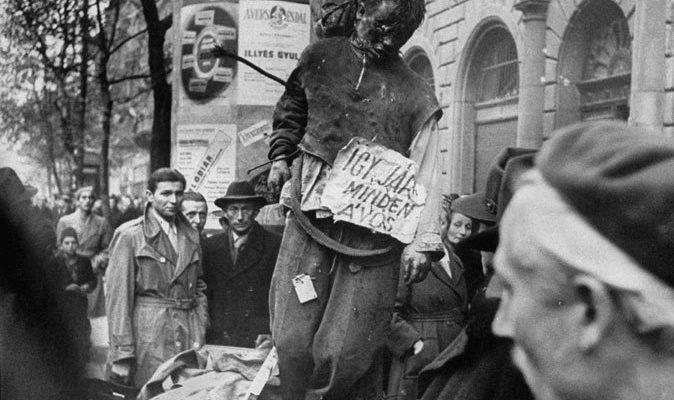
Those Hungarian students and workers and women and fighting children have done more to close the future of Communism than armies of diplomats. They have exposed the brutal hypocrisy of Communism . . . they have torn its mask off. . . . We owe them pride and praise. For their defeat has been itself a triumph.
—Archibald MacLeish
In Vienna, Péter decided that we should go to the United States, which, thanks to a bill introduced by President Eisenhower, gave special permission for 32,000 Hungarian refugees to enter the country.1 A couple of weeks later we arrived in the United States, carried by a military plane and were taken to Camp Kilmer in New Jersey. By Christmas of 1956 some three hundred Hungarian university students were transferred from the camp to a language school at Bard College, a small and progressive college in New York state affiliated with Columbia University. At Bard we learned little English while managing to teach the professors a lot of Hungarian. We also organized the American equivalent of MEFESZ, which we called AHSA (American-Hungarian Student Association). In December 1956 the AHSA members at Bard College elected me as their president, and in that capacity I visited the United Nations, met Povl Bang-Jensen, lectured, and held meetings with international student leaders, including those of the National Student Association of the United States (NSA).2
When the language course at Bard College was over, NSA invited the leaders of our student organization, AHSA, to share their offices in Boston. Besides Péter and me, our initial group included AHSA's unpaid secretary (my future wife), the smart and beautiful Márta Szacsvay; our vice-president, Laci Korbuly; his younger brother Dani; and our secretary general, Feri Gárdonyi.3 In Boston we worked in various jobs (I was a dishwasher, Márta a waitress), and we spent our free time and money to build our student organization. We published a small newsletter, organized lecture tours about the Revolution, tried to secure scholarships for our student members, and prepared a conference in Chicago for the summer of 1957. To the conference we invited a large number of American political leaders, and in response to our invitations we received a number of supporting statements and salutations, including some from the president and the secretary of state.
When September 1957 arrived, we all had scholarships and went off to our different schools to continue our studies. Márta became a drama student at Skidmore College, Péter went to Oklahoma State University to complete his study of animal husbandry, and I went to Stevens Institute of Technology in New Jersey to complete my first degree as a mechanical engineer specializing in ship design.4 Stevens was an outstanding engineering school full of caring and friendly people. The individuals who most stand out in my memory are Professor Frederick Bowes and his wife, a painter, who tried to ease my loneliness and poverty by asking me sit for her (while practicing her painting) and paid me for sitting. As a result of her talent, now I can prove that my beautiful corduroy jacket once in fact existed.
I was in school at Stevens when the news arrived that Ilonka Tóth had been hanged, and I was also in school on June 16, 1958, when I learned that the Soviets had executed Imre Nagy and his cabinet ministers. In response to that outrage, we tried to capture the Soviet UN Consulate on Park Avenue in New York City to establish a representation of the Free Hungarian Government there. This representation would have been headed by Anna Kéthly, the only member of the Nagy government who lived on free soil. The police of New York City did not approve of our plans, and I ended up in jail.
During the Christmas break of 1958, even before we graduated, Márta and I were married.5 Members of the Hungarian student association filled the church of Saint Stephen of Hungary on 82nd Street in New York City. When it was time for me to kneel, I resisted Father Csaba Kilián's hand pressure on my shoulder. He must have thought that I had some objection against kneeling. In fact, I just did not want all our friends to see the holes in the soles of my shoes.
When I graduated in 1959, Márta was still in school. When I started looking for a job in ship design, I quickly learned that I was a "security risk" (because my parents lived behind the Iron Curtain). So I had to look for work in a field that did not involve the navy. This in the long run turned out to be a good thing for me, because it gave me an opportunity to look around and pick a newly emerging field. At that time automation, computers, and the whole profession of process control was new, so I picked that. I started to work for Crawford & Russell (later John Brown). The specialty of that engineering design firm was to build plastics plants. Sam Russell, the president, had been FDR's commissioner for developing a synthetic rubber industry during World War II. When the Japanese cut off America's natural rubber supplies, it was Sam's job to invent that industry. He did that in two years. He was a man of vision and action. It was a pleasure to work for him.
My first monthly paycheck (before taxes) was $450, and the rent of our little apartment was $125. The kids came right away: Ádámka (diminutive for Adam) in 1960 and Cica (Hungarian for Kitty, which I often use instead of her real name, Ágnes) in 1961. So we were poor, but that did not prevent us from paying for a $680 airplane ticket for Memi to visit us and later for the other grandparents to do the same, when the Communist puppets finally gave them visas. We were both going to school at night. I was getting my master's degree in thermodynamics and was learning about computers, while Márta was studying costume design and getting her master's in English literature, which later allowed her to teach that subject at the Stamford High School. Naturally, we had no money for baby-sitters, so we had to pick our evening courses so that one of us stayed with the kids while the other was in school. Particularly for Márta this was a very difficult period, because, unless I used the bicycle, she was left without a car, locked up with the kids all day.
By 1961, Sam Russell appointed me, at the age of twenty-five, to head the automation department. So I got myself some serious, black-rimmed eyeglasses (which I did not need), grew a beard, and tried to act respectable, mature, and experienced. But I still did not dare hire engineers who were much older than I. Therefore, as the department grew from three employees to twenty-six in ten years, I ended up hiring some very smart but totally inexperienced kids straight out of school. Sam loved their low salaries, but because of their lack of experience they had to be quickly taught at least the basics of our profession. So I got permission to spend every Friday teaching them the art (not the science) of process control. My Fridays' notes had accumulated on my desk when one day a visiting editor, an old-fashioned Dutch-American man named Nick Groonevelt—who still parted his hair in the middle—asked me about them. When I explained what they were, he asked, "Do you realize that your profession has no handbook yet?"
"Naturally," I responded. "Would I be teaching from these pages if it did?"
Nick knew a good thing when he saw one and talked me into editing these notes into a three-volume handbook (today I am working on its fourth edition). The handbook set was published in 1969, right after the Soviets suppressed the "Prague Spring." It is for that reason that I dedicated it "To the young people of Hungary and Czechoslovakia". Before publication, I wrote to Edward Teller and asked him to write a preface to it, so that between the dedication, the accents on my name, and his participation, it would be clear to the reader that this was not just a handbook, but a Hungarian contribution to science. Ede Bácsi not only obliged, but spent a whole weekend in the library at Lawrence Livermore Laboratory to learn about my strange and mysterious new field of process control. This was about the same time when another Hungarian refugee of the 1956 Revolution, Andy Grove, formed the Intel Corporation.
In the year 1969, Aptyi died. I was with him and held his hand during the last minutes. The loss I cannot describe. After the funeral, I brought back the family Bible from Hungary. From then on, it became my job to register the births, marriages, and deaths in our growing family. It was then that I stopped thinking of myself as Öcsi and became Béla.
Because of the royalties from my books, for the first time in our lives we started to have some extra money. The kids were still rather young and did not mind spending time with us, so instead of buying a house (we were still renting), we purchased a ski condominium in Vermont. That was one of the best investments we ever made. It not only gave us some lasting friendships, and we not only enjoyed the fresh air and the honest people of Vermont every weekend, but we also had an opportunity for long talks in front of the fireplace in those peaceful evenings on Okemo mountain. I got myself a bright yellow parka so the kids could always see where Papa was on the slopes, even in a fog or when it was snowing. In front of the fireplace I embroidered my yellow ski parka with Hungarian folk motifs. Over the years, that yellow ski parka became just as much part of me as was my corduroy jacket during the Revolution. I was wearing it when in 1992, with other Hungarian environmentalists, I tried to stop the construction of the last monument to Stalinist gigantomania, the diversion of the Danube into a concrete-sealed canal at Gabcikovo. I was also wearing it when we celebrated the 150th anniversary of the 1848 Revolution with Governor Pataki in New York City. During the cultural part of the program the governor turned to his son with the comment: "That was your grandfather's favorite song." It was good to hear that. It is always good to see that even in our overly materialistic and somewhat atomized society the old values of respecting tradition and heritage survive.
In the early 1970s the children reached the age to join the Hungarian Scouts, and on every weekend we took them to New York City for their meetings and to attend the Hungarian School. Since we had to be there anyway, Márta started teaching there, and she also prepared a brand-new textbook for teaching Hungarian. I, too, did some teaching and for a few years became the director of that small weekend school. It was about that same time that Nick Groonevelt talked me into editing yet another handbook: the Environmental Engineers' Handbook. He argued that if I were able to edit the handbook of one new profession, I should be able to do it for another one as well. I enjoyed working on that three-volume set (it covered air, water, and land pollution) and learned a lot in the process. Today, it has also been published in an electronic format on CD.
In 1975 I finally opened my own consulting firm. It was hard to leave Sam Russell and all the good friends at the office, which I had been bicycling to since 1959. I am still in contact with many of those fine engineers today. After opening my own office, I got very lucky. My first clients included IBM, Hewlett Packard, the National Aeronautics and Space Administration, and the U.S. Department of Energy. At times I was sitting at the same table with Bill Gates, who was pitching his QDOS (Quick and Dirty Operating System), while I presented my "Digital Maid," the home computer that made coffee, opened windows, reported blood pressure, refilled the refrigerator, and much more. For IBM I directed a corporationwide effort to minimize energy consumption, reduce pollution, and increase chip production at fifty-three IBM sites. I also assisted in Jimmy Carter's effort to make the United States energy independent by designing the plants for converting our abundant coal supplies into synthetic fuel. Unfortunately, President Reagan put an end to that program by deciding that it was easier to send the marines to the Middle East than to build coal conversion plants.
To counterbalance all the good things that happened to me in the United States, I also got some bad news from Hungary. In 1977 I learned that the Soviets, in order to obtain a convenient route for their navy into the heart of Europe, forced Hungary and Czechoslovakia to agree on a project that would take the Danube out of its natural riverbed and reroute it into a concrete-sealed canal on Slovak territory. That project was bound to destroy the unique life forms that had evolved in Europe's only inland sea delta, the delta of the ancient Pannon Sea, called the Szigetköz. In 1977 I did not take such madness seriously; I did not believe that it could actually materialize.
In the 1980s Márta concluded her teaching career, and we built a studio for her. Ever since, she has been working as a ceramic artist and has created some outstanding objects of beauty. Our children were getting their degrees, Ádámka at Columbia and Yale, Cica at Cornell and the Sorbonne. For me the 1980s was the decade when I got involved (working in Hungary with my good friend from the MEFESZ days, Imre Mécs, whose death sentence was commuted in 1963) in an effort to find the grave of our executed prime minister, Imre Nagy. I also helped the underground democratic press, the young "samizdat" movement, which needed copiers and paper supplies for their publications. The secret police were constantly following me, but I got used to that. Then one day in 1983, when I was having coffee in the dining car of a train, the three familiar faces of my "trailers" showed up again. One of them walked directly into me, and after I regained my balance, I noticed that my coffee tasted strange.
I do not know what happened, but after drinking that coffee I must have acted strangely, because Árpád Göncz (the president of Hungary until recently, then a prominent member of the opposition) drove me to a taxi station to get me back to Budapest. I understand that I made some suicide attempts, and after those I received four electroshock treatments in a hospital. When I recovered from the effects of that strange-tasting coffee, my memory was a mess. As a consequence of not remembering the million specifics of my consulting jobs, I lost some of my clients. This was particularly unfortunate in the case of IBM, because I had designed their headquarters at 590 Madison Avenue in New York as the first "self-heating" building in that city, and I could not even remember my own design.
My recovery, the gradual return of some of my memory, took a long time. In order to make a living, I had to make some changes. One change was the realization that if I could no longer do it, I could still teach it. So I accepted an invitation to become an adjunct professor of process control at Yale University and also gave courses and seminars to other institutions and companies. Even during that difficult period I did not stop my search for the grave of Imre Nagy, and, as a result, on October 9, 1985, I was able to report the location of his grave in an op-ed article in the Wall Street Journal. In 1989 Imre Nagy was finally given a formal funeral and was buried in a temporary grave.
In 1985 János Szentágothai, the president of the Hungarian Academy of Science, and Sándor Szalai, the person leading the academy's Danube committee, asked for my help. They felt that the monstrous Danube diversion project could not be stopped without Western help, and believed that I (the editor of the Environmental Engineers' Handbook) was the natural person to help them. First I hesitated, but when I learned that even on his deathbed Dr. Szalai was urging his daughters to talk me into facing up to this challenge (which he no longer could—he died from cancer), I got involved. In the years that followed I have spent a great deal of my time (and a fair amount of our savings) in fighting this project of environmental devastation. I organized meetings, lectures, and demonstrations; visited world leaders; and published articles. In that process I also learned a lot about the combined strength of the ultranationalist fanatics of "greater" Slovakia, of cronyism among the former Communists, and of western financial institutions (Austrian and American banks) that were supporting the "concrete lobby" with their loans.
At the time of the collapse of the Soviet empire in 1989, I was positive that we would be among those emigrants who would return to a free Hungary and would help in the rebuilding of our homeland. It did not happen. Part of the reason was that we could not separate ourselves from our children, and the other part was that while I remained 100 percent Hungarian, I also had become 100 percent American. Neither of my loyalties took anything away from the other; they were like the difference between love of one's mother and love of one's wife. Yet becoming a 200-percent person did change something in me. I was no longer an unconditional Hungarian; I could not accept the deals and compromises that were being made.
I felt an outrage when I saw that there would not be even a mini-Nuremberg (probably because of some deal between President Reagan and Premier Gorbachev) and that the guilty would not even be identified. I was equally angry to see that instead of returning private property to the people from whom it was taken, many Communist collaborators managed to "privatize" the national wealth into their own pockets. I just could not stand the idea of a new Hungary built on lies, cover-ups, and theft.
In 1992, on October 23, the Slovak nationalist fanatic Vladimir Meciar blocked the natural flow of our border river, the Danube, and diverted it into Slovak territory. I was there in my yellow ski parka at the head of 647 demonstrators to try to stop the trucks carrying the concrete blocks with which they closed the riverbed, but we failed to stop them. We were dragged away from the trucks and Slovakia got "greater" by murdering a river. After that, I also went to The Hague when the International Court of Justice discussed this case, the first international environmental lawsuit ever. I am still working on this today. I am hopeful that the expansion of the European Union will eventually bring a sense of fairness and environmental consciousness to Slovakia, too. I have prepared a compromise plan that would allow the Gabcikovo Dam to function while returning the Danube to her natural riverbed and allowing the species that evolved in this delta of the ancient Pannon Sea to recover.6
In the 1990s our family grew. Ádámka married Jennifer Bitman, and they gave us two grandchildren: Ivan and Katie.7 In 1998 Cica (Ágnes) married Richard Lawrence and increased the number of our grandchildren to three by the addition of the little blonde Ava.8 As I am writing these words, I am also thinking of my grandchildren, hoping that one day they might read this memoir.
It was in 1998 that the first sculpture honoring the Revolution was erected in Hungary. It was created by Miklós Meloccó, the son of the reporter János Meloccó, who was hanged because he dared to write about the Communists' drugging of Cardinal Mindszenty. In Miklós Meloccó's sculpture the baby butterfly of liberty is depicted as people are desperately trying to help it to fly. He used real people for his figures: Jancsi Danner is behind the statue, fallen down on the ground, while I am the third from the front on the left side of the sculpture. Another honor that I cherish is the Imre Nagy plaque, which I received from President Árpád Göncz in October, 1999.
Our calendar has entered the third millennium, and the state of Hungary has entered her second. It is a sad new beginning for us Hungarians. It is sad partly because historic Hungary has been split up among nine states, and thus Hungarians have become one of the largest minorities in all of Europe. It is also a sad period because mankind seems to pay attention only to the violent, and the Hungarian minorities are a nonviolent people who believe in democracy and self-determination. I do hope that the attitude of the our leaders will change. I hope that the Hungarians of Vojvodina will eventually receive the same protection as did the Albanians of Kosovo. Similarly, I hope that school and church properties will be returned to all Hungarian minorities and that the autonomy of the Hungarian communities of Yugoslavia, Romania, and Slovakia will eventually be restored. But most important, I hope that the European Community will expand into the region so that state borders will become transparent and my divided nation can be at least be culturally reunited. And finally, I hope that now, when a new generation of Hungarian leaders is starting to lay the foundations of Hungary's next millennium, they will rely on the ideals of the 1956 Revolution.
Back to Testament of Revolution — Table of Contents
 Mondák
 Vicc
 Költő / Író
 Népdal
