








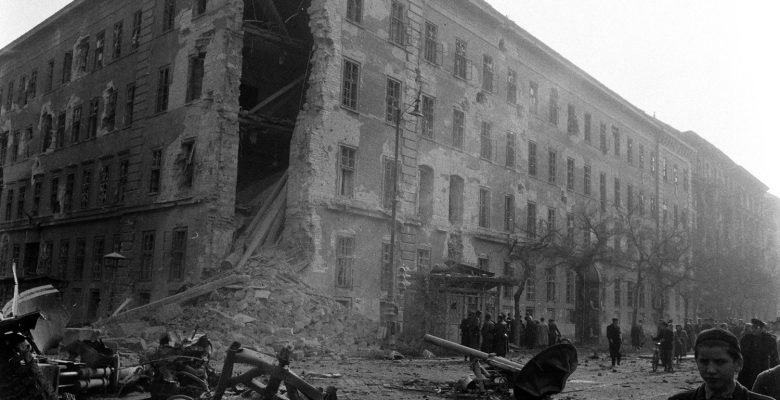
If ten or so Hungarian writers had been shot at the right moment, the revolution would never have occurred.
—Nikita Khrushchev
It was a cloudy Sunday afternoon. People were walking their dogs on the mountain of Saint Gellért on the banks of the Danube in the middle of Budapest. Gellért became a saint when some one thousand years ago the Hungarians got tired of listening to the sermons of this Italian priest and threw him off these cliffs. I loved to walk on that hill and take in the panoramic view of this beautiful city.
I had no money left after I paid the entrance fee to get into the Gellért spa, but that did not bother me. I knew that tomorrow I would get my monthly scholarship of 140 forints.1 Budapest is a city of spas; it is sitting on what used to be the bottom of the ancient Pannon Sea. In almost every city block there is a public bath, each supplied by a natural spring. Some are medicinal, as their waters contain various minerals, while others are just hot-water springs. At the Gellért there are both kinds, but this time I did not come to soak but to loosen up. I swam my usual fifty laps, glanced at the clock, and got out of the water. I had only twenty minutes to change and get to the high-jump competition. I was running as I got to the streetcar station on Béla Bartók Street.
The yellow No. 47 tram was screeching as it made the ninety-degree turn onto Freedom Bridge. (That bridge used to be named after the king of Hungary, Franz Joseph, but like everything else, it too was renamed by the Communists.) It took only three or four long steps to reach the last car and jump onto it. The ticket collector, a big-busted blonde woman, was right there on the dirty back platform. She barked at the young man standing next to me, “No standing on the stairs! Please come up to the platform!”
He moved up. I stayed on the stairs. I knew that being 187 centimeters tall (6 feet, 2 inches), I was tall enough for her to think that I was already up. I must be six inches taller than the average Hungarian. That is almost the height of one step on the stairs. I was right; the ticket collector did not bother me. I was poised for a quick jump and dash to the sports field when I reached my stop.
I was so impatient, so afraid of being late for the competition, that I decided to jump off the tram between stops, right in front of the Kinizsi sports field in the district of Ferencváros. Actually, I was pretty good at jumping off. I practiced it a lot and knew that you have to jump backward to reduce the forward speed, and when your shoes come in contact with the pavement, run like hell. The trick is to do this while facing forward and to start running during the flight, so that when you hit the pavement you are already running like crazy and will not fall on your face—which, at thirty miles an hour, is no fun at all.
I quickly changed into my slightly dirty red-and-white jumping outfit and put on my spiked and rather stinking jumping shoes in the equally smelly changing room. I liked my red athletic tricots, because they made my skinny upper body look more muscular. The jumping competition had already started. The bar was at 130 centimeters. When I checked in, the coach, Jani Bácsi, gave me an annoyed bark. “Hey, are you another one of those conceited prima donas? You don’t even show up until we pass one-thirty? Or was it Ágnes?”
I acted as if I did not hear him and concentrated on bending, stretching, and loosening my muscles. I was surprised that he remembered Ágnes. Jani Bácsi did not see my fifteen-year-old (well, almost sixteen-), green-eyed little girl friend more than once or twice, when she waited for me after a training session. So how could he remember?
When I got in line, the bar was already at 140. There were two jumpers ahead of me. The first was a spectacled, redheaded fellow. He took off his glasses and ran directly at the bar, jumping headfirst in the newly fashionable “rolling” style. He cleared. The next jumper, a tall, blond guy, used the same “scissoring” technique as I, except that he pushed off from his left foot and therefore approached the bar from the right. He also cleared. Now it was my turn. I ran at the bar from the left, kicked off when I was almost completely under it, felt a good lift . . . and then my left knee hit the bar. While I was spitting out the sand I had swallowed on landing, the judge yelled, “Number twenty-nine! Second try!” I walked back and got ready to try again.
I cleared 140 on the second try and that made me less nervous. I cleared 150 on the first try, and by a good margin. I actually got a “Not bad, number twenty-nine” from the judge. At this point, out of the fifty or so jumpers at this meet, only about half were still in the competition. My best jump to date was 155. But on this day I felt particularly good and cleared 155 with no difficulty at all. At 160 I got a bit scared. The bar was high enough for my mother or Ágnes to walk under! I missed twice but cleared it on the third try. Wow! That felt good! There were only six of us left, and now a few spectators started to gather around the jumping area. It felt good to be the center of attention. Just their presence gave me more energy and confidence. Among the spectators was a friend, a fellow student, Attila, and a petite blonde runner, Marika, the bride of another friend, Gyuszi Perr. She was so vibrant, so full of energy. When I cleared 165 and was basking in the kudos from the crowd, she came up to me, jabbed a finger into my gut, and proclaimed, “Just like a field frog!”
I started taking off my jumping shoes, but Jani Bácsi stopped me. “Don’t you want to try for one-seventy? If you clear, you get a medal!”
But I was thinking of something else. “We have no bread at home and it’s my job to bring some for dinner,” I replied.
“Bread on Sunday?” mused Jani Bácsi.
“Yeah,” I told him, “The Közért on Baross Square is open until six, so I have to run!”2
When one is twenty and has not eaten since morning, the smell of freshly baked bread is very special. The 2-kilogram (4.4-pound) loaf cost 6.80 forints. Memi had given me ten for the bread, and I had two of my own, which I had spent to get into the Gellért spa. So Memi’s ten was just enough for the bread and to call Ágnes. I was hoping we could make plans to see a popular Italian movie, The Women of Selistye, the next day. The movie was to start at 4:00 P.M. Her classes would be over by then. Of course I did not have money for the movie tickets either, but tomorrow would be October 22, so I would try to get my November stipend of 140 forints. God, that was a lot of money! I would be rich tomorrow!3
It took more than an hour to get from the Közért to our house in Kerepes. I did not even notice that half the bread was gone by the time I got to our gate. I first picked at the crust, then the insides. It was warm and tasted so good. As I opened the creaking iron gate of the house, my young German shepherd, Bukucs, ran to me at full speed. She was just crazy about me. Nobody ever loved me like that. I do not know why I deserved it. Was it my smell? Was this my reward for keeping my urges for personal hygiene under control? She just rubbed her nose to my knee and could not stop licking and jumping. Was she trying to remind me that it had been some time since I went with her—only her—for a full day in the woods? Did she have the urge for another trip for mushroom picking and bird watching? Was she trying to make that point?
The light was on in the kitchen, and as I stepped through the door my younger brother, Andris, started yelling, “Öcsi ate the bread! Öcsi ate the bread!”
Andris was four years younger than I, a skinny crybaby, but he still called me Öcsi, “little brother.” I got the name before he was born, when I was the little one compared to my older brother, Péter. So at that time it made sense, but the name stuck to me, as do most family nicknames.
In the corner of the kitchen my father, Aptyi, was talking excitedly with two of our neighbors. Their hats were still on and their hands held half-empty wine glasses. I heard the mispronounced name Eisenhoffer—Eisenhower—over and over again, but I was not paying much attention. Memi took the bread—in fact, confiscated it—with the declaration, “For tomorrow’s sandwiches!” She gave me a bowl of steaming hot bean soup, but no bread.
Péter was reading in the next room, and Nagymemi, my maternal grandmother, was slowly moving back into her room. As always, she had her winter coat on. We did not heat the house until it got very cold, and this was only October.
“I cleared 165,” I said to no one in particular.
The room fell silent for a few seconds as Aptyi looked at me proudly and Memi promptly went to the doorpost, where the heights of the family members were marked and dated, to see how high 165 centimeters was. Andris exclaimed, “My foot! You did not!” Now that was a real brotherly compliment.
After dinner—my bowl of soup—I threw my drafting board on the kitchen table and started working on the ball-bearing design that I had to hand in the next day. I already had the outlines drawn in light pencil. What was left to do was to mark over the pencil-drawn lines in black India ink. I used a razor blade to scrape out the slightest mistakes and commented to Andris, “Appearance is everything to Professor Vörös. This machine-design professor doesn’t care if the balls are cubical as long as the drawing is neat.”
I was still working when the neighbors started saying their good-byes. It is said that Hungarians have a tendency to say good-bye and stay, but this is a slight exaggeration. They eventually do leave. It just takes them longer than anybody else.
Memi finished cleaning up and was off to bed. Aptyi checked on the animals (we had a milk cow, a horse, a couple of goats, pigs, and a bunch of chickens) before following her to their bedroom. It was well after midnight—Andris and Péter were already snoring—when I finally rolled up my drawing and hit the bed myself. We had three rooms. We called one of them the bedroom, the others the living room and the dining room, but at night we slept in all three of them.
The next morning, Memi tried to wake me at 6:00 and again at 6:15. There was no heat in the house, and the bathroom was dreadfully cold, so who wanted to get up? The toilet did not flush. The “hot” water was cold. And everybody wanted—or needed—to get in there at the same time. I finally got out of bed and dressed quickly.
My sandals were cold for October, but I certainly was not going to wear out my beautiful new csukas, my shoes with the two-inch-thick synthetic rubber soles. I had spent all my earnings of the last summer (nine hundred forints) to buy my csukas. This summer’s earnings were spent on an equally smart purple corduroy jacket. We received no stipends during the summer months, and I spent all my earnings this summer on that jacket. I had never had new shoes before. So on this day, October 22, I wore only the sandals along with my jampec (teddy-boy) pants, which were so tight below the knee that I needed to open zippers to get into them.
I did wear my new corduroy jacket. It was tailor-made. It had cost me the equivalent of ten weeks’ wages. It was my first and only tailor-made jacket. It gave me broad shoulders and a muscular, dashing look. More important, it gave Ágnes an armpit to nest in whenever we walked. It was as though that warm niche was made just for her, and she loved it. She would look up from there with a mischievous twinkle in her eye while contemplating whether she should trip me or whether an unexpected shove with her little bum would do.
I left the house at 6:35. The train would leave at 6:52. I needed twenty minutes to walk to the station, so I walked with a fast pace. I passed Éva Ordassy, another beauty I was in love with (without her knowledge). She was on her way to the Teachers’ College. That encounter told me that I was in trouble; she was catching the 7:02 local. I had to pick up my pace. So I started to run like a gazelle, which was not easy in sandals and with the drawing of the ball bearings and the books tucked under my arm.
It was 6:51 when I got to the top of the hill. I could see the train coming in, and I was still three hundred meters from the station. Now I ran like my life depended on it. I still had another two hundred meters to go when the train stopped in the station, one hundred when the last passenger boarded, and fifty when the train started to move again. My friend Tibi Bakonyi had noticed me running and was holding the door open for me on the last car. The train was already picking up speed when I grabbed the handle with my right hand and was yanked forward by it. I flew up onto the stairs with the drawing and books safe under my left arm. I had made it!
Though Tibi was my friend, he pretended to be uninterested in the world around him. He was constantly playing it cool. His pitch-black hair was always neatly combed. He also owned an authentic Pelikan fountain pen, a real treasure, especially for a student. Tibi’s father—his name was Aladár and we called him Aladár Bácsi—had been one of the Regent’s guards.4 He had lost his right leg during the fighting in October, 1944, when the German SS occupied the palace and arrested Miklós Horthy. Now, twelve years later, Aladár Bácsi still hated the occupiers, all occupiers, including our current ones, the Russians.
That morning, my cool and aloof friend Tibi was playing tarots. According to Tibi, tarots was the aristocrat of card games. To him, it compared rather favorably with bridge: highbrow to lowbrow. It was also the card game of the opposition—any and all types of opposition, opposition to anything. There is no such person as a conformist tarot player.
My mother’s first love, János Melocco, was a tarot player. Later he became a reporter for a Catholic newspaper. We called him János Bácsi, and the woman who became his wife we called Dóra Néni.
When János Bácsi found out that the Communists had drugged Cardinal Mindszenty during his staged trial in order to make him “confess” to his “crimes,” he tried to publish an article about it, and for that “crime” he was hanged.5 The delicate Communist method of notifying Dóra Néni of her husband’s fate was to send her a package containing his clothing with a printed form. The form stated that his hanging was a state secret, not to be discussed with anyone. There was no other explanation—nothing.6 None was needed. We all knew that this was the way the “heroic” Soviet people performed their struggle against the reactionary, counterrevolutionary, chauvinistic enemies of the state. This was how the Communists “fought for peace.”
When the train got in, in order to be on time for my first class at the Technical University, I did my usual running and streetcar jumping. I scaled the many stairs leading up to the main entrance of the university two at a time. Every time I did that, I still marveled at this majestic jewel of Hungarian architecture on the banks of the Danube. My first class was Machine Design 302, surely the most boring subject any junior of mechanical engineering ever had to endure. I turned in my ball bearing drawing and settled down next to Attila Lipcsey, who commented, “If I knew about India ink when I applied for admission to this university, I would have tried for music school.” I chuckled. For my own part (being Category X and the son of a state enemy), I was grateful to be admitted anywhere.
I started reading the sports paper, which reported on the previous day’s athletic competition. “Yeah!” I blurted out, “Varga took the bronze!” Professor Vörös, in the middle of his lecture, stopped in midsentence, and some two hundred heads turned toward me, so I shut up.
At lunchtime, on the way to the cafeteria, I stopped at the scholarship office and felt lucky, because my favorite administrator was there. She was a Communist Party activist or something, but in spite of all that she still was a good woman. I told her that I was penniless and wanted to get my November scholarship early.
She chided, “But this is only the twenty-second of October!”
I pleaded, “Yes, but Ágnes and I would like to see this movie, The Women of Selistye. It’s an Italian movie. And today is the last day they are showing it.”
“I know that The Women of Selistye is an Italian movie,” she said, seeming to imply that not all party secretaries were complete morons.
I did not debate the point, just continued pleading. “You know, Ágnes is only fifteen, though she is going to be sixteen next month. For her, seeing this movie is very important. Besides, the national economy is not going to collapse if I get my 140 forints of stipend four days early, now, will it?”
She smiled, opened the safe, and counted out the money. As she handed it over, she reminded me: “You know about the meeting in the aula at two o’clock. Be there! It is going to be a very important meeting.”
I could not resist. “Another one of those very important ones? What is it this time? Are we intensifying the fight for peace or just reestablishing our eternal friendship with Mongolia?”
“No, this is important! It is about Poland and Poznan.”
Of course I did not believe her. Yet her face was serious, so I just shut up and backed out of her office.
I called Ágnes from the cafeteria. She was home for lunch. I could hear her jumping up and down as we talked. She wanted to see this movie very badly, and her mouth was running at twice the speed of her brain. It made me happy that she was so excited. It was worth pleading a little to get that money. I assured her, “Yes sweetheart, I will see you at the Bástya movie house at four!”
And she in turn assured me, “You bet you will! Yes, sure, definitely, absolutely, and in addition certainly. I will be there even if mini-Gypsies are falling from the sky!”
During lunch Attila and I bumped into another friend, Gyuri Egry. His nickname was Men_, which suggested a person who was “with it,” who was “going places.” He told us that on the previous Saturday in the city of Szeged there had been a meeting at which an independent student organization, MEFESZ, was established. (MEFESZ was the Hungarian acronym for the League of Hungarian University and College Student Associations. Members were the associations themselves; the MEFESZ had no individual membership.) That was unbelievable news. No independent organization of any kind existed in the country. The Communists ran everything.
Men_ was a close friend and classmate, also a junior in mechanical engineering and an inch or two taller than I. He had a long, always smiling horse face and walked like a camel, with his toes turned in, swaying from side to side. Yet even with that unusual gait he was a basketball player. During the past summer’s military training, we both had marched, in the front row of our platoon in tennis shoes, because none of the boots were big enough for us. I suspect that the reason the Russians did not occupy Scandinavia was that the Red Army lacked the shoe sizes for the male population there.
I asked Men_, “Are you coming to this meeting at two?”
He gave me a casual “Yeah, it can’t hurt.”
“It can hurt me,” I said. “If I miss the movie at four, Ágnes will never forgive me!”
“So what? You leave at half past three. End of discussion.”
After lunch Attila and I decided to visit the “Gellért department.” Attila did not understand why I liked to visit the Cliff Chapel, the church in one of the caves of Gellért Hill. I never told him that my mother, as a teenager, spent a whole night praying in that chapel because she had missed her curfew by a few minutes and was afraid to go home. That tells you something about my grandfather. He was a tough little Austro-Hungarian colonel who in 1915 participated in the beating of the Serbian army after a Serb nationalist killed Francis Ferdinand. After that bloody war he came home and proceeded to translate the poems of such French poets as Mallarmé, Rimbaud, and Verlaine. He was a strange fellow, to say the least.
Back to Testament of Revolution — Table of Contents
 Mondák
 Vicc
 Költő / Író
 Népdal
