




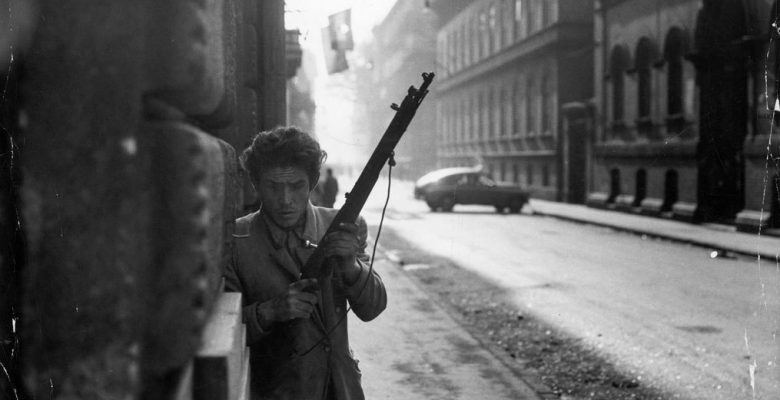
This is not a history book. It is a memoir of one who in 1956 was a twenty-year-old student in Hungary and today is a sixty-four-year-old grandfather in the United States. In a way, this book is written by both of us. This prologue, the postscript, and some footnotes have been prepared in 2000 by my grandfather-self (Béla), while the memoir itself was written by my student-self (Öcsi) in an Austrian refugee camp in December 1956. Béla is a common given name in Hungary, while Öcsi is an equally common nickname there, meaning little brother. In 1956 everybody called me that. Throughout the book I use real names and describe actual events.
The memoir is presented in fifteen chapters. Before starting the memoir I have inserted a brief summary of the history of Hungary followed by a description of my own family, so when you start the first chapter, which begins on October 21, 1956, you will have a better feel of where the events are taking place and who the participants are. You should also know that this book is dedicated to two martyrs of the Revolution, one a devoted Christian, the other an agnostic Jew. After reading the paragraphs on Hungary's history, you will better understand why I mention that István Angyal was Jewish.
<HA>Hungary's History
<TXT>For one thousand years Hungary occupied the oval-shaped central plain of the Danubian Basin, which was once the Roman provinces of Pannonia and Dacia, an area surrounded by the protective bulwark of the Carpathian Mountains. Hungary was a tolerant and multiethnic kingdom that served not only as a balancing power between Slavic and Germanic nations but also as the eastern bulwark of Europe. The first king of Hungary, Saint Stephen, wrote to his son: "Make the strangers welcome in this land, let them keep their languages and customs, for weak and fragile is the realm which is based on a single language or a single set of customs." Throughout the centuries Stephen's advice was respected, and eventually fourteen nationalities composed the kingdom of Hungary, with Latin being its official language until 1844.1
In 1222 the privileges of Hungary's nobility were set down on paper, and the beginnings of a parliament were established in the "Golden Bull," which document is junior to the English Magna Carta by only five years. During the reign of the Renaissance king Matthias Corvinus, Hungary's population equaled that of England, the court of Buda became one of the cultural centers of Europe, and the library of Buda was one of Europe's finest. After that golden age, one tragedy followed another.
In 1526 the Turks occupied central Hungary. The western parts of the country were taken by the Habsburgs, and for 150 years only the eastern parts of the country remained under Hungarian control. That part (Transylvania, today part of Romania) is where Béla Bartók collected his Hungarian folk tunes. Transylvania is also the place where the Hungarian Diet (an assembly of noblemen similar to a parliament) at Torda in 1568 proclaimed the freedom of religion for the four "received" religions (the Catholic, Calvinist, Lutheran, and Unitarian faiths). It was also in Transylvania that Francis David in 1560 laid the foundation of the Unitarian Church. After the end of Turkish occupation, the Habsburgs attempted to take over all of Hungary.
The first fight for Hungarian independence (1703–11) was led by Francis II Rákóczy (1676–1735), and the second (1848–49) by Louis Kossuth (1802–94). Kossuth was the second foreigner ever to be invited to address the U.S. Congress (1852), and it was also Kossuth who later suggested converting the Austro-Hungarian duality, which was formed in 1867, into a Danubian Confederation, a united states of Central Europe. This was Kossuth in his nineties, who said, "Whenever a power vacuum evolved in the Carpathian Basin, the Balkans became unstable, and no outside power can permanently fill such vacuum, because all outsiders lose interest after a few years."2
The period between the formation of the Austro-Hungarian duality (1867) and World War I was not only a period of great progress for Hungary but also the golden age of Hungarian Jewry. There was no official anti-Semitism (although there was some popular anti-Semitism in Hungary), and Jews were treated with much more tolerance and enjoyed greater opportunities for upward mobility than elsewhere in Europe. In gratitude for being accepted, the Jews of Hungary assimilated and became Hungarian patriots. The unique mix of Hungarian and Jewish talent resulted in contributions that are relevant in science and in all the fields of scholarly and artistic endeavor.3
At the beginning of the twentieth century Russia started to sponsor pan-Slavic agitation and a drive for a Greater Serbia. Archduke Francis Ferdinand opposed it, and for that reason the Serbian nationalists ordered his assassination. He was murdered in 1914 in the same city (Sarajevo) where, eighty years later, the Bosnian War would begin. The retaliation against Serbia (opposed by Count Stephen Tisza of Hungary, who argued that a whole nation should not be held responsible for the acts of a few fanatics) ignited World War I.
During the war, the Czech leaders Eduard Benes and Thomas Masaryk supported the pan-Slavic ambitions of Russia and Serbia. They organized a propaganda campaign, suggesting that French dominance of Europe could be achieved only if Hungary were dismembered. Two French politicians, Georges Clemenceau and Raymond Poincaré, agreed to support the plan, while President Woodrow Wilson opposed it—he preferred borders that corresponded to ethnic frontiers. Still, the Treaty of Trianon was implemented, and Hungary was dismembered. President Wilson called this step "absurd," and the U.S. Congress refused to approve either the Treaty of Versailles (1919) or the Treaty of Trianon (1920), and in 1921 the United States signed a separate treaty with Hungary. While the prevailing mood of isolationism in the U.S. Senate played a part in this rejection, the main reason was the Senate's sense of fairness and its desire not to be tainted by the obvious injustice of Trianon.
As a result of Trianon, Hungary's territory was reduced by two-thirds, and the Hungarians became Europe's largest ethnic minority. They became foreigners in other peoples' lands without ever leaving their thousand-year-old hometowns, because the borders had been redrawn around them. Towns were separated from their suburbs, villages were split in two, and communities were cut off from their railroad stations or water supplies. From the fragments of the Hungarian kingdom, the artificial and unstable entities of Czechoslovakia, Yugoslavia, and greater Romania were created.
The chaos that followed World War I resulted in a short-lived Communist dictatorship in "mini-Hungary." This "red" dictatorship of the proletariat was directed by Béla Kun (1886–1937), whose brutality, and the fact that he was Jewish, later resulted in both "white terrorist" reprisals and the rekindling of anti-Jewish sentiments in the country. The Kun government was followed by the conservative reign of Admiral Horthy (1868–1957), who initially cooperated with Mussolini in the hopes that Il Duce would help Hungary regain her lost territories. After the suicide of premier Pál Teleki, that desire tragically led Hungary first to declare war on Serbia and the Soviet Union (June, 1941) and later to halfheartedly support the German war effort by sending some of her military forces to the eastern front only while holding her antiaircraft fire when western aircraft passed over Hungarian territory.
During World War II, Hungary became a sanctuary for Jews; she gave shelter to about a quarter million refugees from Poland and Ukraine. The Jews of Hungary would have survived the war if Germany had not occupied the country. Unfortunately, when the Germans no longer viewed Admiral Horthy as reliable—and because they wanted to deport Hungarian Jews—in March, 1944, the German army occupied Hungary, and a few months later, in October of that year, it overthrew the Horthy regime and arrested the admiral. After German occupation, over half a million Hungarian and foreign Jews were deported (as a child, Pista Angyal—one of those to whom this volume is dedicated—was one of them), but the majority of the Jews of Budapest survived. They were saved by the heroic deeds of both Hungarians, such as Colonel Koszorús, who on July 6, 1944, militarily evicted Eichmann's supporters from the capital, and by foreigners, such as the Swedish diplomat Raul Wallenberg, who provided many safe houses and false identity papers to Jews.
At the end of World War II, Hungary was occupied by Soviet forces, but she still managed to hold reasonably free elections in 1945 and 1947. In the first election the Communist Party received only 17 percent of the vote, but after that, because of Soviet pressure, the party gained control of the ministry of the interior. First some key politicians were arrested by the secret police (the ÁVH), then democratic institutions were gradually eliminated, and by 1949 the Communist Party gained full control. The Soviets organized a secret police and appointed a puppet government, both dominated by Jewish Hungarians. This was a conscious effort on the part of the occupiers to deflect and redirect the loathing of the public from themselves to the Jews. This puppet government, headed by Mátyás Rákosi, eliminated all democratic institutions, nationalized industry, closed the private schools, confiscated the land of the farmers, arrested Cardinal József Mindszenty, and, in order to obtain housing for the Communists and their collaborators, deported most of the middle class from Budapest.
These actions destroyed not only the nation's economy but also her agriculture, which used to be one of Europe's best. To reverse this trend, the Soviets in the mid-1950s began to promote some reform-minded Communists, such as Imre Nagy, who was considered to be a friend of the farmers. In 1955 the puppet government of Hungary joined the Warsaw Treaty Organization and thereby gave the "right to the brotherly socialist states to defend Hungary," even against her own people. The situation in Poland was not any better, and in October 1956 strikes broke out in the Polish city of Poznan. The news of these strikes triggered the events in Hungary that are the subject of this book.
<HA>My Family
<TXT>My grandfather, Dr. Pál Lipták, was born in 1876 as one of ten children of a poor carpenter in a small town named Békéscsaba. Thanks to the educational policy of the Hungarian kingdom and to the personal efforts of one of its cabinet ministers, Gábor Baross, all my grandfather's education was paid for by the government. In 1906 he completed his Ph.D. thesis, which laid the theoretical foundations for construction using reinforced, prestrained concrete. This invention made him very rich. He owned steel mills, mines, and all kinds of other property. When I asked my father how rich grandfather was, he would reply, "He was the second highest taxpayer of Budapest." The fact that grandfather was most proud of the amount of taxes he paid shows his sense of indebtedness for his free education to Hungarian society and the nation.
When during World War I the government could no longer pay for the military supplies that were needed at the eastern front, my grandfather's plants continued shipping the supplies without getting paid. His effort was so substantial that the last king of Hungary, Charles IV (who was also the Austro-Hungarian duality's Emperor Charles I), took pains to thank him in writing. The king wrote to him a few days before the dual monarchy disintegrated.
My grandfather died in 1926, ten years before I was born. By then not much was left of his fortune, because both the war effort and the dismemberment of Hungary cost him dearly. For him the consequence of the Treaty of Trianon was that his mines no longer belonged to Hungary. Still, there was enough inheritance for my father (Béla Lipták, Sr., the second youngest of his six children) to get started.
After my grandfather died, my father, who was an athlete and a shot-put champion in his university days, quickly completed his degree. In 1928, at the age of nineteen, he purchased an eleven-hundred-acre farm in Tolna County, where he created a model farm and a textile factory. In 1932 he married a blonde beauty, the daughter of a colonel, the belle of the balls of Budapest. My mother was very religious, very sociable, always happy, singing, and joking. Her father was a military man, reserved, highly educated, while her mother was a bit conceited and somewhat domineering. Péter, my older brother, was born in 1934; I in 1936; and Andris, my younger brother, in 1940. We in our family always came up with unique nicknames. My father was called Aptyi. The regular Hungarian equivalent of daddy would be apu or papa, but, as always, we had to be different. My mother was called Memi, rather than the common anyu or mama. We called my maternal grandmother Nagymemi. And I got the name Öcsi, or "little brother," probably before they realized that in a little while we would have an even smaller brother.
Our early childhood was a very happy one. Our fourteen-room house was always full of relatives and guests. My mother loved company and was a good hostess. Aptyi enjoyed hunting and horseback riding but basically was a workaholic. Our isolated farm (called Furkó Puszta) on the floodplains of the Danube had a bucolic quality to it. We did not need to go to the zoo to see wild animals. During the winter we would get snowed in so deeply that for weeks we were isolated from the outside world. Santa Claus came to our house on a reindeer-drawn sled. Later, I learned that behind Santa's white beard and mustache was my rather corpulent godfather, my father's younger brother, while the four reindeer were in fact horses wearing cleverly attached antlers. If, on Christmas Eve, we peeped through the keyhole of the living room, we saw angels hanging the ornaments on the tree. Later I learned that the angels were my mother, her sister, and my godmother with wings on their backs and halos attached to the wigs on their heads.
I was probably six or so when I first heard that there was a war going on. At that time we did not go to school; the teacher came to our house, and she did not talk about such things as wars. The little I knew about the world I learned while sitting next to Nagyaptyi (my maternal grandfather), who was constantly listening to the BBC on his short-wave radio. He referred to a fellow named Hitler as "the madman." I also heard that Uncle Laci, my father's older brother, who was involved with politics, was fighting against some Jewish laws.4
I did not know what that meant, but I did know that there were Jewish people, because Jóska Bácsi was one. The closest translation for bácsi is uncle, but bácsi does not refer to a blood relative, only to an older friend. We referred to most people who were older as bácsi or néni—uncle or aunt—as a sign of respect. József Litván was a friend of my father and was also a buyer of his products for the firm of Budakalászi RT. For a while he stayed in our house. I do not know for sure, but he was probably hiding.
I was about eight when one day there was a lot of commotion in the house: Memi was crying as Aptyi got his army revolver and stormed out of the house. He did not come back for a long time. Later I learned that Germany occupied Hungary and Eichmann's thugs had taken the mother of my godmother (the Jewish wife of an Austro-Hungarian general), and Aptyi went to try to get her out of the concentration camp. In the process he almost got himself shot by the SS.
Not much later, in the winter of 1944, the Russian troops entered Hungary. First Memi escaped with us, the three kids from Furkó. Aptyi stayed behind for a while, but he, too, left before the Russians got there. Only my old friend Bundi, a gigantic Saint Bernard dog, was left behind to defend our home. Bundi did his best and was killed while fighting the intruders. As the Russians kept coming from the east, we kept moving to the west, but when we reached the Austrian border, Aptyi could not cross it. He just could not leave his homeland.
So we waited and waited in this village at the border. I remember my mother getting dressed in torn peasant clothes, her face dirtied with mud and ashes. Next I remember the last Hungarian gendarme patrol calmly marching through the village, their uniforms and bayonets shining, their steps in unison. And then, after a period of deafening silence, all hell broke loose as the drunk and dirty Russian troops started to arrive and the pillage began. That night I remember waking up to see my former shot-put champion father, Aptyi, lifting up a Russian soldier with one hand while taking away his gun with the other. The young soldier was not prepared for such a reception and started to cry while Aptyi took the bullets from the gun and gave it back empty. The Russian was relieved. Apparently, Russian soldiers were executed if they lost their guns, no matter the circumstances. Later on, Aptyi became friendly with this young Russian, and in exchange for one thousand cigarettes the soldier got us a stolen horse and carriage. This was important because our car was long gone, but on this carriage we could return to the city of Sopron.
There was nothing to eat. We would pick mushrooms in the woods and collect the bones of dead horses. The baby of Duduke (Memi's younger sister) died from hunger. Aptyi and I left the family in Sopron and set out on our thousand-cigarette carriage for Budapest. On the way there, when we saw a loose horse, we would tie it to the cart. By the time we arrived in the outskirts of Budapest we must have had a dozen hungry horses trailing behind the cart. At night we slept under the wagon, and I still remember the white eyes and teeth of the hungry horses as they tried to bite me. When we arrived in Budapest and were waiting in front of Nagymemi's apartment house, I was playing with the whip and accidentally hit a Russian officer. Because of that, Aptyi was arrested, and when he got out, I was surprised that he did not beat me up.
Aptyi knew that the Russians confiscated all factories, so we never went back to our farm and factory at Furkó, which my dog Bundi had tried to defend, but settled in a village named Kerepes. The rumor was that the Russians would deport the middle class from the capital in order to get apartments for their collaborators, so we did not stay in Budapest. In Kerepes, Aptyi rented some land and resumed farming. I went to the local school and got into fights because the peasant kids wore long pants and did not like my short ones or because I did not like their doubting the existence of Santa Claus, whom I had met in person.
As soon as Aptyi made some money (he traded horses in Austria and he also got paid for some textile shipments he made to Switzerland during the war), he sent us to the best school in the country, the ancient Benedictine school of Pannonhalma. I spent the years 1946 and 1947 there and then transferred to the Piarists in Budapest for my sixth grade, but I could not stay there for long, because the Communists were closing all the private and religious schools.
It was in 1948 when the Communists arrested Cardinal Mindszenty, and it was the year after that when they hanged János Meloccó, an investigative reporter, who identified the drug they used on the cardinal to obtain his false confession to treason and illegal monetary transactions. Aptyi was a Lutheran, and until that time he had never come with us to the Catholic Church in Kerepes. But after they hanged János Bácsi, who had been my mother's boyfriend and was a good friend of the family, he not only came, but he sat in the front row during the high mass every Sunday, and when he sang the national anthem, the windows shook. This was also the time when they took away Aptyi's rented farm in Kerepes and he became a laborer. We barely had enough to eat. Memi was feeding pigs and raising chickens, and Nagyaptyi, Memi's father, first stopped talking and then died.
Because my paternal grandfather was a major supporter of the Lutheran High School of Budapest, they accepted me (in spite of my being a Catholic). I was very happy there. This was not only because of my grandfather's memory but also because this was the school where such geniuses as the Nobel Prize–winning Eugene Wigner and John von Neumann had studied. It was the best high school in Europe. In 1952 the Communists also closed down this school, and as a result I continued my school hopping until I finally graduated from Eötvös High School in 1954. In spite of my good grades, I stood no chance of being admitted into any college, because I was branded a class enemy, "Category X," indicating that my parents were "enemies of the state."
Once again my long-dead paternal grandfather came to my help. In earlier years he had given some help to the man who now was the president of the Technical University of Miskolc, and when in 1954 the quota of that university was not completely full, this man got in touch with Aptyi. The president had the right to fill eight spaces without considering the category of the applicants, and I ended up as one of those eight. Needless to say, all eight of us were Category X students. We started school in September, and by October we got in trouble for organizing a Russian book-burning party. By November we were all kicked out of both the dormitory and the cafeteria of the university.
The authorities assumed that this would be the end of our college careers, as no student could continue without food and housing—but four of us did. We formed a jazz band (I played the drums), we rented the back room of a retired prostitute's apartment, and we stole food from wherever we could. One source was the North Koreans' kitchen and the other was the baker's truck. There were only a few North Koreans at the university, so their chef and waiter was the same person. Therefore, while he was serving the food in their dining room, we would jump through the kitchen window and steal what we could. I never told Aptyi about losing my dormitory and cafeteria privileges, because I knew it would break his heart and because he couldn't help, anyway. So I just studied like a maniac to make the honor roll, because if I did, I could transfer to the Technical University of Budapest. Out of the eight of us, one was taken away by the ÁVH, four dropped out of school, one stayed at Miskolc and died during the Revolution, and two, Laci Török and I, managed to transfer to Budapest.
This was a fantastic achievement and also a great lesson for me. From then on I kept my mouth shut and did not say anything about the Russians or about politics. Fortunately, thanks to the incompetence of Commuist bureaucracy, the documentation of my expulsion from the dormitory in Miskolc did not follow me to Budapest. So I had a clean slate. I became involved in sports, started to discover girls, made some good friends, and in general enjoyed myself at the Technical University of Budapest. Aptyi, in the meantime, became an advisor to the collective farm in Csömör, Péter was a student at the Agricultural University of Gödöll_, and Andris was in high school. We all pretty much accepted Russian occupation and Communism as a given, as something permanent, and tried to live our lives in spite of that. That was my frame of mind on October 21, 1956, when my memoir begins, and you will hear the voice of my twenty-year-old self, Ösci.
Back to Testament of Revolution — Table of Contents
 Mondák
 Vicc
Vicc Költő / Író
 Népdal