





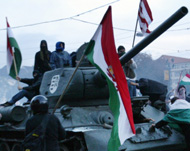
Protesters atop a commandeered tank, flying Hungarian flags, October 24, 2006.
Hungarian cops clash with protesters TEAR GAS, WATER CANNONS USED ON RIOTERS By Pablo Gorondi Associated Press BUDAPEST, Hungary – Police fired rubber bullets, tear gas and water cannons to disperse thousands of anti-government protesters who later hijacked two unarmed tanks in violence that marred the 50th anniversary of Hungary’s uprising against Soviet rule.
At least 40 people, including some police officers, were injured, rescue officials said. State news agency MTI reported that police beat some of the protesters — including women and elderly people — with rubber batons, and some had head injuries.
In one of the main showdowns Monday near Deak Square, the city’s main subway hub, hundreds of officers behind three water cannons slowly advanced on a few hundred rioters. The protesters threw bottles and rocks at the police, who fired tear gas and rubber bullets back at them as a police helicopter circled low above the crowd.
Then one of the protesters seized a tank that was part of an exhibit in the square to commemorate the revolution. He drove it among the protesters until he was pulled out by police officers who rushed the vehicle. A second tank in the exhibit was pushed by the rioters toward the police.
The tanks were powerful symbols of the 1956 revolt. The night the uprising began, Red Army tanks rolled through the streets of Budapest and 12 days later, a blitz led by 4,500 Soviet tanks overran the country.
Most of the protesters were peacefully demanding to be allowed back to Kossuth Square outside parliament, where the main commemorations of the 1956 revolution were under way.
Anti-government protests began Sept. 17, when Socialist Prime Minister Ferenc Gyurcsany was heard admitting on a leaked recording that the government had lied about the economy before winning re-election in April.
Monday, the protesters had gathered in different spots near the center of the city. Some had set up roadblocks with garbage cans and threw rocks at the police dressed in riot gear, who used tear gas and water cannons to disperse them near St. Stephen’s Basilica.
At dawn, police had expelled several hundred protesters from Kossuth Square, where many had been camping for weeks, demanding the prime minister be dismissed. The government used the square for some of Monday’s official memorial events.
The protesters had vowed to stay at Kossuth Square until Gyurcsany was dismissed, but police pushed them out of the square after they refused to submit to security checks. Authorities did not dismantle the dozens of tents and were expected to allow the demonstrators to return after Monday’s events.
Late into Monday night, police were still trying to disperse crowds of protesters at various spots near the city center, firing hundreds of tear gas canisters and detaining several people.
Delegations from at least 56 countries were in Budapest for Monday’s commemorations, including NATO Secretary-General Jaap de Hoop Scheffer and Spain’s King Juan Carlos.
The 1956 student protests began on the afternoon of Oct. 23, and by nightfall had turned into an armed uprising. Around 2,800 Hungarians and 700 Soviet soldiers were killed in the Red Army offensive to crush the revolt, which was launched Nov. 4, 1956.
After the military defeat, strikes and protests continued for several weeks until a Soviet crackdown definitively ended the uprising in January 1957.
Originally published on hungaria.org’s “Revolution ’06” commemoration pages, October 2006. Recovered from archive.
 Mondák
 Vicc
Vicc Költő / Író
 Népdal