



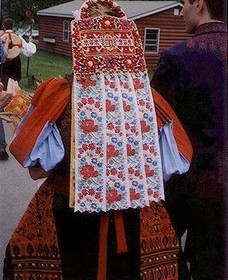


When visiting a Hungarian home one cannot help but notice the profusion of Hungarian textile arts, folk art and others. These textile items are a connection to Hungarian identity retention. Embroidery is still the most popular textile art practiced in Hungary and in almost every Hungarian immigrant community. A historical tradition in Hungarian needlework is the sharing of patterns and skills with others. This Hungarian needlework list hopes to continue to have this tradition live on.
Needlework and the enjoyment of embellishing textiles have been with us since the invention of the needle, perhaps in pre-historic times. Beaded headdress and woven gold textile headdress fragments were found in Hungarian graves of the Age of Migration. The most famous Hungarian embroidery still in existence is the “Coronation Cope”which was made for the for the coronation of the first Hungarian Christian king, St. Steven. It was made under Queen Gizella’s guidance in 1031. In Hungary since medieval times gold and silver embroidery has been continuously done for the clergy. During the Renaissance, embroidery became secularized and noble families started to decorate clothing and household goods with their attendants. These embroidery techniques and designs percolated down into the decoration of village households. Renaissance patterns are well recognizable in Hungarian village art from the 18th century on. At the end of the 19th century artists “discovered the decorative arts of the Hungarian villages and brought them into vogue. The Millenial celebration also served as an avenue for the promotion of folk arts and textile arts. After the Treaty of Trianon most of the Hungarian folk art villages became part of other countries. Needlework patterns worked from Transylvania. and other lost areas helped to hold on to the culture and memories of relatives cut off. After Second World War, during the Stalin years needlework skills fell out of favor with the official regime and picked up a negative connotation. Like everything else the communist government was trying to repress had the opposite effect. Instead Hungarian textile arts went through a new flourishing and revived. By now it not only well in Hungary but all over the world.
 Mondák
 Vicc
Vicc Költő / Író
 Népdal