






At the occasion of the decisions to be taken concerning the accession of
Romania to the European Union we wish to put the unresolved ethnic
problem of the Székely (siculi) before the international community.
One of Europe's most ancient native people, the Székely (Siculi) live
along the Carpathian Mountains at the Eastern part of Transylvania, in
the center of today's Romania. Whereas their language is Hungarian, their
mentality, customs, popular mind and traditions differ from that of other
Hungarians in the Carpathian Basin.
According to written sources, the Székely already enjoyed special
privileges in Attila's Hun Empire. At that time they took major decisions
in the so-called People's Assemblies. As of 800 A.D. it was the National
Assembly, which played the same role. In return for their obligatory
military service they retained their ancient Constitution, customary law,
their own judges and particular inheritance rights. They were called
"Székely Nation" according to the legal status they possessed for the
last thousand years. The Székely Nation ensured that each of its members
benefited from collective rights. All Székely were equal under the law,
all were considered noble, all had the right to freely choose their place
of living and none of them paid taxes. Their Constitution, which reaches
back to the Hun Empire and which already existed in its final form at the
time of Szent István (Saint Steven, the first crowned king of Hungary,
(997-1038), crowned in 1000) was the first Constitution i n Europe,
preceding England's Magna Charta (1215) and Hungary's Golden Bull (1222).
The Székely people continue practicing their traditional customs, which
are part of Europe's cultural heritage. The famous Székely gates are one
example of these traditions. The ornamentation of these carved and
sometimes painted wooden gates carries messages of several thousand
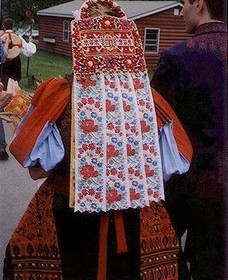
years. The Székely's folk music and folk-dance are authentic; their
national costumes are unique. The traditional costumes worn by women and
men differ from village to village. Their jealously guarded heritage is
the Székely runic writing, which preserves for the 21st century one of
humankind's oldest writing.
According to the official Romanian statistics, the Székely region is
presently inhabited by 613 000 persons, including 8% of other nations
(Romanians, Saxons, Csángó-Hungarians and Roma). 96 % of the local
administration is in the hand of the Székely. There are only a few
villages, which are not governed by a Székely mayor.
Contrary to the official statistics, the Churches still register more
than one million Székely paying Church taxes, in spite of the fact that
the emigration of the Székely continued since 1920 in several waves and
that the Romanian authorities resettled about 100 000 Székely into other
parts of Romania outside of Transylvania. This form of genocide is
corroborated by the fact that in 1914 one million Székely lived in that
region and that this number has not changed despite the natural increase
in population.
I. THE AUTONOMY OF THE SZÉKELY-LAND
In the spirit of Resolution 2003/1334 of the Parliamentary Assembly of
the Council of Europe, the Székely nation wants to establish the most
complete form of its self-government and self-determination: the
territorial autonomy of Székely-land.
The effort of the Székely to establish an autonomous territory derives
from the fact that for the last one thousand years it had a special
status. Their land has natural borders. In the East, it is separated from
the historical parts of Romania by the chains of the Carpathian
Mountains, which are traversable through passes only; in the West, it is
separated from the rest of Transylvania by other mountains.
The Székely-land is today the most neglected, economically intentionally
weakened region of Romania, in spite of the fact that it is endowed with
rich natural resources. During the last half a century Romanians have
deforested huge parts of the land and transported the wood to other parts
of Romania for processing. This did not allow the development of the
wood- and furniture-industry on the land of the Székely. The game
resources of the forests (beer, dear, boar, lynx, wolf) are under
exploited. Its marvelous landscape rivals that of Switzerland. It is,
together with Iceland and Hungary the richest area of the world in
medicinal springs, thermal waters and hot springs.
The potential of the land is great, but the Romanian Government
voluntarily cripples it. The roads are bad, the hotels are insufficient,
the thermal establishments are of minor quality and the infrastructure is
weak. The enterprises are vegetating, the banks refuse to provide credit
and the functioning of the local administration is at a critical level.
Despite this situation, practically nothing trickles down from the aid
provided by the EU.
The system of prefects enables the Romanian administration to provide
subvention for projects only to those mayors, who are subservient to the
central authorities. Although in the land of the Székely 96% of the
mayors belong to this nation, the militiamen are all Romanians. This
impossible situation hurts the self-esteem of the Székely and creates
tensions between them and the Romanian administration, in spite of the
fact that there is a peaceful coexistence between the Székely majority
and Romanian minority on this territory.
70% of the inhabitants of Székely-land consist of self-supporting
farmers, who barely survive on their small land. Poverty is everywhere.
Investors avoid an area without sufficient infrastructure and
consequently there are no new workplaces and the craftsmanship is
regressing. This situation leads many young people to leave their land of
birth and to search for workplaces in countries of the European Union.
The Székely nation is unanimously calling for autonomy. The National
Committee of Székely-land convenes the Székely National Assembly for the
14 May 2005 in Csíksomlyó. The delegates of all settlements will be
present together with the representatives of the churches, associations,
professions and enterprises. It is the Székely National Assembly, which
will declare the territorial autonomy of Székely-land and form the
Székely local government. It will establish the Székely counties, the
local administrative organs (court of justice and the prosecutor's
office) and other instances of public administration.
The next day, the 15 May, the representatives of the Székely
administration intend to start the coordinating negotiations with the
central government of Romania. The agreement concerning the status of
autonomy must guarantee adequate representation and effective
participation of the representatives of the Székely in the
decision-making and public administration of the central government.
II. THE SZÉKELY-LAND AS A EUROPEAN REGION
The National Committee of Székely-land demands that the recognition of
the Autonomy of Székely-land, and the acceptance of Székely-land as a
European region by the Romanian authorities be considered as
prerequisites for the accession of Romania to the European Union. At
present, the Romanian government intends to divide the region in three
Euro-regions, thereby ensuring that the Székely form no majority in any
one of them. This would result in mass emigration of refugees from
Székely-land to countries of the European Union. The people in
Székely-land wish to remain together in one region. They share the same
identity, the same spirit, and the same cultural and religious heritage.
As they share the same past and the same present, they wish to share the
same future as well. The Székely nation wants to have a future on its
traditional territory. This is why it places the creation of
Székely-land's autonomy and the recognition of this territory as a
Euro-region in the package of unresolved matters of Romania's accession
to the European Union. The present action of the Székely intends to bring
peace and fraternity among the people of Romania.
Csíksomlyó, 14 March 2005.
The Administrative Body of National Committee of Székely-land
 Mondák
 Vicc
Vicc Költő / Író
 Népdal