







Precedent for the 21st Century: The Danube
Lawsuit
|
|
In 1992, Slovakia diverted
her border river with Hungary onto her own territory and thereby destroyed
Hungary’s ancient wetlands, while keeping the generated electricity to herself
(See map.)
On June 20, 1995 the Court accepted the first “amicus curiae” (friends of the
court) filing on behalf of nine international environmental and human rights
NGOs, which are demanding the restoration of the Danube ecosystem. This
acceptance of the “NGO Memorial” was a precedent setting first step towards the
eventual development of a body of international law, which will, – on behalf of
mankind, – protect the natural environment against the irresponsible acts of
national governments. On the 25th of September, 1997 the International Court of
Justice ruled that implementing the diversion of the Danube was illegal and that
the 1977 original treaty is still in effect.
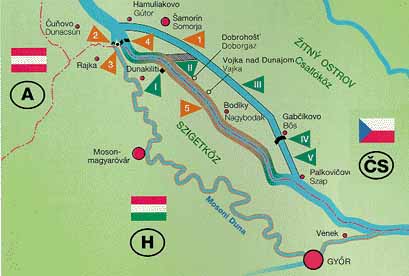
The ICJ ruling in effect said that “the operation of the components shown in
Arabic numbers” is illegal, (and therefore should be discontinued) and that the
1977 treaty is still in effect. Therefore the components shown in Roman numbers
are legal (and therefore should be operated). Please find attached below the
explanations of both sets of numbers and please note that the Compromise Plan
prepared by the environmentalists is fully consistent with the ICJ ruling, so
please support it.
PARTS OF THE 1977 TREATY:
I: Dunakiliti dam
(built, but not in use)
II: Planned and than suspended Dunakiliti closure at
Dunakiliti
III: The 21 kilometer headwater channel and navigation route
leading from Dunakiliti to Gabcikovo, (built and operating)
IV: The Gabcikovo
barrage (built and operating)
V: The 9 kilometer outlet channel below
Gabcikovo (built and operating)
“VARIANT “C” COMPONENTS, WHICH THE COURT FOUND ILLEGAL
1: The 10
kilometer headwater channel from the Cunovo barrage
2: The sluice across the
Mosoni Danube
3: The Cunovo barrage
4: The Cunovo riverbed closure
5:
The (now useless) original navigation route in the natural riverbed, which now
also contains a partial closure, installed before the visit of the judges.
Between now and March 25, 1998, the two parties will probably seek the
participation of the European Union in the coming negotiations. If an agreement
is not reached by than, the Court will impose its own will by June 25, 1998. If
the will of the court is not accepted by the parties, the matter goes before the
Security Council of the UN. It is hoped that the final resolution will come
close to some variation of the Compromise Plan.
The Danube river brings the water down from the Alps and enters the
Carpathian Basin, below the city of Bratislava. Here, the river splits into
three: The Minor Danube is in the north in Slovakia, the Danube river itself in
the middle forms the border between Slovakia and Hungary and the Mosoni Danube
flows to the south in Hungary.
After the last Ice Age, this region used to be the delta of the ancient
Pannon Sea which filled the whole Carpathian Basin. While, during the last
10,000 years, the Pannon Sea dried up, some 400 species, which evolved in this
unique inland sea delta, did survive. The region between the Danube and the
Mosoni Danube is called (in Hungarian) the Szigetkoz, which means: “region of a
thousand islands”.
The model shows the
original riverbed, which has been blocked by Slovakia at the village of Cunovo
(red colored dot on the model). As a result, and in order to prevent the
riverbed from going completely dry, Hungary also blocked the main riverbed at
the 1840th river kilometer near Dunakiliti (also noted by a red dot on the
model), by a bottom weir. Due to this dual blocking of the riverbed, the
polluted, virus and bacteria infested water been trapped. One should note, that
underground (below the Szigetkoz) is one of Europe’s largest freshwater
reservoirs.
As a result of the blocking at Cunovo, the dammed up water formed an
artificial stagnant reservoir below Bratislava. Because this major city does not
treat its wastewater, this artificial lake is polluted and also contains toxic
chemicals. Because of the health hazard associated with this stagnant reservoir,
the model shows this
water in yellow color. This dammed up water overflows into an artificial and
sealed bypass canal, which delivers the flow to the Gabcikovo power plant. (The
electricity produced and the shipping fees collected at Gabcikovo amounted to
about $1 billion since October 23, 1992, when the diversion of the river into
Slovakia occurred. While the Danube is the joint property of both nations, this
sum was kept by Slovakia.) Downstream of Gabcikovo, the water is returned into
the natural bed of the border river at Szap.
On the 25th of September 1997, the International Court of Justice (ICJ) ruled
that the operation of the “C-Variant” (the blocking and rerouting of the Danube
at Cunovo) was illegal. This is indicated by the red color of the Cunovo weir in
the photo of the model. While the ICJ did
not specifically address the issue, this ruling also implies, that the “bottom
weir” installed by Hungary below Dunakiliti at river kilometer #1840, is also
illegal, as it was necessitated by the blocking of the river at Cunovo, which
was found to be illegal.
The ICJ also ruled that the 1977 treaty is still in effect and therefore its
components, namely Dunakiliti (built by Hungary), Gabcikovo (built by Slovakia)
and the associated artificial canals, are all legal. This is why the model shows them in green
color.
Therefore, the color code is:
GREEN: Found to be legal by the court. RED:
Found to be illegal by the court. NATURAL COLOR: Unaffected by the ruling.
The Compromise Plan
One of the most promising solutions to the conflict was submitted by the
NGOs. This compromise plan would return the Danube to its natural riverbed,
redesign the Gabcikovo dam to withstand earthquakes and allow shipping during
drifting ice conditions. Hungary would regain its border river, and both the
Szigetkoz and the region’s water supplies would be protected.
Slovakia would retain its harbor at Bratislava and, at times of high water,
would receive all the electricity generated at Gabcikovo. At times of low water,
the Gabcikovo bypass would operate only as a shipping canal.
Thousands of jobs would be created if the region from Hainburg to Gonyu were
restored as Europe’s prime nature preservation park – a region where Austrians,
Hungarians and Slovaks could work and travel freely, providing an example for
Central Europe’s wider reconciliation.
The details of the Compromise Plan have been submitted to the International
Court of Justice by the Foundation to Protect the Hungarian Environment.
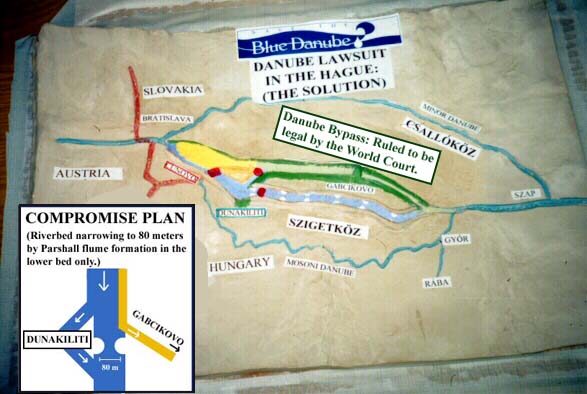
The most important features of the Compromise Plan are that it is in full
compliance with the World Court’s ruling, and that it returns 100% of the water
into the natural (unblocked) riverbed.
The illegal blocking of the Danube at Cunovo and its consequence, the bottom
weir near Dunakiliti (shown in red in the model) will both be
removed and the Danube will be returned into its natural riverbed. Because it
will no longer be a stagnant body of water, but a flowing river, its quality
will be improved. This fact is noted by its blue color. (Thereby, the Compromise
Plan will improve the quality of the drinking water of 3 million people, will
eliminate the health hazards associated with swimming in the river and also will
protect the underground fresh waters reserves from pollution.)
It is necessary to increase the water level in the natural bed of the Danube
for two reasons: First, because the ICJ ruling requires that Gabcikovo must be
operational (and that can only be achieved if the water level at Dunakiliti is
high enough, so that the water will overflow into the bypass canal) and
secondly, because the natural environment of the Szigetkoz requires the raising
of the groundwater levels in the whole region.
The unique feature of the Compromise Plan is that it achieves the raising of
the water level, NOT by damming, but by elevating and narrowing of the riverbed.
The advantages of this approach are multiple:
a) It is a permanent solution, while damming is only a temporary one, because
it causes downstream riverbed erosion, which later necessitates the building of
additional dams.
b) By elevating the water level only within the riverbed, no reservoir is
created. This not only eliminates the pollution caused by the settling of
pollutants and of toxic sludge, but also increases safety, because the
inundation basins are kept empty and therefore are available to store excess
water during floods.
c) While large quantities of stone, gravel and sand are needed to elevate the
riverbed and the river banks, these materials are available, as the present
reservoir is on top of a 6 meters deep layer of gravel.
d) The locations of the venturi-type restrictions, called “Parshall Flumes”,
are illustrated by white semi-circles in the model. One such
restriction is shown separately in the sketch at the lower left of the
photograph of the model, where the opening
is given as 80 meters, although it can be less.) The advantages of this method
of elevating the water level within the riverbed are multiple:
1) While bottom weirs and Parshall restrictions both raise the water level,
the bottom weirs block its flow, while the Parshall restrictions do not, and
they increase its flowing velocity. This provides two desirable side effects:
firstly the high velocity minimizes the settling of solid materials and the
increased turbulence increases the oxygen uptake of the river, which in turn
prevents eutrophication and sedimentation, thereby protecting ground and
drinking water supplies.
2) The bypass lock around the Parshall Flume provides for good shipping in
the natural riverbed, in addition to the shipping route provided in the
Gabcikovo canal.
3) The white waters of the Parshall Flume represent a unique tourist
attraction.
4) The system allows the already built structures of Dunakiliti to control
the total flow into the natural riverbed. This can be useful both as a means of
flood protection and as a means of providing the required water dynamics in the
Szigetkoz wetlands, including periodic flooding, which is needed by the flora
and fauna of the ecosystem.
5) Lastly, but not least importantly, this approach would make this
restoration project a “natural candidate” for financial support by the World
Bank (WB). This is so, not only because the WB is already financing the
restoration of the Danube Delta on the Black Sea, but also because (according to
the Rio Treaty) the 400 endangered and unique species of the Szigetkoz belong to
all mankind.
Ruling Consistent with Compromise Plan
On the 25th of September, 1997 the first international environmental lawsuit
was concluded in The Hague. It left the final resolution of the conflict between
“treaty law” and “environmental law” unresolved. It agreed with Hungary, that
blocking and diverting the Danube (by Slovakia) was illegal and it agreed with
Slovakia, that Hungary can not just cancel the Soviet imposed contract, because
that would be a precedent for treaty cancellation every time the political
system changes in a country. (A strange position, as that is exactly what
happened with the Warsaw Pact treaty.)
The judgement is in agreement with the MEMORIAL prepared by an international
coalition of nongovernmental organizations (NGOs) including Greenpeace, IRN,
Natural Heritage Institute, Sierra Club and World Wildlife Fund and the ruling
can be implemented by the Compromise Plan prepared by the environmentalists.
This plan would return the Danube into its natural riverbed, redesign the
Gabcikovo dam to withstand earthquakes and allow shipping during drifting ice
conditions. Hungary would regain her border river, and both the Szigetkoz and
the region’s water supplies would be protected.
Slovakia would retain its harbor at Bratislava and, at times of high water,
would receive all the electricity generated at Gabcikovo. At times of low water,
the Gabcikovo bypass would operate only as a shipping canal. Thousands of jobs
would be created if the region from Hainburg to Gonyu were restored as Europe’s
prime nature preservation park – a region where Austrians, Hungarians and
Slovaks could work and travel freely, providing an example for Central Europe’s
wider reconciliation.
The details of the Compromise Plan been submitted to the International Court
of Justice by the Foundation to Protect the Hungarian Environment.
The Court’s Ruling on Compensation
The financial interpretation of the Court’s ruling is that “each party must
compensate the other.. for damage caused” In this regard Hungary “won”, because
the original treaty distributed the construction costs evenly between the
parties and Hungary’s 50% consisted of building the lower canal, Dunakiliti and
Nagymaros. Of these, she has fully constructed the first two and partially the
third, while Czechoslovakia paid for the building of the upper canal and
Gabcikovo. Therefore, the only “saving” which Hungary realized was that she did
not fully complete Nagymaros. BUT, this did not make the burden on the Hungarian
taxpayer any less, because Hungary also paid for the demolishing of the
Nagymaros dam and Hungary will be paying Austria 1.2 billion KWH/year until 2015
for the work that was done. Therefore, the total construction costs to each of
the two sides are about the same, approximately $1.2 billion.
The other financial component is the income from the operation of Gabcikovo,
which is designed to generate 2.7 billion KWH/year of electricity plus shipping
fees.
This income of over one billion dollars during the last 5 years, should have
been equally shared between the parties, but was kept by Slovakia. Therefore,
1.0 of the 1.2 billion Slovak investment has already been returned, while
Hungary’s $1.2 billion investment brought nothing but legal expenses, plus
environmental destruction, loss of drinking water, loss of agricultural
production, loss of shipping revenues, which total several billion dollars.
In the early 1980s, an Interdisciplinary Commission of the Hungarian Academy
of Science (MTA) determined, that the B-N project would destroy the ancient
ecosystem of the Szigetkoz and would threaten the drinking water supplies of the
region. The shortage of funds and the joint opposition of the environmentalists
and MTA succeeded in delaying the start of construction at Nagymaros until 1985,
when the Austrian finance minister Hannes Androsch arranged for a loan of 5.8
billion Austrian schillings to be repaid between 1996 and 2010, by supplying
electricity, at a rate of 0.91 billion KWH/year for 15 years. This would have
taken 67% of Hungary’s share of the electricity generated by the G-N project.
(The total production at Gabcikovo today is about 2 billion KWH/yr. As half of
that should belong to Hungary, Slovakia’s share represents 4% of her electricity
needs.)
It was at this time that (being the editor of the Environmental Engineers’
Handbook) I was asked to obtain international support for saving the Danube
wetlands. With the Sierra Club, the Audubon Society, Friends of the Earth, WWF
and many others, we organized the first international day of environmental
protest ever held on the 31st of October, 1988. Simultaneous protest marches
were held in 49 cities around the World, and in our handouts we asked the
environmentally conscious youth: not to ski in Austria that year. The protests
succeeded, and on May 13 1989 the construction was halted.
How You Can Help
If you take the trouble of contacting your national and international leaders
and your local media about this, you will help to establish an international
legal framework for the protection of the remaining natural treasures of this
planet. Please write that letter.
Contact key leaders and encourage them to support the compromise plan:
- The Honorable Stephen Schwebel, President of the International Court of
Justice Carnegieplein 2, 2517 KJ, Den Haag, The Netherlands (Fax:
011-31-40-3649-928) - The Honorable Arpad Goncz, President of Hungary, Budapest, H-1394, Pf.
423, Hungary (Fax: 011-361-156-3801, E-Mail: p104@mehp.meh.hu) - The Honorable Viktor Orban, Prime Minister of Hungary, 1055 Budapest,
Kossuth Ter 3, Hungary (Fax: 011-361-156-3801 ) - President Clinton– president@whitehouse.gov
- Vice President Gore– vice.president@whitehouse.gov
- EPA Administrator Carol M. Browner (fax: 202-260-4474)
Please also
contact your local newspapers, radio and TV stations to bring the attention of
the world to this precedent setting environmental lawsuit in The Hague.
For periodic updates, please sign up to the “Danube List” by sending an
E-mail to: liptakbela@aol.com. These
E-Mail updates are prepared by Bela Liptak, an adjunct professor at Yale
University and editor of the Environmental Engineers’ Handbook. For more
information contact:
prof. Béla Lipták,
84 Old N. Stamford Road,
Stamford, CT
06905-3961
Tel: 203-357-7614,
Fax: 203-325-3922,
e-mail: liptakbela@aol.com
The writer is the editor of the “Environmental Engineers’ Handbook”
and
president of the Foundation to Protect the Hungarian Environment.
Liptak Bela is solely responsible for the content of these pages. FREE Hosting is provided by Hunor Networking Web Services
 Mondák
 Vicc
Vicc Költő / Író
 Népdal