







Recently (January 30, 2000), Central Europe was exposed to one of the worst environmental disasters since Chernobyl, due to a cyanide spill originating from Romania. Although the "short term" damages were caused by the cyanide, there is also a very serious long-term environmental hazard due to the metal byproducts of the "Aurul" gold mine near Baia Mare/Nagybánya.
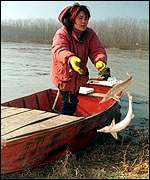
Twice within a period of six weeks, Central Europe suffered environmental disasters of the greatest magnitude, both originating in Romania. On January 30, 2000, a cyanide spill from a Romanian mining operation inflicted environmental damage comparable only to the massive release of radiation that followed the Chernobyl disaster. The cyanide and metal byproducts escaping from the Aurul gold mine found their way into a tributary of the Tisza, the second-largest river of Hungary. The Tisza carried the toxic material into the Danube, winding its way through Vojvodina in Serbia, Romania and Bulgaria into the Black Sea. The cyanide killed all life in the Tisza and caused untold environmental and economic damage in the lower Danube basin.
A subsequent spill, on March 10, 2000, proved just as damaging as the first — in some respects even more devastating, because it deposited heavy metals and destroyed even the upper part of the Tisza that had not been polluted by the first spill. By that Friday, the Tisza — once considered one of the cleanest rivers in Europe — was completely destroyed.
Demonstration — Washington, D.C.
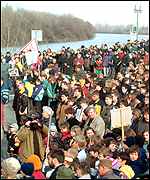
A demonstration against the Romanian cyanide spill and the lack of international environmental treaties, laws, and actions was held Saturday, April 1, 2000 (11:00 AM–2:00 PM) and Sunday, April 2, 2000 (11:00 AM–2:00 PM), in front of the Romanian Embassy in Washington, D.C. Since environmental catastrophe knows no borders, organizers called for the issue to be considered and addressed worldwide, with international environmental treaties, laws and actions identified as an enormous shortcoming of Central and Eastern Europe at the time. The invitation extended especially to those connected to the affected countries — Romania/Transylvania, Hungary, Yugoslavia/Vojvodina, Bulgaria, Moldova, Ukraine and the European Union.
Demonstration Slogans / Demands
- Save the Blue Danube
- Save the Tisza — Once the Cleanest River of Europe
- Another Environmental Chernobyl
- Europe's Largest Environmental Disaster Since Chernobyl
- Romania = Europe's Environmental Time Bomb
- River Killers
- The Environment Is Every Country's Responsibility
- Take Responsibility for Your Actions / Inactions
- The Environment Is No Internal Affair
- Don't Deny It — Fix It
- We Demand International Environmental Laws, Treaties, and Actions
- No International Environmental Treaties, Laws and Actions = Future Cyanide Spills
- We Demand International Prosecution of the Responsible Parties
- The Gold Is Yours, the Cyanide Is Ours
- Dead Fish Instead of "Gold"fish?
- Stop the Pollution
- Stop the River Killing
- Stop the Pollution and Exploitation of Transylvania
- UN Environmental Protectorate Is Needed for Transylvania
- EU Doesn't Need Polluters
- No EU Membership for Polluters
- If You Want to Become an EU Member — Cleanup and Pay First
- Once Isn't Good Enough? How Many More?
Forrás: cyanidespill.org (archív oldal, 2000. évi tiltakozó akció a Nagybánya/Baia Mare-i ciánszennyezés ellen).
Further Spills: March 2000
Less than six weeks after the January 30 disaster, on March 10, 2000, heavy rain and melting snow burst a dam at the Baia Borsa lead and zinc mine in northern Romania, 115 miles from the Hungarian border. Some 20,000 tons of heavy metal sludge were released into a tributary of the Vișo river, which carried it into the Tisza — the river once called the “Blonde Tisza” turned black. Four days later, on March 14, a further heavy metal spill occurred at the same mine’s Novăț settling pond, sending a third wave of pollution — roughly 30 km long, though visually smaller than the first — into the Hungarian section of the Tisza on the night of March 15. Hungarian authorities declared a disaster-defense alert along the upper Tisza and banned all water use from the river, affecting some 25,000 people. Around the same time, a chemical plant in southern Romania was separately reported to have leaked ammonia at up to 3.6 times the safety level, and a German Environment Ministry official visiting Romania was told by local environmental organizations that some 55 similar “environmental time bombs” existed in the country.
On March 15, 2000, Hungary, Ukraine, and Romania signed a protocol establishing a triangular commission of nine experts — three from each country — to monitor water pollution along the Tisza going forward.
The Mining Company’s Response
On March 16, 2000, Romanian officials accused Esmeralda Exploration — the Australian company holding a 50% stake in the Baia Mare gold tailings mine alongside the Romanian state firm Remin — of deliberately entering voluntary administration (a first step toward bankruptcy) to avoid paying compensation for the January 30 spill. Gabriel Dumitrașcu of Romania’s Environment Ministry said the country “suffered more than any other” from the spill, and Zoltán Illés, head of the Hungarian Parliament’s environmental protection committee, called the move “a trick on their side to not pay compensation,” warning that Hungary would pursue the company’s financial backers through international courts if necessary. Esmeralda’s receivership administrators denied trying to avoid liability, while the company itself continued to deny responsibility for the spill and characterized damage reports as “grossly exaggerated.”
European Commission Response
On February 18, 2000, returning from a fact-finding mission to Romania and Hungary, European Commissioner for the Environment Margot Wallström announced the creation of an international task force, chaired by the European Commission, to independently assess the disaster. She outlined seven steps: immediate technical assistance to Hungarian and Romanian authorities; an evaluation of financial assistance needs for damage assessment and restoration; reinforcement of the EU’s civil protection capabilities; extension of the Commission’s ongoing study of mining-industry environmental hotspots to candidate countries; review and adaptation of existing EU legislation; and acceleration of a Framework Directive on environmental liability based on the “polluter pays” principle. “The Baia Mare accident,” she said, “has demonstrated that we need to further tighten European legislation. We must ensure that polluters can effectively be held responsible for damages.”
Sources: Béla G. Lipták’s call to action for the April 1–2 demonstration; press materials from the Coalition to Save Our Rivers (contact: Bryan Dawson); wire reports from UPI, Xinhua, and RFE/RL Newsline, March 2000; European Commission statement BIO/00/32.
 Mondák
 Vicc
 Költő / Író
 Népdal
