






I felt a kick on my foot. I woke up and looked around as things slowly began to come back to me. Laci was on my left, Ili on my right, but I did not see Gyuszi Perr or Imre Majoross, and it seemed that we were fewer now than a moment ago when I had closed my eyes. Down around the professor's desk, the guards were snoring. Up at the other end of the lecture hall, the entrance door was open. "The guards are dead drunk! This is the time to get out!" whispered Laci.
We rose slowly and tiptoed up to the open door. All we heard was snoring as we quietly made our way through the dark corridor. The night was very dark as we descended into the basement and exited the building through the back door of the gymnasium. There were no Russians to be seen, but we were playing it safe anyway. We stayed in the dark, sneaking from bush to bush. On Budafoki Street, Laci bid us farewell.1
Ili and her sister had a rented room nearby. They asked me to walk them home. When I agreed, they hooked into my arms as we strolled through the dark and empty streets in the first glimmer of dawn on this Wednesday, November 7. In the room I saw only one double bed. "So, how will we do this?" I asked, and they replied in unison, "I will sleep in the easy chair." So I took off my boots and jacket and hit the bed. I do not know what happened next. All I remember is that during the night, when I was turning around, I touched Ili. Her body felt tense, but I could have just imagined that.
In any case, when I woke up the next morning we were all in the same bed, with plenty of space. It was warm and cozy. They had no food, so breakfast was out of the question, and with the girls watching I did not feel like washing myself, so I said a quick farewell and left.2
It was midmorning. One could hear bursts of gunfire from the Pest side of the Danube. Here, on the Buda side, all was quiet. It felt strange that the submachine gun was not pulling on my right shoulder. I had gotten so used to the gun that I felt incomplete without it. I still had my tricolored armband. The streets were empty; there was no traffic. It was a workday, but on this day nobody worked.
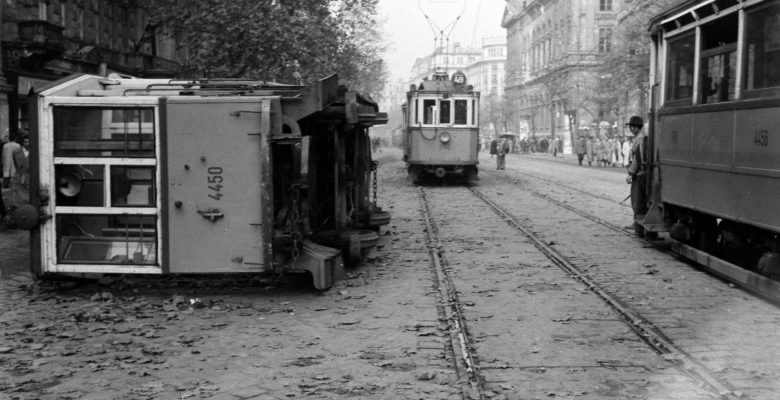
I walked across the empty Freedom Bridge. The Russian tanks stationed at the bridgehead paid no attention to me. I walked over to the Pest side to visit Ágnes. The burnt-out houses and tanks were still smoking, and unburied corpses were visible everywhere. I saw the remains of a Russian soldier in the hatchway of a burnt-out tank. His clothing had burned away, and his body had shrunk to the size of a child. The Russian tanks were occupying the main avenues but had not entered the side streets. One could not see the Russian soldiers; they felt safer inside their tanks.
While walking on Rákoczi Street I noticed a Russian soldier opening the escape hatch of his tank and sticking his head out. The immediate response was a burst of gunfire from the roof of a burnt-out building. The Russian head disappeared, and the three tanks aimed their cannons at the roof.
Because of the fighting on Rákoczi Street, I crossed over to the next parallel street, Wesselényi Street, and on it I walked toward the Grand Boulevard. As I reached the corner of Akácfa Street, I heard firing, and one of the bullets hit the wall behind me. I suspect that this round of bullets was intended for me. There must have been ÁVH snipers in the area. Now, with the Russian tanks all over, those brave souls once again dared to be sniping at the freedom fighters and the members of the national guard. For a second I considered removing my armband, but I could not make myself do it, so I just proceeded a bit more carefully. I tried to flatten myself against the walls of the buildings. As I advanced on Wesselényi Street and approached the Kertész Street corner, I saw a Russian tank at the Wesselényi Street entrance into the Grand Boulevard. The tank cannon had been lowered and was pointing right into Wesselényi Street.
As I carefully lurked forward, I saw a group of about ten people—unarmed, older workers—protected by the corner of Kertész Street. Apparently they wanted to cross the Boulevard, but could not because of the tank. As I reached them, I heard the siren of an ambulance coming from behind me. As I turned, I saw a minivan with a large Red Cross flag covering its roof. As the driver noticed the tank, the ambulance slowed down.
A blonde nurse was sitting next to the driver. She was leaning forward, staring at the tank. As the ambulance passed us at the Akácfa Street corner, the tank fired. By the time I heard the blast, the Red Cross car had just reached our corner. The explosion was deafening. The left half of the car was crumpled, like a sardine can when hit by a hammer. The driver had disappeared. We stared at the burning wreckage, frozen by shock and fear.
The blonde nurse freed herself, then opened the door on the right and tried to stumble out. Now she was on one knee in the middle of the street, facing the tank, about ten or fifteen yards from us, except that we were protected by the corner of the building while she was totally exposed. Now she stood up. She was not more than eighteen. She turned to walk toward the wounded patient in the burning ambulance when the tank machine gun fired. The girl was hit. She lost her balance and fell onto the hood of the burning car. I could hear the burning of her hair, I could see her skin turning darker. I bit my lips. I tasted blood in my mouth.
A bald worker picked up a garbage can and, holding it in front of him, ran out into the street. There was another burst of machine-gun fire, and the next second he was moaning in a pool of blood. The garbage can was full of holes; the bullets had gone through it as if it were made of tinfoil.
Then somebody started pulling on the waterspout running down the side of the building. Our frozen, paralyzed group came to life, and like frenzied lunatics we began tearing at the drain pipe. Our hands were bleeding, we pushed and stepped on each other, rust and plaster was falling into our eyes, our clothing was torn, but eventually the pipe began to give, as our frantic efforts paid off. With the ten-yard-long pipe we pulled the girl off the burning car. Her long, blonde hair was gone, her white smock was dark, and so was her skin. Only her open eyes and her teeth were white. It took about half an hour to pull the two dead bodies into the protection of our street corner. The driver and the patient both burned in the car. The tank's machine gun kept firing throughout this ordeal.
Those thirty minutes filled me with such intense hatred that I could have dropped the atomic bomb on Moscow. The people in my group looked like madmen. It took decades to get rid of that terrible hatred, but to forget that girl, to forget the senselessness of a child being roasted like a pig—that I cannot forget and never will.
It took some effort to cross the boulevard, but I finally succeeded. There was nobody in Ágnes's apartment. When I asked the superintendent about her family's whereabouts, he was not communicative at all. It must have been my armband that scared him. The old slave reflexes were already returning. His answers could not have been shorter: "They left for Austria."
"Who are they?"
"The boy and the girl."
"Which girl?"
"The blond one."
He walked away, indicating that the discussion was over. So Judit and Gábor had left, and Ágnes was probably still at Lake Balaton.
What should I do now? It was past noon. I was getting very hungry. I also could hear the intense fighting that was still raging around the triangle formed by the Kilián Barracks, Corvin Plaza, and Tüzoltó Street. I started walking in that direction, toward the south. I stayed to the east of the main boulevard, which was bumper to bumper with Russian tanks. It took some effort to cross Rákoczi Street. After that, the thunder intensified. I not only heard the roar of tank cannons but also the scream of mine throwers and the rattle of the Russian aircraft overhead. My progress was slow. I hoped to reach Pista Angyal's group in Tüzoltó Street, but when I got near, I found that crossing Üll_i Street was impossible. The street was full of tanks, and they fired at anything that moved. So I stayed in the side streets and eventually reached István Hospital on Nagyvárad Square.
"You cannot enter with arms, you have to leave all your arms here!" said the porter.
"That will be easy, since I have none. Where do I get something to eat?" I asked in return.
"Go to the cafeteria in the basement. They probably have some soup, left over from lunch."
It was 2:00 or 3:00 P.M. on this ugly, ugly Wednesday. I got a tray, got my twenty forints ready, and loaded my plate with two bowls of soup and a half-dozen big slices of bread. I had not eaten in nearly two days, so I was ready for a feast.
"How much is that?" I asked the woman cashier.
"It's a lot," she answered, smiling.
"But how much money do I owe you?" I asked again.
"Looking at you, it is I who probably owes you a lot!" she replied, and waved me on.
"I just can't get rid of this twenty-forint bill!" I complained jokingly, and settled down to stuff myself.
The cafeteria was mostly empty. A doctor with black-ringed eyes was drinking espresso at the next table. His hands trembled as he stirred the coffee. Another doctor was copying a list or something, while two nurses were standing in the corner, talking to a cleaning lady. I got down to some serious eating. When I finished the first bowl, I put the second soup plate into the empty one so as not to overadvertise my appetite. The windows were trembling from the detonations, the hospital was overflowing with the wounded, yet the cafeteria was peaceful and my mind was blank. I concentrated on eating.
When I was done with the two bowls of soup, I still had two slices of bread left. I was in the process of stuffing them into the side pocket of my corduroy jacket when I heard a familiar voice: "Is this another test of yours? Are you testing the holding capacity of the human stomach?"
"If it is not the coffee man," I said with a happy grin, looking at Pista Angyal.
"So, how are you progressing with your comparative study of the Jewish-Hungarian and German-Hungarian characters?" he asked. He too was grinning, but I did not answer. Pista looked at me very seriously and asked, "What is it?"
"The test is over. There is no German-Hungarian to compare you with. Jancsi Danner is dead." I was nearly screaming. He put his hand on my shoulder and, after a long, long while, mumbled to no one in particular, "It doesn't look good, does it?"
Pista was with his co-commander, a fellow named Olaf, and a Russian called Vaszil. It was not clear who this Vaszil was, although they seemed to be good friends, and he seemed to be on our side. They asked me about the defense of Móricz Square, and I asked them about their prospects here in the ninth district.
"We are holding our own and are trying to arrange a forty-eight-hour cease-fire with the Russians. They agreed to a meeting and supposedly we will learn the time and place of it at five o'clock this evening. This is why we are here. We are waiting for that call."
"Why can't you call from your garage?" I asked.
"Oh, they have pulverized us with bombs and cannon fire. We have no telephone, no electricity, no water, nothing. They are lobbing grenades at us and are now attacking from the air as well."
"So what is next?" I came to the bottom line.
Pista looked at the floor, then at Olaf, before answering. "The Kilián Barracks is in the process of giving up. Their defenders, the ones with some heart left, are now joining us. Only Corvin Alley, Csepel Island, and Stalin City are still holding out. They, too, are running low on ammunition. The civilians in the ninth district are begging us to give up. This is why we are here. We want to arrange an honorable cease-fire with the Russians. We will try to do that at five o'clock. After that, we'll either talk or fight on, but before either, we will have to get some bread. You are not the only one with a big appetite, you know!"
While Pista, Olaf, and Vaszil were waiting for the telephone call, we talked some more. Pista told me that he had faith in János Kádár. Pista thought that Kádár was a Communist whose quarrel with the Soviets was not so much about their social model as about their totalitarian methods and their occupation of other people's countries. He was optimistic about the cease-fire and was planning to put up red and black flags next to the Hungarian tricolor on their building. It was nearing five o'clock when I said farewell to them.3
Kerepes was twenty kilometers (twelve and a half miles) the the north-east of Budapest. It took me three or four hours to walk home that evening. On Hungária Boulevard some pockets of freedom fighters were still holding out, while others had given up and were on their way home. As I approached the Russian-held airport at Mátyásföld, the road looked like a scene from the Second World War. I had not realized that there were so many tanks in the whole world. Each tank column was a mile long, and they just kept coming, one after the other. Whenever I heard fighting, I detoured into the cornfields and returned to the main road when it seemed to be safe to do so.4
Kornél Poppe, our neighbor's son, was also on his way home, so we walked together. There were no Hungarian vehicles on the road. The few pedestrians we met seemed scared when they noticed my armband and did not dare to look me in the eye. Kornél acted as if he did not notice it, but when we got to the outskirts of our village, he decided to take a back road, so I walked home alone. It was dark. As I reached the gate to my house, Bukucs went out of his mind with excitement. He was licking me and climbing all over me while alternately lying on his back and showing his belly. This was his sign of ultimate submission.5
Then I heard a suppressed scream and saw Memi running toward me. She was checking me over for wounds when Aptyi arrived. He just took me in his arms and held me. I did not say anything, but after a while, like ice melting or like a volcano building up pressure for eruption, I began to feel an avalanche of emotion that I could no longer control, and I burst into uncontrollable, sobbing and tears.
When we finally straightened out, Aptyi's voice was choked. He turned in the direction I had come from and said, "Well, it's time to go." I had no idea what he meant. Why were we not going into the house? Where were Péter and Andris?6 We were already out on the road when he explained: "This morning the house was searched by the ÁVH. The Pufajkas were looking for you. So you cannot sleep here."
We were on our way to one of our neighbors, Szabó Bácsi. I would sleep there. They had planned everything. Memi had packed some food, had got me clean underwear, and, without saying it in so many words, let me know that the less time I spent in Kerepes, the better it would be. The Szabós were very nice. They tried very hard not to show that they hated the idea of my being in their house. But it was obvious that they were scared stiff.
My mother, father, and I sat there for a couple of hours, talking without saying anything that the others did not know. We were trying to reassure each other without knowing how that could possibly be done. About midnight, I asked them to go home and told them that I would leave for Budapest early in the morning.
Back to Testament of Revolution — Table of Contents
 Mondák
 Vicc
Vicc Költő / Író
 Népdal